Kettlebell goblet squat
A squat holding a kettlebell at your chest. The fastest way to learn good squat form and add weight to it.
NeedsKettlebell
The movement
2 stages
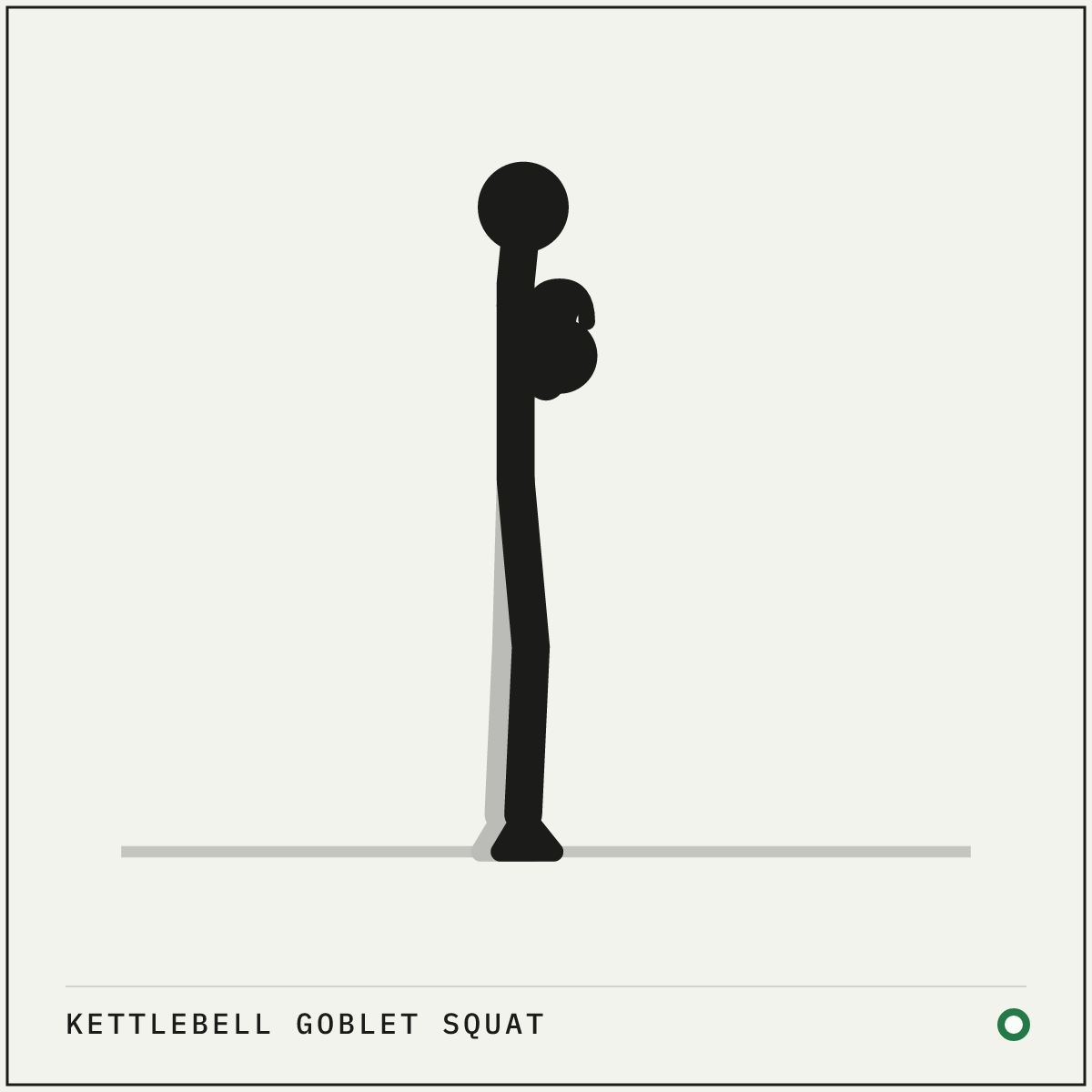
Stand tall
01 Stand tall
Hold the weight at your sternum, elbows tucked.
02 Bottom
Elbows travel inside the knees; torso stays tall.
How to do it
Setup
- Hold a kettlebell by the horns at chest height.
- Stand with your feet roughly shoulder-width apart, toes pointed slightly outward.
Execution
- Break at the hips and knees simultaneously to drop your hips down and back.
- Lower until your elbows touch the inside of your knees (or slightly below parallel).
- Drive through the midfoot to stand back up, squeezing your glutes at the top.
BreathingInhale deeply and brace your core before descending. Exhale as you drive out of the bottom.
Cues and mistakes
Check every rep
- Keep your chest tall to prevent the weight from pulling you forward.
- Drive your knees out as you descend to create room for your hips.
What goes wrong
- Letting the upper back round forward under the weight of the kettlebell.
- Letting the heels rise off the floor at the bottom of the squat.
Safety
- If you fail the rep, you can simply drop the kettlebell straight down in front of you.
General guidance, not medical advice. See how Setkit works.
Notes
The goblet squat is arguably the best learning tool for the squat pattern. By front-loading the weight, it forces you to keep your torso upright and automatically recruits the anterior core.
Because holding a very heavy kettlebell in front of your chest eventually becomes harder than the squat itself, the goblet squat is usually treated as a beginner movement or a high-rep hypertrophy builder before graduating to the barbell back squat for absolute strength.