Barbell rollout
Roll out on a loaded barbell to challenge your core's ability to resist extension under extreme leverage.
The movement
2 stages
Start
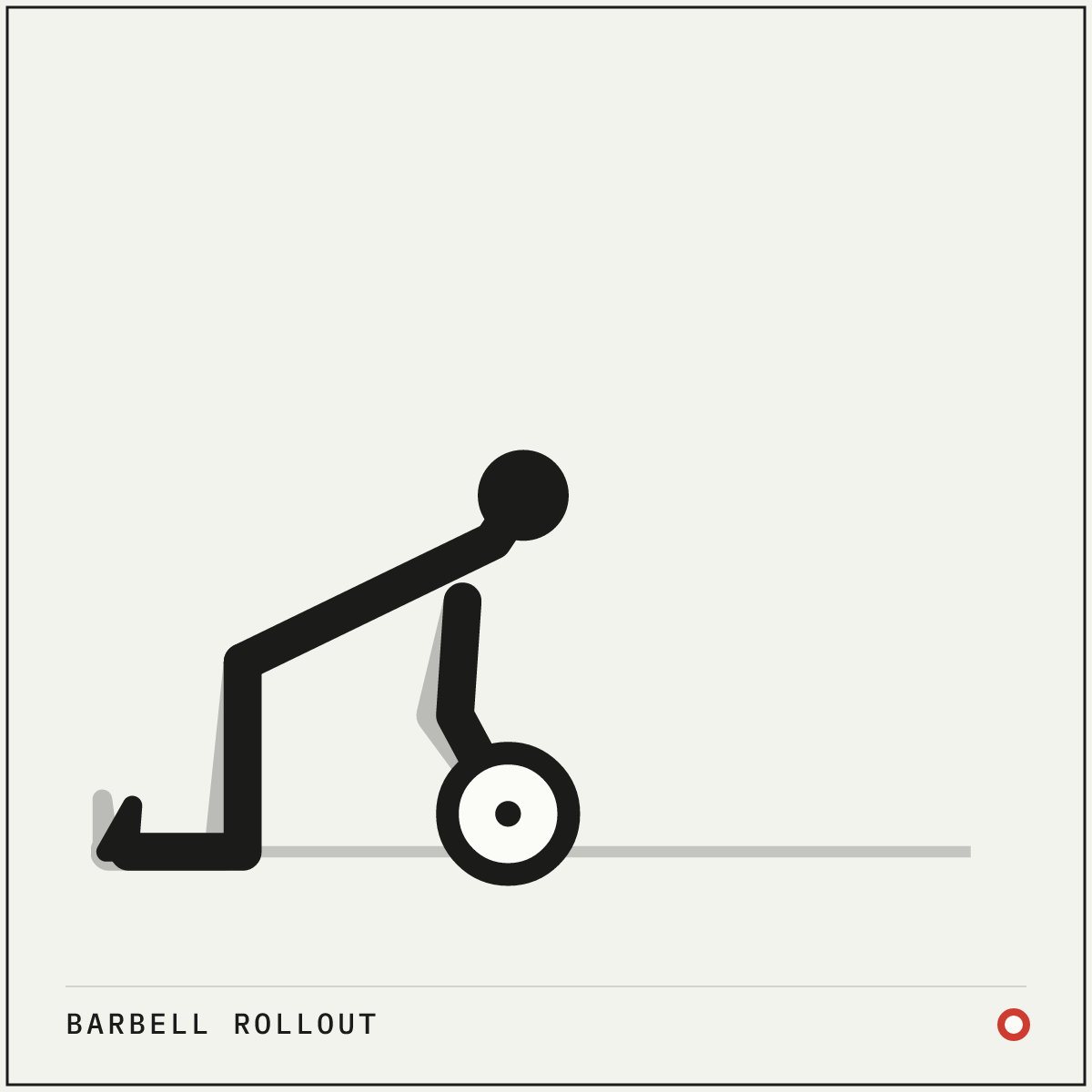
01 Start
Kneel with your hands on the barbell directly under your shoulders.
02 Roll
Roll the bar forward, extending your hips and arms until your torso is nearly parallel to the floor.
How to do it
Setup
- Load a barbell with small plates (5kg or 10kg) so it can roll.
- Kneel on a pad or soft surface with the barbell in front of you.
- Grip the bar shoulder-width apart, arms straight and shoulders over the bar.
Execution
- Brace your core and squeeze your glutes.
- Slowly roll the barbell forward, letting your hips extend and your arms reach out.
- Go as far as you can while maintaining a flat lower back.
- Pull the bar back to the starting position using your core and lats.
Cues and mistakes
Check every rep
- Keep your core braced as if about to be punched in the stomach.
- Do not let your lower back sag or arch at any point.
- Your hips and shoulders should move forward together.
What goes wrong
- Arching the lower back, which shifts the stress to the spine.
- Bending the elbows to pull the bar back instead of using the core.
- Leaving the hips behind while only the arms roll out.
Safety
- Only roll out as far as you can control without lower back pain or arching.
General guidance, not medical advice. See how Setkit works.
Notes
The barbell rollout is a severe test of anti-extension. Unlike a plank, where the leverage is static, the rollout actively lengtheners the lever arm between your base of support (your knees) and your hands. This demands massive tension from the entire anterior core to prevent the spine from collapsing into extension.
Using a barbell instead of an ab wheel provides a wider, more stable grip, which is slightly friendlier on the shoulders. It also allows you to adjust the height of the bar by using larger or smaller plates, slightly altering the difficulty.
Start with partial range of motion, rolling out only a few feet. The limiting factor must always be your core control, not your shoulder mobility or spinal tolerance. As you get stronger, you can roll out until your torso is nearly parallel to the floor.