Plank
The basic trunk hold. Learn to keep your body rigid and straight while gravity tries to bend it.
TrainsCore
NeedsBodyweight
The movement
2 stages
Set
01 Set
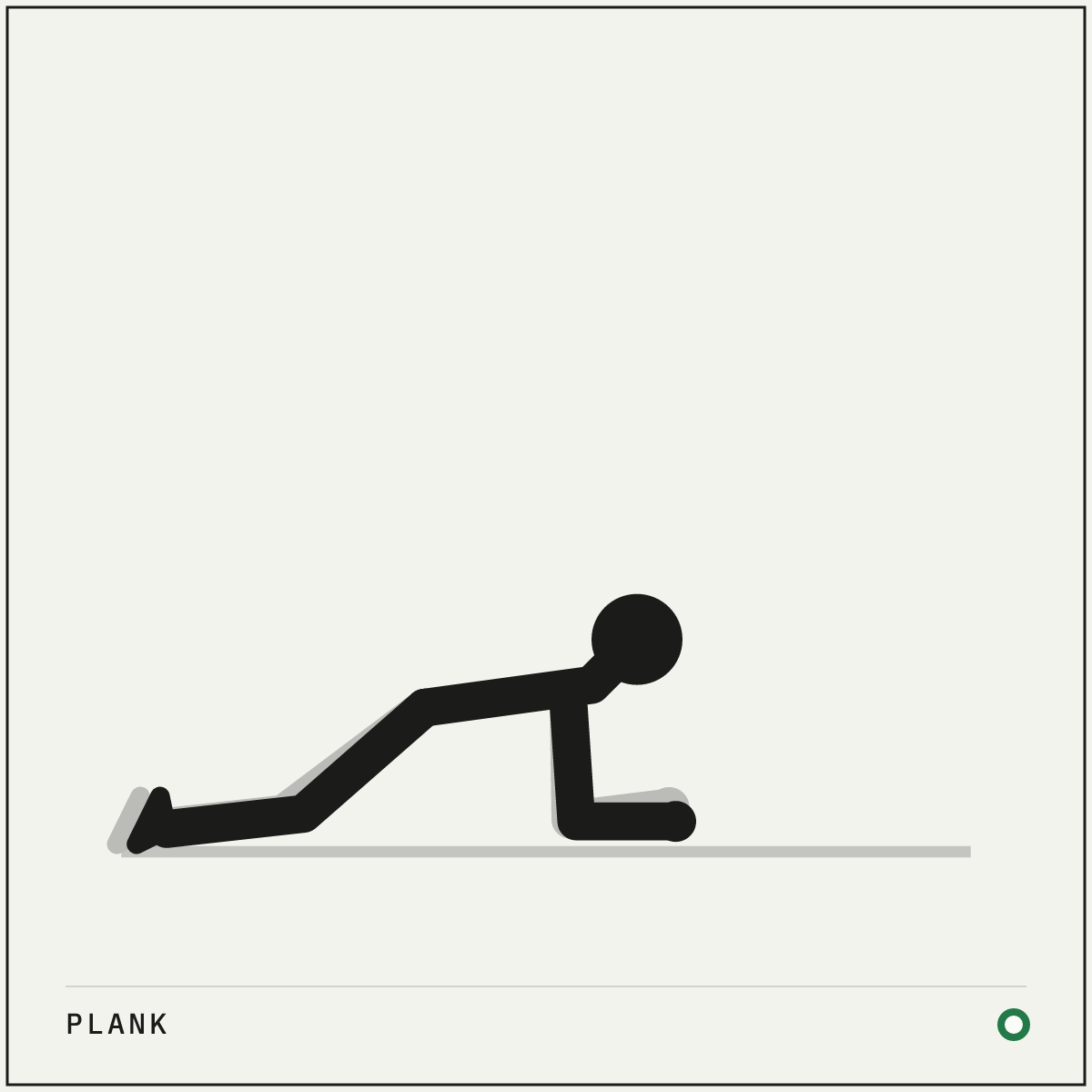
Forearms down, knees on the floor, elbows under shoulders.
02 Hold
Lift the knees; squeeze the glutes and brace the trunk.
How to do it
Setup
- Put your forearms on the floor with your elbows under your shoulders and your hands relaxed.
- Step your feet back until your body forms one line from head to heels.
Execution
- Squeeze your glutes, tuck your pelvis slightly, and tighten your stomach as though bracing for a poke.
- Keep breathing steadily while holding that tension, in shallow breaths.
- Hold until your body line starts to break, then rest.
Cues and mistakes
Check every rep
- Glutes on and ribs down. Work the position rather than waiting it out.
- Push the floor away so your shoulder blades do not sink together.
What goes wrong
- Hips sagging, which loads your lower back instead of your stomach.
- Hips lifted high, which makes the time easier and the exercise pointless.
- Holding your breath for the whole set.
Safety
- A shaking plank with a straight line is fine. A comfortable plank with a sagging line is the one to worry about.
General guidance, not medical advice. See how Setkit works.
Notes
The plank looks like lying face down and is really a lesson in holding a position. Gravity pulls your middle toward the floor, and every muscle from your shoulders to your glutes works together to refuse. Holding a straight, braced spine under load is the skill underneath nearly all serious training, and the plank is that skill on its own.
Quality beats duration by a wide margin. A sagging plank held for several minutes builds nothing but tolerance for a bad position. A hard thirty seconds with your glutes locked, your ribs down and the floor actively pushed away is worth more than five loose minutes.
Once you can hold a minute in good shape, the plank is not failing you. It is telling you to move on. Put your feet up on a box, have someone place a weight plate on your back, or progress to side planks and renegade rows.