Bear crawl
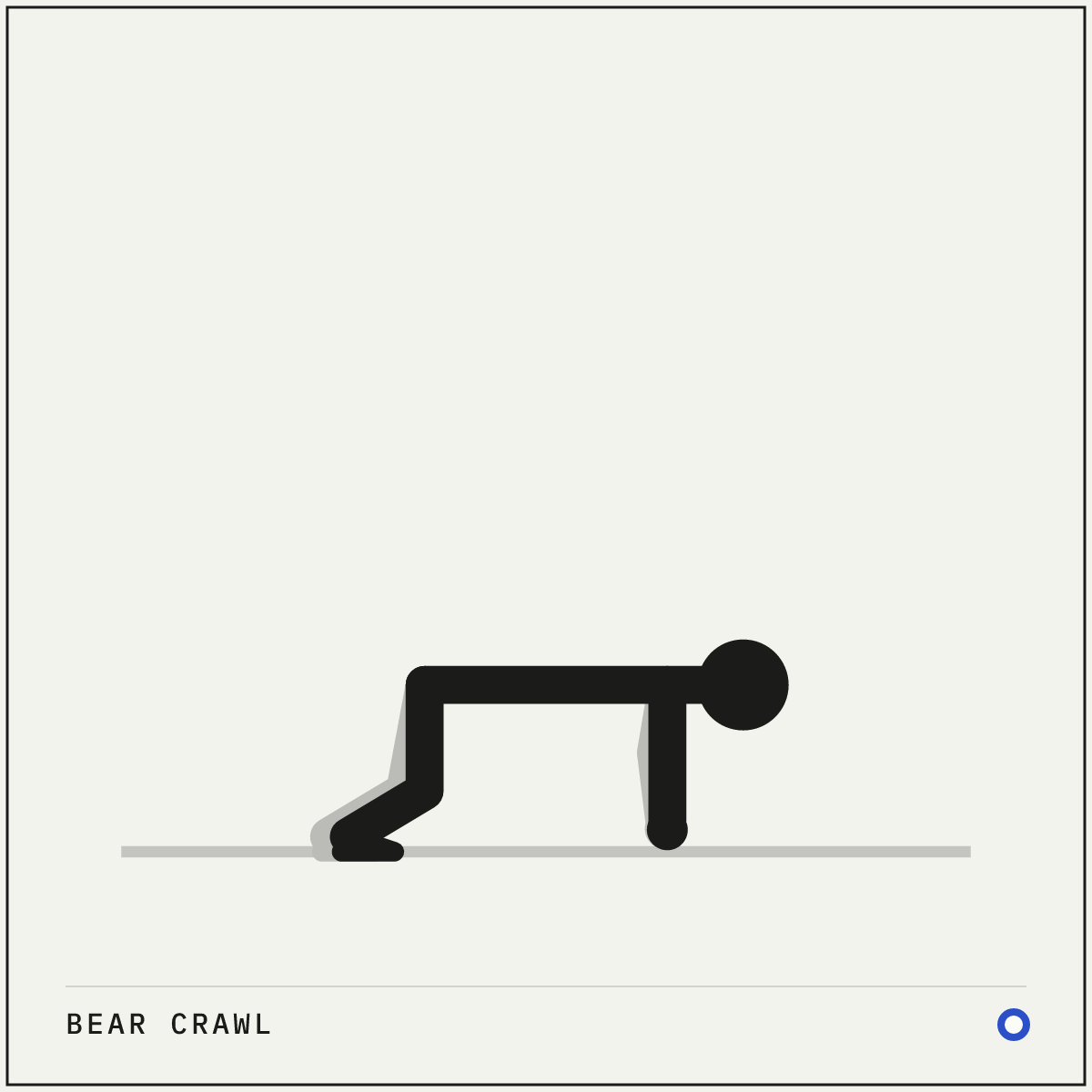
A crawl on hands and feet with your knees hovering just off the floor. A plank that moves, loading the shoulders and trunk every step.
NeedsBodyweight
The movement
2 stages
Knees hovering
01 Knees hovering
Hands under the shoulders, toes tucked, knees a couple of inches off the floor.
02 Opposite hand and foot
Move the opposite hand and foot together and keep the hips dead level.
How to do it
Setup
- Start on all fours with your hands under your shoulders and your knees under your hips.
- Tuck your toes and lift your knees a couple of inches off the floor.
Execution
- Move the opposite hand and foot forward together, keeping your knees low.
- Keep your hips level and your back flat, with no rocking from side to side.
- Continue for distance or time, then crawl backward the same way.
BreathingBreathe steadily and continuously. Holding your breath here ends the set early.
Cues and mistakes
Check every rep
- Hips stay level, with no rocking from side to side.
- Take short steps and keep your knees just off the floor.
What goes wrong
- Letting your hips swing side to side, which means your trunk has stopped resisting the twist.
- Raising your hips high, which puts the weight on your legs and gives your shoulders a rest.
- Moving the same-side hand and foot together, which removes the whole point of the exercise.
Safety
- Your shoulders carry a large share of your bodyweight for the whole set. Build the distance up gradually if you are not used to being on your hands.
General guidance, not medical advice. See how Setkit works.
Notes
A plank teaches your trunk to resist movement while nothing else is happening. The bear crawl asks for the same thing while your arms and legs are moving, which is both harder and closer to what your trunk does in daily life. Every step creates a small twisting force your body has to cancel, and a set is a continuous string of them.
Your knees are the whole standard. Two inches off the floor puts real weight through your shoulders and forces your trunk to hold position. Letting them drift upward turns it into a comfortable walk on all fours. You cannot see your own knee height while crawling, so set the position deliberately at the start of each set rather than going by feel.
Moving opposite limbs together is what creates the twisting force to resist. Moving same-side limbs is more stable, noticeably easier, and trains something else. It is a common accidental change once you get tired.
It scales by distance and direction rather than by weight. Crawling backward is harder than forward for most people, so adding backward sections is a better progression than simply crawling further.