Mountain climber
Running in a plank position. A conditioning staple that makes your trunk hold a plank at speed.
TrainsCore
NeedsBodyweight
The movement
2 stages
Drive left
01 Drive left
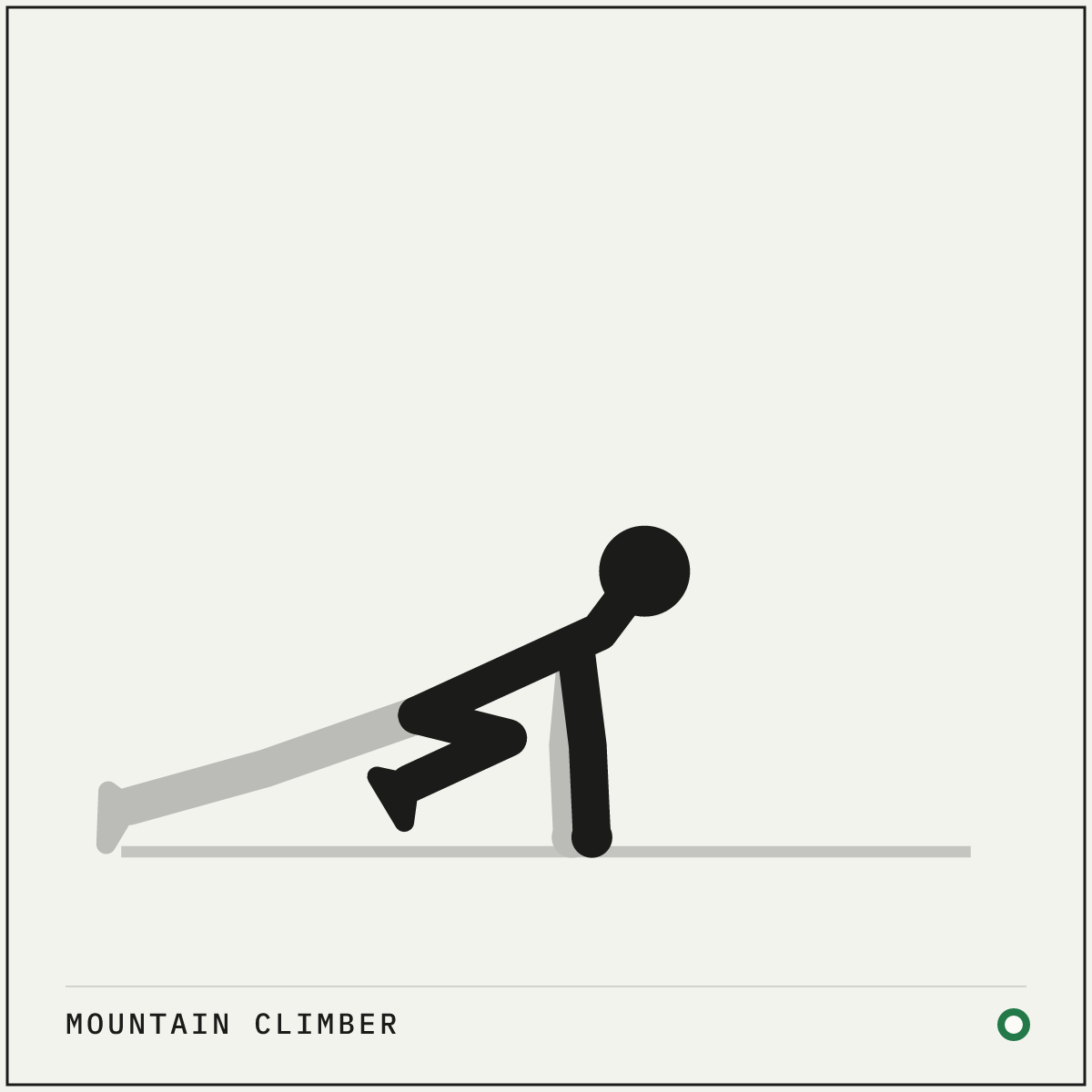
One knee drives under the chest; hips stay low.
02 Drive right
Switch legs like running; shoulders stay over hands.
How to do it
Setup
- Take a solid push-up position with your hands under your shoulders and your hips level.
- Set your shoulders over your wrists and tighten your trunk.
Execution
- Drive one knee toward your chest, tapping the ball of your foot down or letting it hover.
- Switch legs in a running rhythm, keeping your hips low and level.
- Hold the plank up top, with your shoulders never drifting behind your hands.
Cues and mistakes
Check every rep
- Hold the plank; your hips should not rise or rock.
- Pick the fastest pace that keeps your hips still.
What goes wrong
- Hips lifting upward as you tire.
- Bouncing your whole body instead of driving your knees.
- Hands drifting forward of your shoulders.
Safety
- This is low-impact by design, but your wrists take the load. Spread your fingers and grip the floor.
General guidance, not medical advice. See how Setkit works.
Notes
The mountain climber is a plank with running attached. Your shoulders and trunk hold a strict push-up position while your legs run underneath. Your heart rate climbs the way it does when sprinting, but the impact stays low and your trunk gets a real workout at speed.
Pace controls the quality rather than the score. The fast, hip-bouncing version common in bootcamp classes mostly trains bouncing. The version worth doing holds a flat line from shoulders to heels and drives the knees as fast as that allows. When your hips start lifting, slow down or stop, because the plank has already gone.
It is one of the mainstays of no-equipment conditioning. A Tabata of mountain climbers is four hard minutes, and in a circuit it sits well between a lower-body and an upper-body station, keeping your heart rate up without tiring out either one.