Dumbbell overhead carry
Walking with one dumbbell locked out overhead, which asks the shoulder to hold the weight up and the trunk to stop you leaning.
The movement
2 stages
Locked overhead
01 Locked overhead
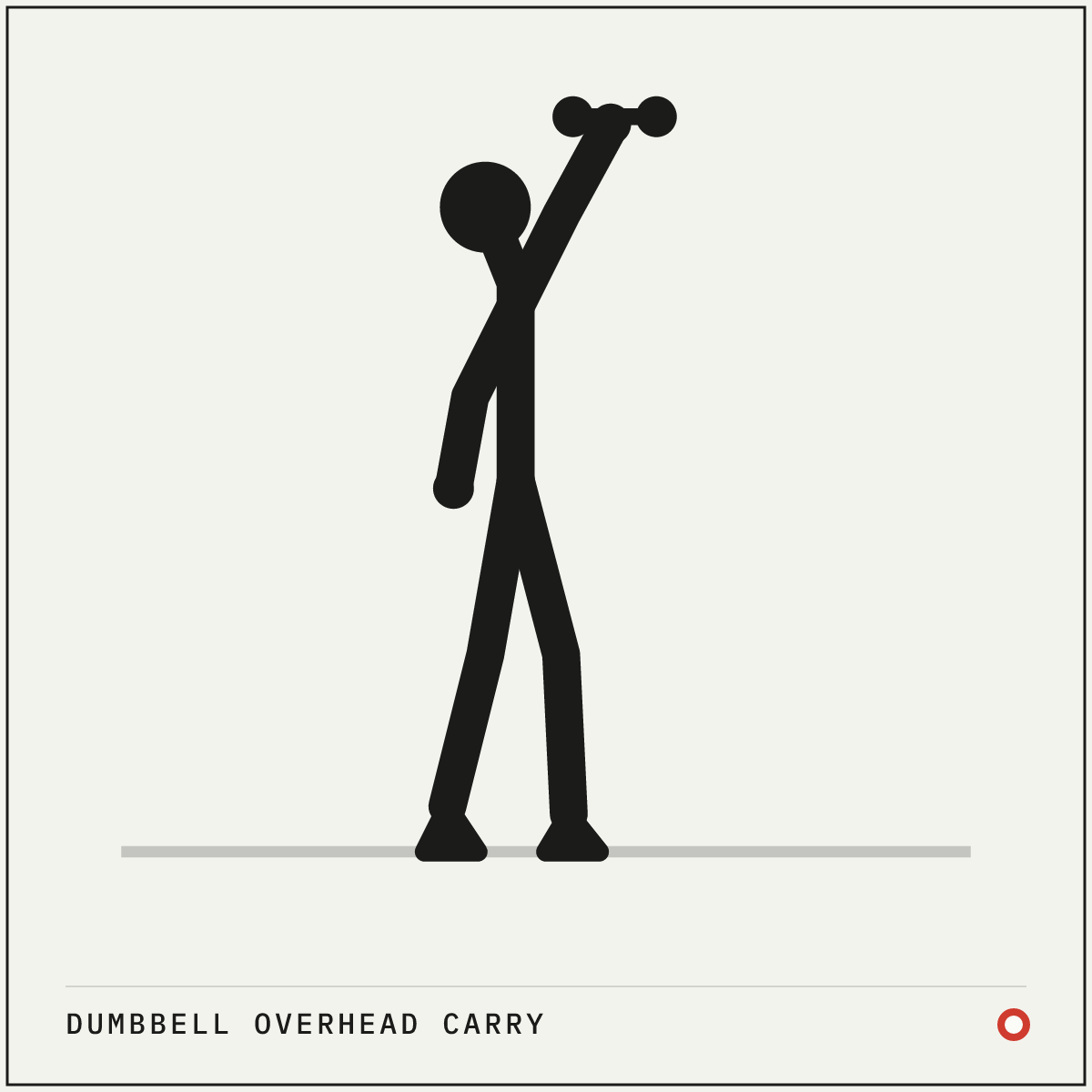
One dumbbell locked out over the shoulder, ribs pulled down, free arm relaxed at your side.
02 Short steps
Take short, slow steps and hold both shoulders level as the loaded side tries to drop.
How to do it
Setup
- Press a dumbbell overhead with one arm until the elbow is locked.
- Stack your wrist over your forearm and your forearm over the shoulder.
- Brace your trunk and pull your ribs down before the first step.
Execution
- Walk forward with short, slow steps while the dumbbell stays still above your shoulder.
- Keep your eyes forward and both shoulders level.
- Lower the weight to your shoulder under control at the end of the carry, then switch arms.
BreathingShort, steady breaths into a braced trunk. Do not hold your breath through the walk.
Cues and mistakes
Check every rep
- Keep the elbow locked straight for every step.
- Ribs stay pulled down; do not lean back under the weight.
- Step heel to toe and let the knee bend to absorb it.
What goes wrong
- Letting the loaded shoulder ride up toward the ear, which shortens the carry to a shrug.
- Arching the lower back so the arm can reach vertical, which trains the arch rather than the carry.
Safety
- If the elbow starts to bend or the shoulder starts shaking, lower the weight to your shoulder straight away. A weight dropped from overhead has a long way to fall.
General guidance, not medical advice. See how Setkit works.
Notes
An overhead carry is a press you never finish. The weight stays locked out while you walk, so the small muscles around the shoulder work continuously instead of in the short bursts a press asks for. That steady demand is why a carry leaves your shoulders tired at a weight you could press for reps.
The limit is usually the trunk rather than the shoulder. A weight above one shoulder tries to tip you toward the empty side, and holding yourself square against that is what makes the one-arm version worth doing. Walk a straight line and check whether your shoulders stay level, because they drop before you notice the effort.
Pick the weight by the position, not by what you can press. If the arm drifts forward of your ear, or the elbow softens partway down the room, it is too heavy for a carry even if a single press would go up. Put it down and take a lighter one; the carry only trains what it trains while the arm is locked.