Farmer's carry
Pick up heavy weights and walk. The simplest exercise in strength training, and it trains almost everything.
The movement
2 stages
Walk tall
01 Walk tall
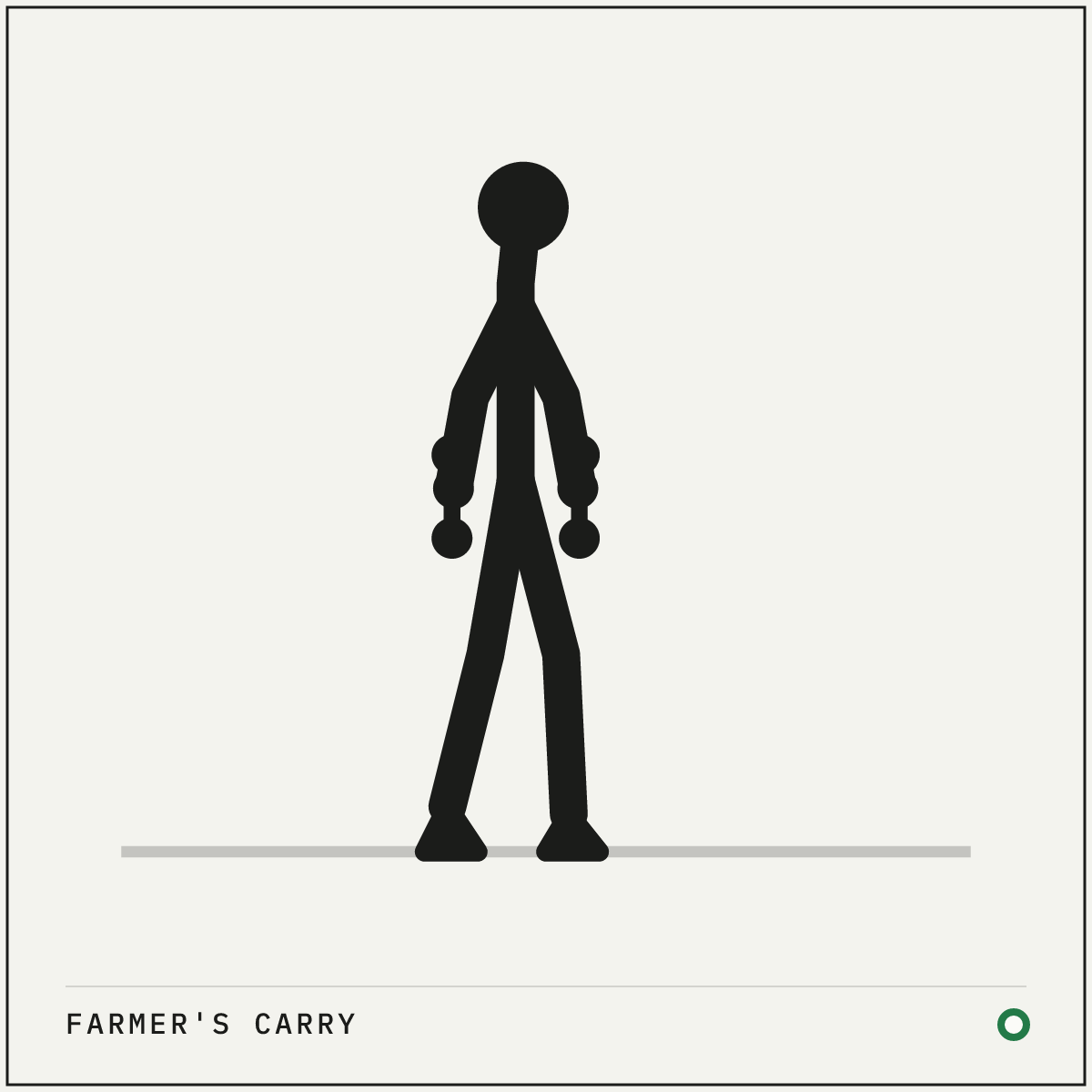
Heavy weights at the sides; ribs stacked over hips.
02 Small steps
Short, quick steps; no lean to either side.
How to do it
Setup
- Lift a heavy dumbbell or kettlebell into each hand with a flat back.
- Stand tall with your ribs over your hips and your shoulders set back and down.
Execution
- Walk with short, quick, deliberate steps for the set distance or time.
- Stay tall the whole way, letting the weights hang from a straight, upright frame.
- Set the weights down with the same flat back you used to pick them up.
Cues and mistakes
Check every rep
- Stand tall and walk with your ribs stacked over your hips.
- Grip the handles hard, because your grip sets the tension everywhere else.
What goes wrong
- Leaning to one side, or rushing with long, lurching steps.
- Shoulders slumping forward as your grip tires.
- Rounding your back picking the weights up or putting them down.
Safety
- Picking the weights up and setting them down are deadlifts and deserve deadlift form. Most carry injuries happen at those two moments rather than during the walk.
General guidance, not medical advice. See how Setkit works.
Notes
The farmer’s carry is the exercise civilization was built on. Pick heavy things up and walk them somewhere. As training it is a plank that moves, with a grip test attached. Your trunk braces against the wobble of every step, your upper back holds you upright against the hanging load, and your hands find out what heavy actually means.
It gives back more than almost anything relative to how little technique it needs. If you can walk tall, you can carry. The only real coaching points are a flat back on the pickup and refusing to slump as the set goes on. That makes it the ideal introduction to heavy training.
Go heavier than feels polite. A carry should be hard work within 30–45 seconds rather than a stroll. Carrying one weight instead of two turns the whole thing into work against leaning sideways, and that is the natural next step.