Kettlebell overhead carry
Walking with one kettlebell locked out overhead, where the bell rests behind the wrist and pulls the arm backward with every step.
NeedsKettlebell
The movement
2 stages
Locked overhead
01 Locked overhead
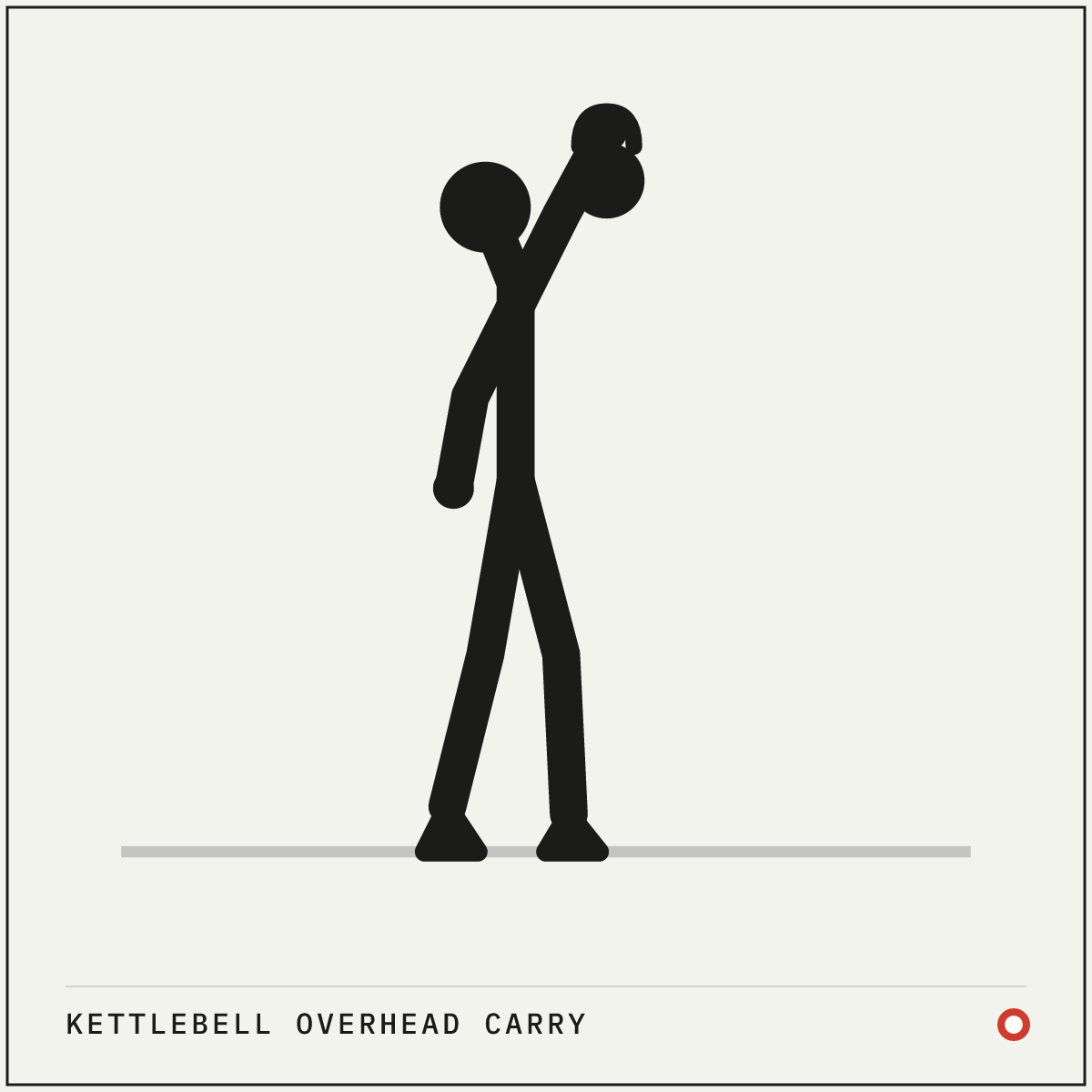
One bell locked out over the shoulder, ribs pulled down, free arm relaxed at your side.
02 Short steps
Take short, slow steps and keep the arm vertical instead of letting it drift back.
How to do it
Setup
- Clean a kettlebell to your shoulder, then press it overhead until the elbow is locked.
- Turn your wrist so the bell settles on the back of your forearm.
- Brace your trunk and pull your ribs down before the first step.
Execution
- Walk forward with short, slow steps while the bell stays still above your shoulder.
- Keep your eyes forward and your arm stacked over the shoulder it started on.
- Lower the bell to your shoulder under control at the end of the carry, then switch arms.
BreathingShort, steady breaths into a braced trunk. Do not hold your breath through the walk.
Cues and mistakes
Check every rep
- Keep the elbow locked straight for every step.
- Ribs stay pulled down; do not lean back under the weight.
- Step heel to toe and let the knee bend to absorb it.
What goes wrong
- Walking with a soft elbow, which hands the work to the triceps and lets the bell wander.
- Arching the lower back so the arm can reach vertical, which trains the arch rather than the carry.
Safety
- If the elbow starts to bend or the shoulder starts shaking, lower the bell to your shoulder straight away. A weight dropped from overhead has a long way to fall.
General guidance, not medical advice. See how Setkit works.
Notes
A kettlebell overhead behaves differently from a dumbbell. The weight hangs behind your wrist rather than sitting above it, so it pulls your arm backward for the whole walk. Your shoulder spends the carry resisting that pull, and that is most of what you are here for.
The trunk usually gives out before the shoulder does. A weight held above one shoulder tries to bend you toward the empty side, and the muscles down the side of your trunk are what stop it. Once they tire you will feel yourself leaning, and the useful part of the set has ended there.
Only carry overhead if you can lock the arm out vertically while standing tall. If your shoulders will not let the arm reach straight up, your lower back will arch to make up the difference, and you will spend the walk practicing that arch. Press overhead and carry lighter loads until the position is available to you.