Kettlebell single-arm press
A strict overhead press with one bell held at the shoulder. The lopsided load makes your trunk work as hard as your shoulder.
TrainsShoulders
NeedsKettlebell
The movement
2 stages
Front rack
01 Front rack
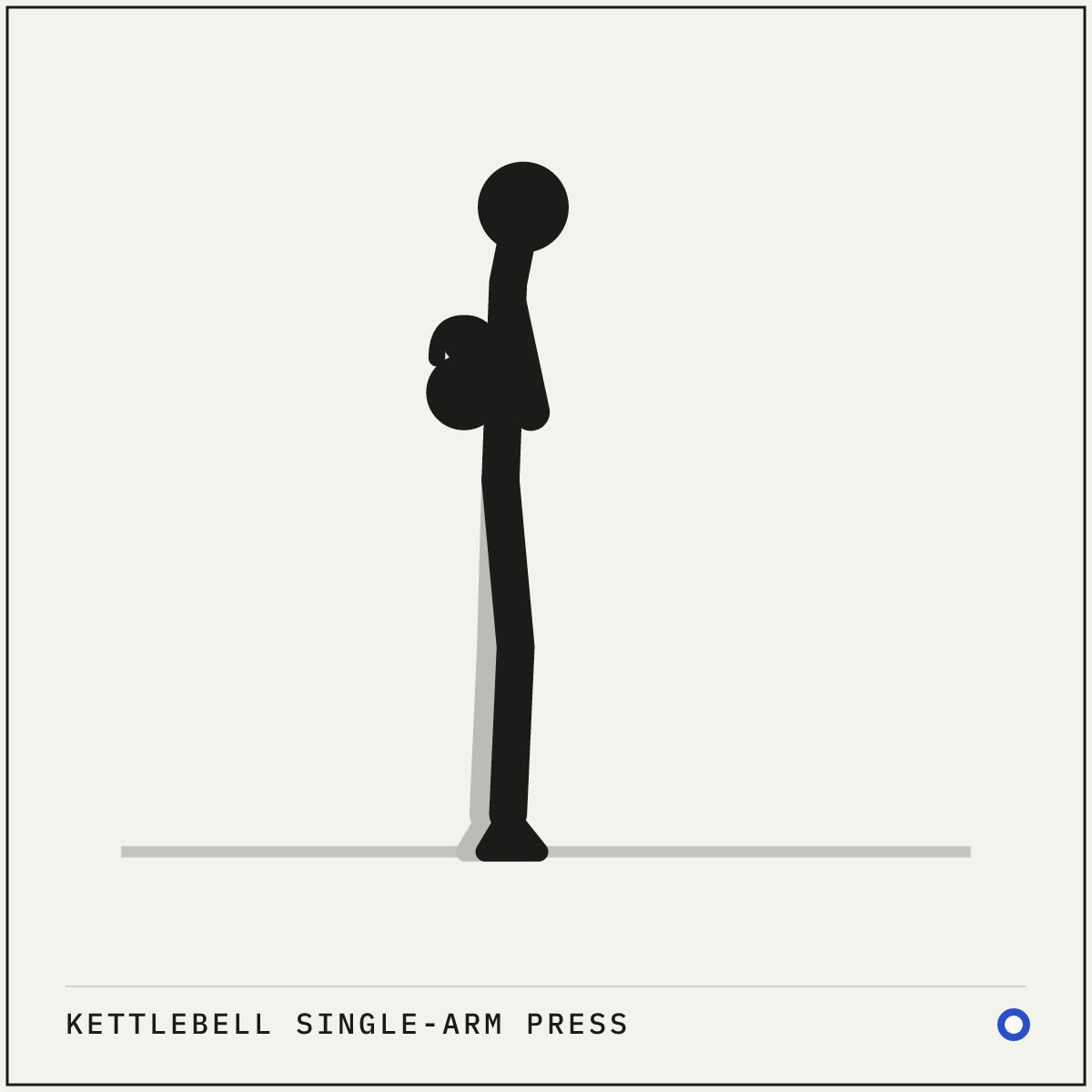
Bell resting on the forearm, forearm vertical, glutes squeezed and ribs down.
02 Stacked overhead
Press straight up until the bell, shoulder and hip stack in one vertical line.
How to do it
Setup
- Bring a bell up to your shoulder with your forearm vertical and the bell resting against the back of your forearm.
- Stand with your feet hip-width apart, glutes squeezed and ribs pulled down.
Execution
- Press the bell straight up, letting your forearm turn so your palm finishes facing forward.
- Straighten your elbow with the bell directly over your shoulder and your upper arm beside your ear.
- Lower under control back to your shoulder without letting your ribs flare.
BreathingInhale at the shoulder, exhale as you press, then breathe again at the top.
Cues and mistakes
Check every rep
- Squeeze your glutes so the press does not turn into a lean.
- Finish with the bell, your shoulder and your hip in one vertical line.
What goes wrong
- Leaning away from the bell to get it up, which loads the lower back instead of the shoulder.
- Letting your wrist bend backward, which makes the bell feel much heavier than it is.
- Pressing around your head in an arc rather than in a straight line.
Safety
- A load on one side wants to bend you sideways. If your torso leans away on every rep, the bell is too heavy, and that side bend is your lower back taking over.
General guidance, not medical advice. See how Setkit works.
Notes
Pressing one bell instead of two changes what the exercise trains. A weight sitting on one shoulder tries to bend you sideways and twist you, so your trunk works hard just to keep the press vertical. Your obliques and your opposite hip end up doing as much as the shoulder does. That is the reason to pick this over a two-dumbbell press, rather than the fact that it uses a kettlebell.
The rack position is what makes a bell different from a dumbbell here. Resting against the back of your forearm with the weight below your hand, the bell starts closer to your body and travels in a slightly turning path, which most shoulders find more comfortable than a dumbbell held out to the side. It also means the press has to start from a properly straight wrist.
Glute tension is the cue that changes everything. Squeezing hard on both sides locks your pelvis and gives the press something solid to push against. Without it the effort leaks out into a lean and your lower back quietly picks up the load. Squeeze your glutes before the press and the bell feels lighter on the first rep.
Because the trunk is a genuine limit here, your working weight will be lower than in a two-arm press of the same total load, and it should be. Sets of five to eight per side with no lean are the goal. Once your torso starts bending away, you are doing a different exercise.