Dumbbell thruster
A front squat running straight into an overhead press. The most work per rep in the library, and the fastest way to run out of breath.
The movement
2 stages
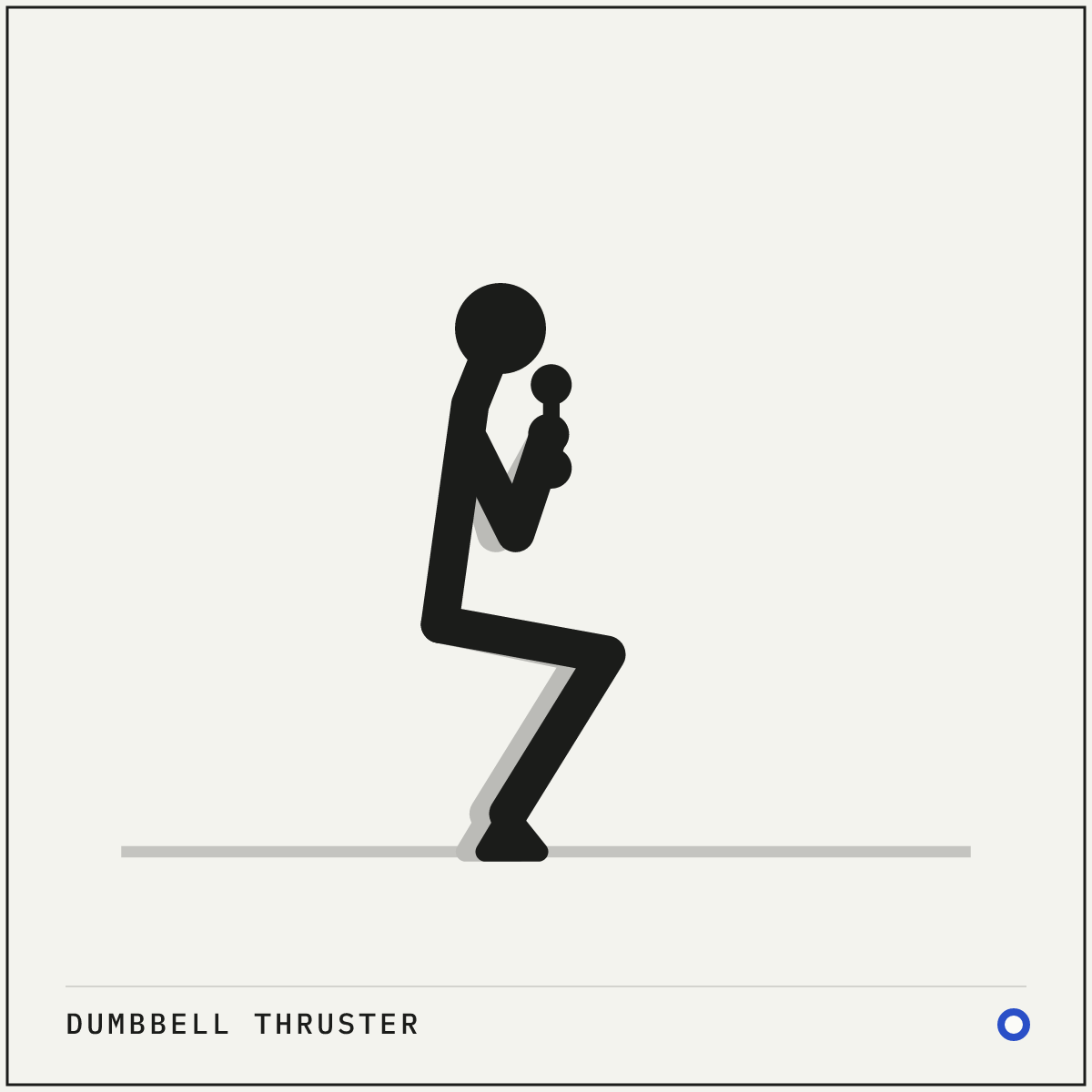
Squat bottom
01 Squat bottom
Squat to at least parallel with the weights resting on the shoulders and the elbows up.
02 Straight overhead
Drive out of the bottom and let that momentum carry the press to lockout.
How to do it
Setup
- Stand with your feet shoulder-width apart and a dumbbell resting on each shoulder, palms facing each other.
- Keep your elbows up and your torso tall.
Execution
- Squat down until your thighs are at least parallel to the floor, keeping your chest up and the weights on your shoulders.
- Drive out of the bottom and let that momentum carry into pressing the weights overhead.
- Finish with straight arms, then bring the weights back to your shoulders and go straight into the next rep.
BreathingInhale at the top, exhale hard through the drive and the press.
Cues and mistakes
Check every rep
- Treat it as one movement: the press starts before your legs finish.
- Keep your elbows up out of the bottom so the weights stay on your shoulders.
What goes wrong
- Standing all the way up and then pressing, which wastes the drive and doubles the effort.
- Letting your chest drop at the bottom, which puts the weights out of position for the press.
- Choosing a weight based on the squat rather than the press, which is always the harder half.
Safety
- Fatigue wrecks the squat long before the shoulders give out. When your depth or chest position starts falling apart, the set is over whatever the target reps said.
General guidance, not medical advice. See how Setkit works.
Notes
The thruster is a squat and an overhead press joined into a single rep, and it asks more of more of your body than anything else here. That is why it shows up in conditioning work. A set of ten raises your heart rate in a way no isolation exercise can, because your legs, shoulders and trunk are all working and your blood has to be in several places at once.
The join between the two halves is the whole skill. Done well, the press begins while your legs are still straightening, so the weights ride the momentum out of the bottom and your shoulders only finish the last third. Done as two separate movements, you have thrown away the help and are doing a hard front squat followed immediately by a hard press, which costs much more for the same result.
The press picks the weight, always. Almost everyone can squat far more than they can put overhead, so dumbbells that feel light at the bottom of the squat will be the reason the set ends. Choose for the press and accept an easy squat.
This is a conditioning tool rather than a strength builder. Neither half carries enough weight to build maximum strength, but for getting a lot of good work into a short session almost nothing matches it. That is why it belongs in circuits and EMOMs rather than at the start of a strength day.