Barbell push press
An overhead press started by a dip and drive of the legs. Moves more weight overhead than a strict press, building total-body power.
The movement
3 stages
Bar racked
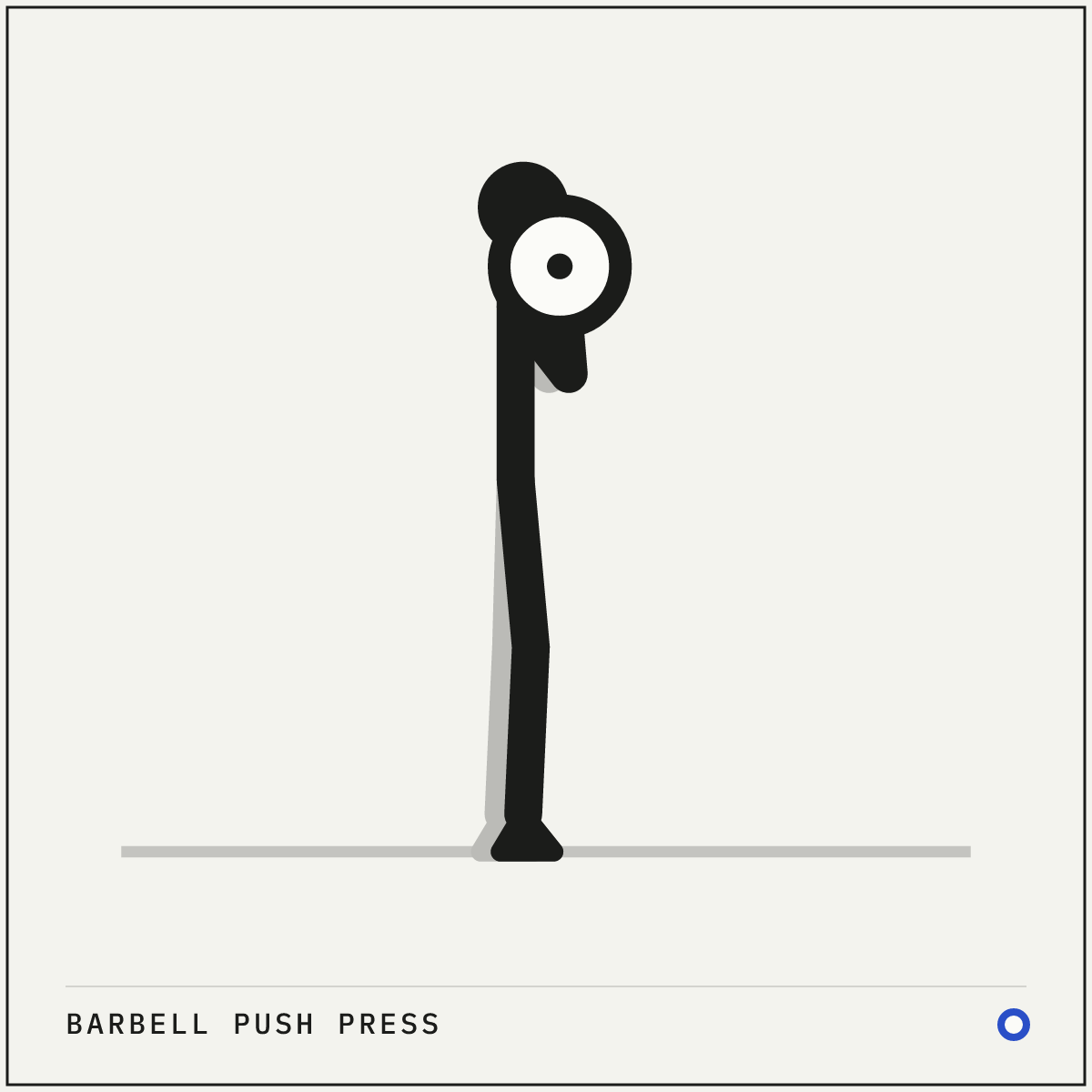
01 Bar racked
Bar on the front of the shoulders, torso upright, weight over the middle of the foot.
02 Shallow dip
Bend the knees a few inches with the torso straight up and down, then reverse fast.
03 Driven overhead
Drive through the legs and let the shoulders finish, bar over the crown of the head.
How to do it
Setup
- Stand with the barbell resting on the front of your shoulders, hands slightly wider than your shoulders.
- Keep your torso completely upright and your elbows pointing slightly forward.
- Brace your trunk hard.
Execution
- Dip by bending your knees a few inches, keeping your torso completely vertical.
- Reverse instantly and drive violently through your legs to launch the bar off your shoulders.
- Press to straight arms overhead, then lower the bar to your shoulders under control to absorb the weight.
BreathingTake a big breath before the dip, hold it through the drive, and exhale at the top.
Cues and mistakes
Check every rep
- Dip shallow and fast, then reverse immediately.
- Your legs start the weight and your shoulders finish it.
- Keep your heels flat on the floor during the dip.
What goes wrong
- Dipping too deep, which turns the movement into a squat and loses the stretch reflex.
- Leaning forward during the dip, which sends the bar out away from your center of gravity.
- Pausing at the bottom of the dip.
Safety
- Absorb the weight with your legs as the bar comes back down to your shoulders. Catching a heavy barbell with stiff knees will jar your spine.
General guidance, not medical advice. See how Setkit works.
Notes
A strict overhead press is limited by the smallest muscles involved. The push press removes that limit by letting your legs get the weight moving, so your shoulders only have to finish a rep that is already traveling. You get more weight overhead, more total work done, and a movement that trains power rather than only strength.
The dip decides whether it works, and it is almost always too deep. A few inches is enough. What matters is reversing fast so the momentum passes into the barbell, and depth turns the whole thing into a front squat with a press stuck on the end.
Staying upright through the dip matters as much as the depth does. Any forward lean puts the barbell ahead of your shoulders, and the press then fights a bad line all the way up. Your torso should drop and rise straight down and up.