Kettlebell swing
A fast, powerful hip hinge. Explosive power and hard conditioning from a single kettlebell.
TrainsGlutesHamstrings
NeedsKettlebell
The movement
2 stages
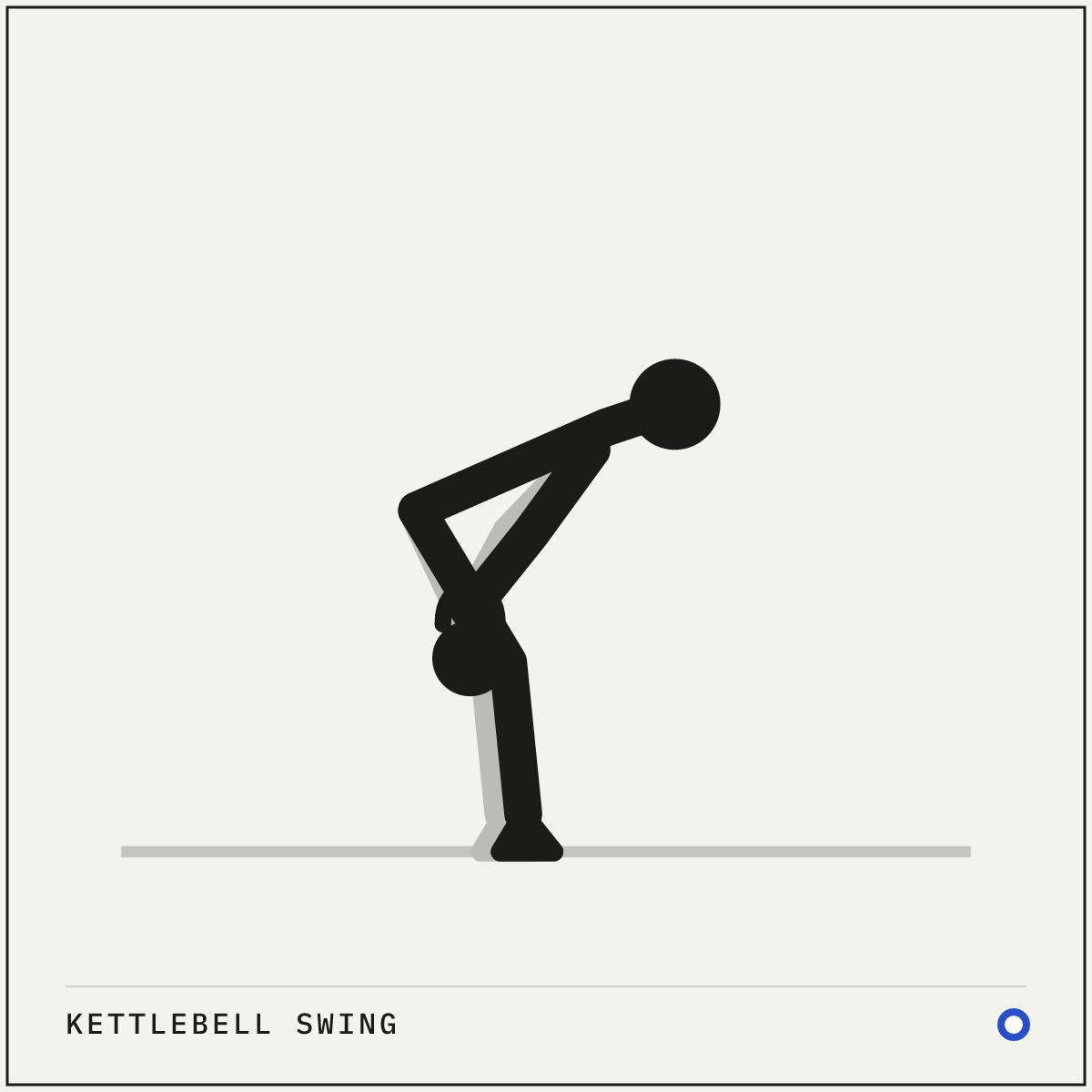
Hinge
01 Hinge
Hips back, forearms against the inner thighs, bell behind you.
02 Snap
Snap the hips forward; the bell floats to chest height.
How to do it
Setup
- Place the kettlebell about a foot in front of you.
- Push your hips back, grip the handle with both hands, tighten your lats and flatten your back.
- Start the first rep by throwing the bell backward between your legs.
Execution
- Snap your hips forward to standing, and let the bell float up to chest height on straight arms.
- Let it fall, and push your hips back as your forearms meet your inner thighs.
- Drive straight into the next rep, so the set runs as one continuous rhythm.
BreathingSharp exhale at each hip snap, inhale as the bell swings back.
Cues and mistakes
Check every rep
- This is a hinge with a snap, not a squat with your arms.
- Your hips drive the bell; your arms only hold on to it.
- Stand fully tall at the top with your glutes squeezed.
What goes wrong
- Squatting up and down and lifting the bell with your shoulders.
- Letting the bell drop too low, which pulls your lower back into rounding.
- Leaning back at the top instead of standing tall.
Safety
- Learn the hip hinge and the deadlift first. The swing adds speed to a shape you need to own already.
- Use a bell heavy enough to swing properly. Too light and you will lift it with your arms.
General guidance, not medical advice. See how Setkit works.
Notes
The swing is what the kettlebell was built for. The handle sits above the weight, so the bell can travel between your legs and float out in front of you, which turns the hip hinge into a movement you can repeat explosively. Done well it trains the same hard hip extension as jumping with far less impact, and it raises your heart rate like almost nothing else in strength training.
Everything depends on the hinge. The bell stays above your knees on the backswing, your back stays long, and every rep finishes standing tall with your glutes locked. The usual mistake is squatting up and down while your arms haul the bell around. That is tiring and it misses the point entirely.
Program swings in short, sharp bursts. Sets of ten to twenty, or an EMOM where a fixed number of snappy reps starts each minute. The set ends when the snap goes out of your hips, not when the timer says so.