Kettlebell snatch
One continuous pull from between your legs to straight overhead. The hardest thing you can do with a single bell.
TrainsGlutesHamstringsShoulders
NeedsKettlebell
The movement
2 stages
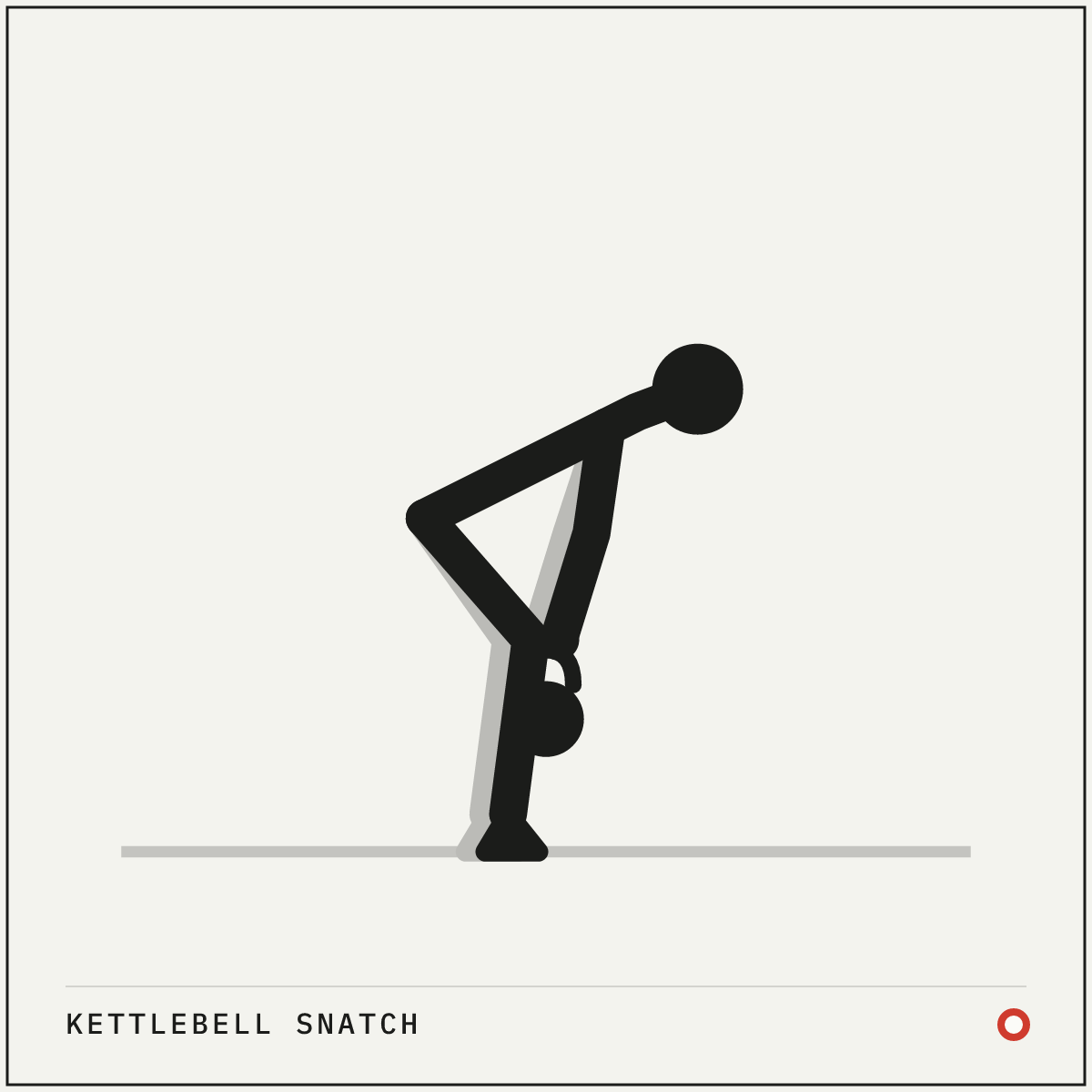
Bell between the legs
01 Bell between the legs
Hike the bell back between the legs with the back flat and the arm long.
02 Locked out overhead
Punch the hand up through the handle so the bell settles on the forearm, arm locked.
How to do it
Setup
- Stand with the bell slightly ahead of you and take the handle in one hand.
- Push your hips back with a flat back and throw the bell between your legs.
Execution
- Snap your hips forward hard and let the bell travel up close to your body.
- As it passes chest height, punch your hand up and through the handle.
- Finish with your arm straight overhead and the bell resting quietly on the back of your forearm.
BreathingSharp exhale at the hip snap, inhale as the bell drops back between your legs.
Cues and mistakes
Check every rep
- Punch your hand through the handle at the top.
- Keep the bell close to your body the whole way up.
What goes wrong
- Hauling the bell up with your arm rather than sending it with your hips.
- Punching too late, which lets the bell crash down onto your forearm.
- Letting the bell drift wide, which turns the way down into an uncontrolled swing.
Safety
- This is a difficult movement done fast with a heavy object above your head. Be solid at the clean and the overhead press first, and stop the set as soon as the bell starts travelling wider.
General guidance, not medical advice. See how Setkit works.
Notes
The snatch takes a bell from the floor to overhead in one unbroken movement. It asks for power, a stable shoulder, grip endurance and a great deal of breathing, all at the same time. That combination is why it is the classic kettlebell conditioning test, and why a five-minute set is one of the hardest things in this library.
Timing decides everything, and you cannot see it from the inside. Your hips do the work and your arm only guides, and your hand has to punch up through the handle at the exact moment the bell goes weightless near the top. Punch early and you fight the bell. Punch late and it flips over and slams your forearm. Almost every complaint that snatches hurt the wrist is a timing problem.
Keeping the bell close is what makes that timing possible. A wide arc gives the bell a long way to travel and a lot of speed to lose, and no amount of good hand technique will rescue it. Telling yourself the bell travels straight up the front of your body is a simplification, but it points you at the right fix.
Treat it as a skill first and conditioning second. A few sets of five per side, done sharply with a bell you can manage, build far more than long ragged sets. The ragged sets are where shoulders and wrists get hurt.