Barbell glute bridge
A glute bridge with the bar across your hips. Heavy, direct glute work from the floor with no bench needed.
The movement
2 stages
Set
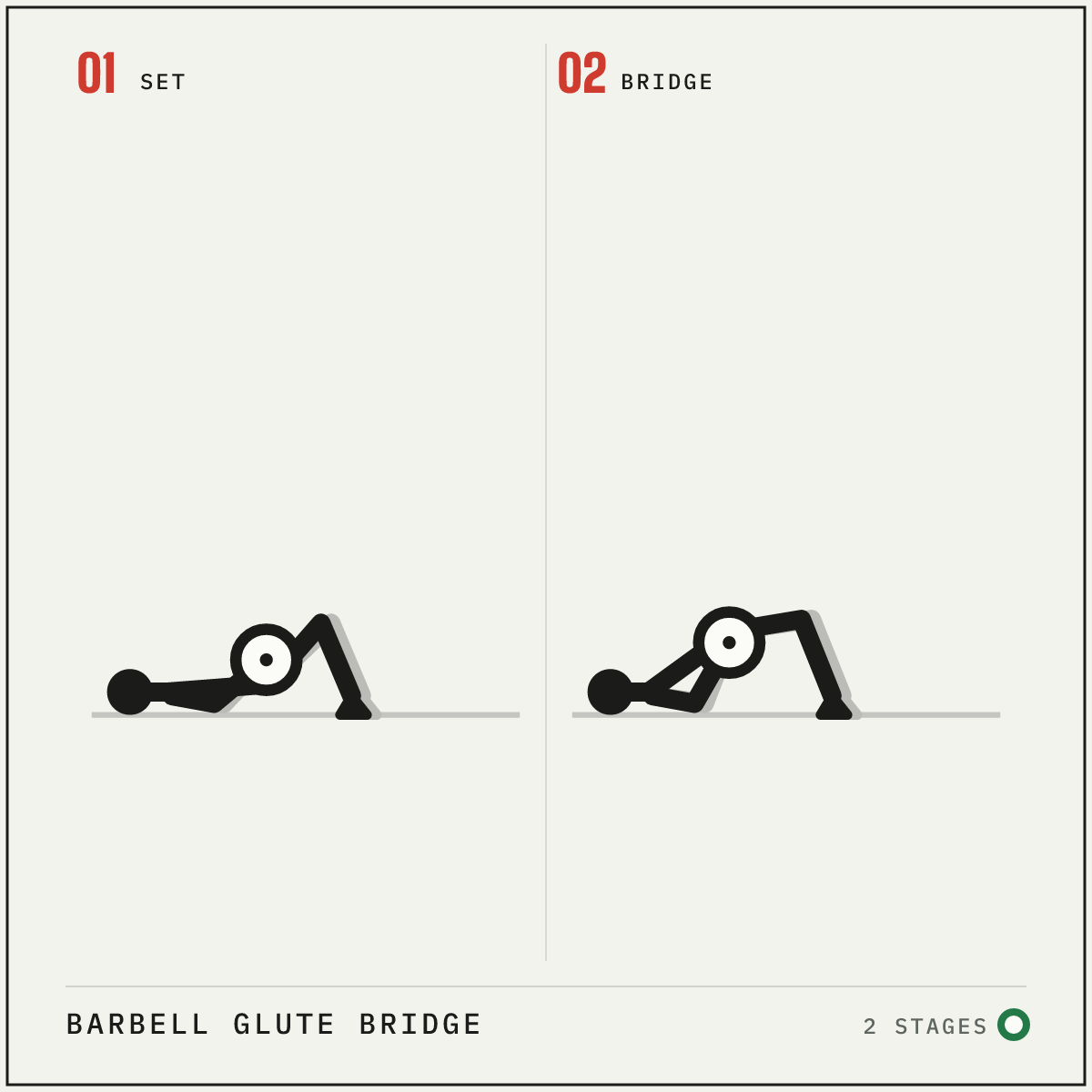
01 Set
Bar padded in the crease of the hips, feet flat near the hips, both hands on the bar.
02 Bridge
Drive through the heels until shoulders, hips and knees form a line, ribs down.
How to do it
Setup
- Sit on the floor with your legs straight and roll the loaded bar over your legs until it rests in the crease of your hips, with a folded towel or pad under it.
- Lie back, bend your knees and set your feet flat, close enough that your fingertips can reach your heels.
- Hold the bar with both hands to keep it from rolling, and tuck your chin.
Execution
- Push through your heels and lift your hips until your shoulders, hips and knees form a straight line.
- Squeeze your glutes at the top for a full second with your ribs down.
- Lower the bar under control until it hovers just above the floor, then drive again.
- Keep your chin tucked and your eyes on your knees for each rep.
BreathingExhale as you squeeze at the top, inhale on the way down.
Cues and mistakes
Check every rep
- The bar rises on the hips, not on an arched lower back.
- Ribs down at the top, with a straight line from knees to shoulders.
- Heels planted, with the shins vertical at the top.
What goes wrong
- Arching the lower back to get the bar higher.
- Feet too far away, which hands the work to the hamstrings.
- Letting the bar roll toward the stomach, where it pinches.
Safety
- The bar rests on soft tissue, so use a pad or a folded towel, and use full-size plates so there is room to roll it on. Finish by rolling it back down over your thighs rather than lifting it off.
General guidance, not medical advice. See how Setkit works.
Notes
A bar across the hips is the simplest way to make the glute bridge heavy. The bodyweight version runs out of challenge within a few weeks, and the usual answer is a hip thrust, which needs a bench. The barbell bridge needs the floor. The range is shorter than a hip thrust, but the top position, where the glutes do their work, is the same, and it takes the same kind of load.
The shorter range is also why it suits a beginner. From the floor your hips travel through the last third of a hip thrust, which is the easiest part to keep clean, and the bar cannot drag you into the arched-back finish that a deep bench-supported rep invites. Learn the squeeze here, with the chin tucked and the ribs down, and the hip thrust will look right from the first session.
Getting the bar into place is most of the effort. Full-size plates leave room to roll it over your legs, and a pad keeps it off the hip bones. Load it so that sets of 8–15 end with the glutes burning rather than the back complaining, and add weight when the last set is still crisp.