Hip thrust
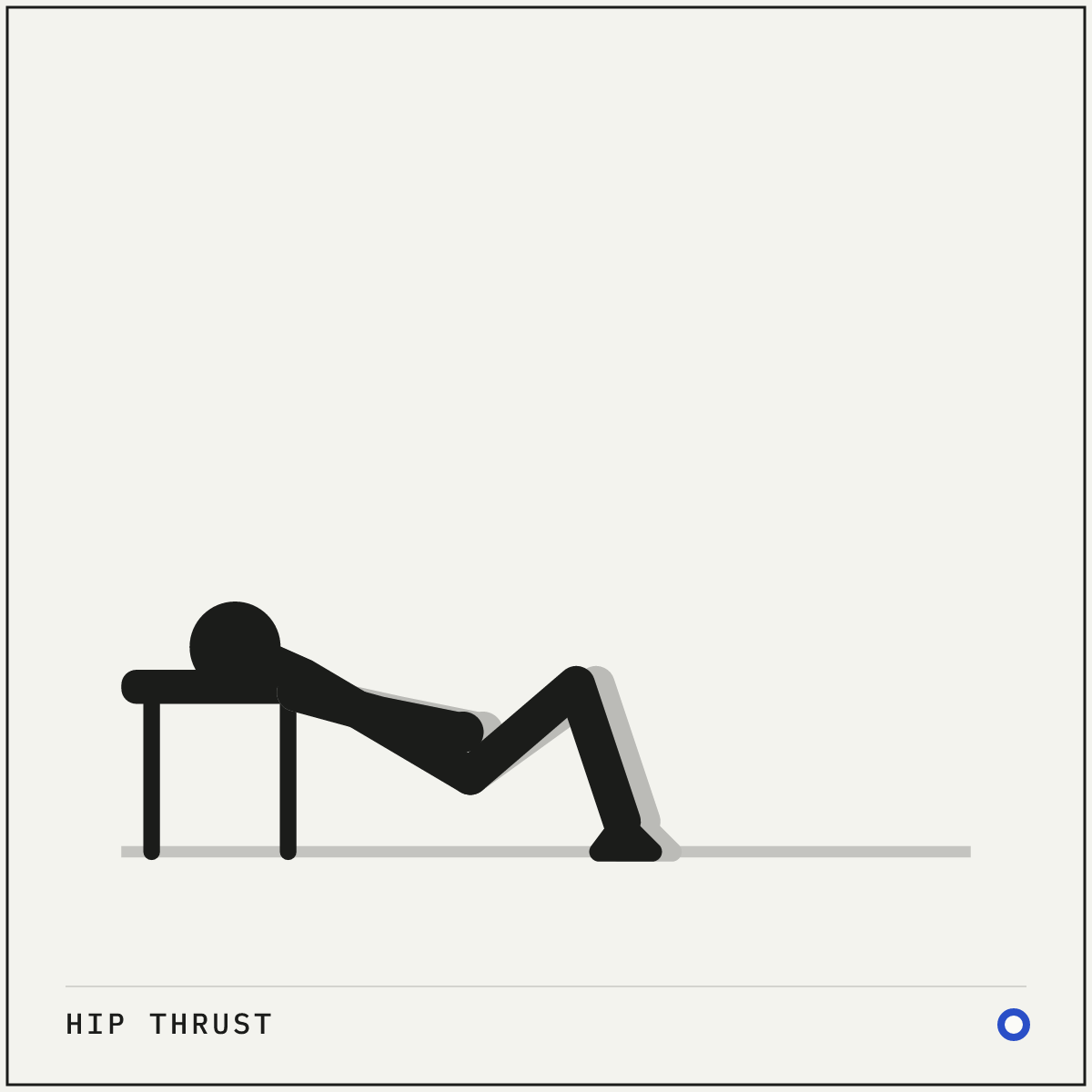
Shoulders on a bench, hips driving up. The biggest range and the heaviest load you can give the glutes directly.
The movement
2 stages
Set
01 Set
Upper back on the bench, feet planted, chin tucked.
02 Lockout
Drive the hips up until the torso and thighs are level.
How to do it
Setup
- Sit on the floor with your upper back against the edge of a sturdy bench, knees bent and feet flat.
- Position the bench edge just below your shoulder blades.
- If you are adding weight, rest a dumbbell across the crease of your hips.
Execution
- Drive through your heels and lift your hips until your torso and thighs form one level line.
- Keep your chin tucked and your eyes forward, so you are looking out over your knees at the top.
- Lower your hips most of the way down, then drive again.
BreathingExhale hard through the squeeze at the top, inhale on the way down.
Cues and mistakes
Check every rep
- Keep your ribs and chin down, and finish the rep with your glutes.
- Adjust how far out your feet are until your shins are vertical at the top.
What goes wrong
- Arching your back and flaring your ribs to make the range look bigger.
- Looking at the ceiling, which pulls your spine into an arch.
- Feet too far out, which turns it into a hamstring exercise.
Safety
- Check the bench cannot tip or slide, and brace it against a wall if you are unsure.
General guidance, not medical advice. See how Setkit works.
Notes
Putting your shoulders up on a bench turns a glute bridge into a hip thrust, and the difference is range. Your hips travel through a much bigger arc, carrying whatever weight you lay across them. Nothing else loads hip extension this directly or this heavily, which is why the hip thrust moved from a bodybuilding oddity to a staple of strength and sports programs.
The detail that matters most is finishing with your ribs down and your chin tucked. What you want at the top is a flat line from your knees to your shoulders, held there by a hard glute squeeze. The version that arches the lower back to gain height looks similar and feels quite different the next morning.
Adding weight is straightforward. Use bodyweight until the movement is clean, then rest a dumbbell on your hips with a folded towel underneath for comfort, and add weight whenever sets of ten still feel strong.