Single-leg bench hip thrust
A hip thrust with one foot on the floor and the other leg held straight. Twice the load on the working glute, at the biggest range the hip thrust already gives you.
The movement
2 stages
Set
01 Set
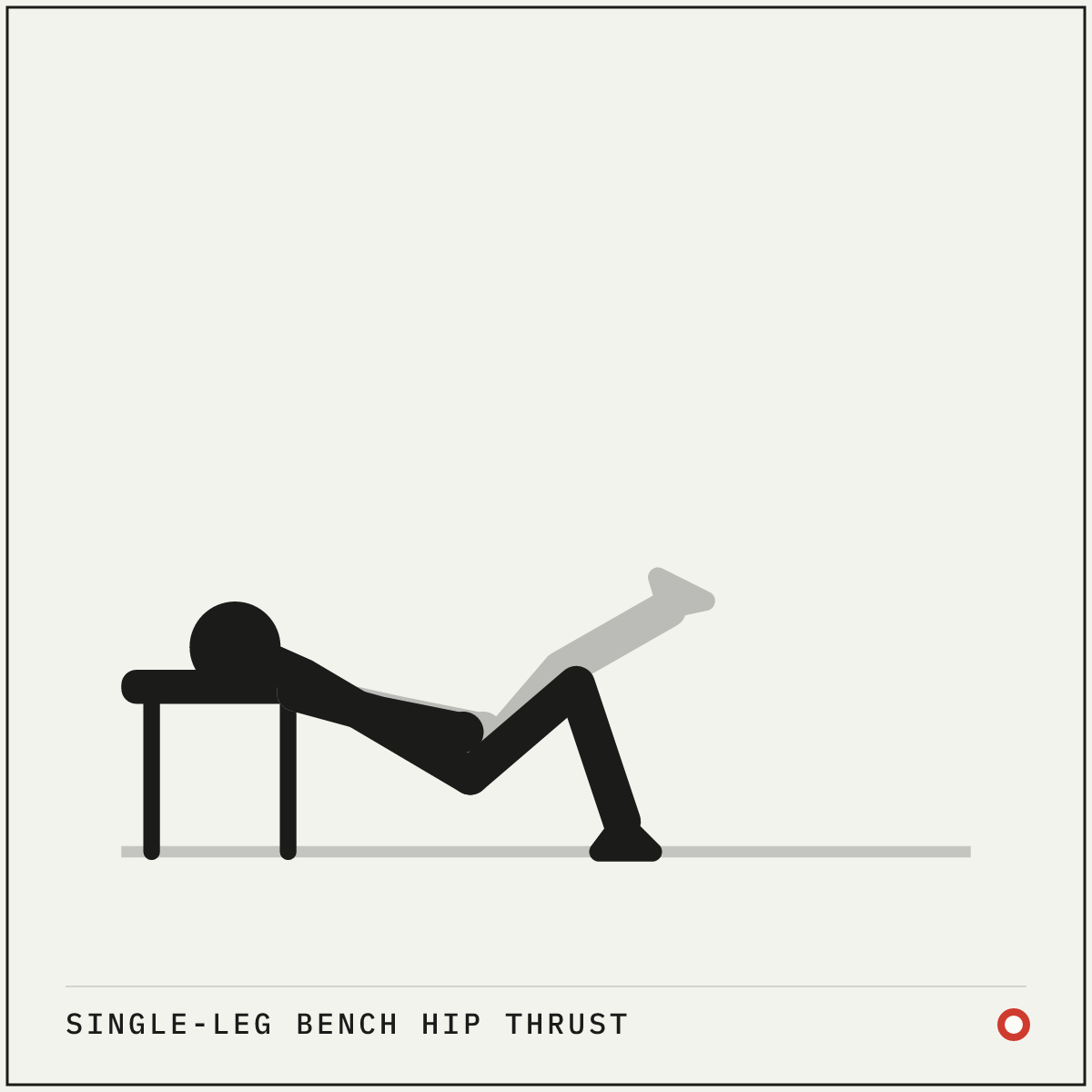
Upper back on the bench, one foot planted, the other leg held straight and raised.
02 Lockout
Drive through the planted heel until the torso and thigh are level, hips square.
How to do it
Setup
- Sit on the floor with your upper back against the edge of a sturdy bench, one foot planted flat and the other leg held straight out in front of you.
- Position the bench edge just below your shoulder blades.
Execution
- Drive through the planted heel and lift your hips until your torso and thigh form one level line.
- Keep the raised leg straight and level with your torso the whole way up.
- Lower your hips most of the way down without your pelvis dropping to one side, then drive again.
BreathingExhale hard through the squeeze at the top, inhale on the way down.
Cues and mistakes
Check every rep
- Keep your ribs and chin down, and finish the rep with the working glute.
- Keep your hips square. Neither side twists toward the raised leg.
What goes wrong
- Letting the hip on the raised-leg side sag or rotate open, which turns the exercise into a twist.
- Arching the back to reach the top instead of finishing with the glute.
- Pushing off through the raised leg's heel, which quietly hands the work back to the planted side.
Safety
- Check the bench cannot tip or slide, and brace it against a wall if you are unsure. Balancing on one leg makes any bench movement more dangerous than the two-leg version.
General guidance, not medical advice. See how Setkit works.
Notes
The single-leg hip thrust keeps the bench’s advantage over a glute bridge, a bigger range of hip extension, and adds the unilateral test a two-leg version cannot give you. One glute does the entire job while the other leg goes along for the ride, which is close to double the work on the side that stays planted.
The raised leg has one job: stay straight and stay level with your torso. It is not there to help. If you feel it pushing off or bracing against anything, the working glute has quietly recruited help it should not need.
Level hips are the entire technique. It is easy to let the side with the raised leg drop or rotate open as you fatigue, which turns hip extension into a twist and takes load off the glute you are trying to train. Reps only count while your hips stay square across the top.
This is the loaded end of the hip thrust family, and there is nowhere further to hide once you can do it cleanly for reps. Most people get here through the single-leg glute bridge first, then move up to a bench once the floor version is easy for eight to twelve reps a side.