Band pull-through
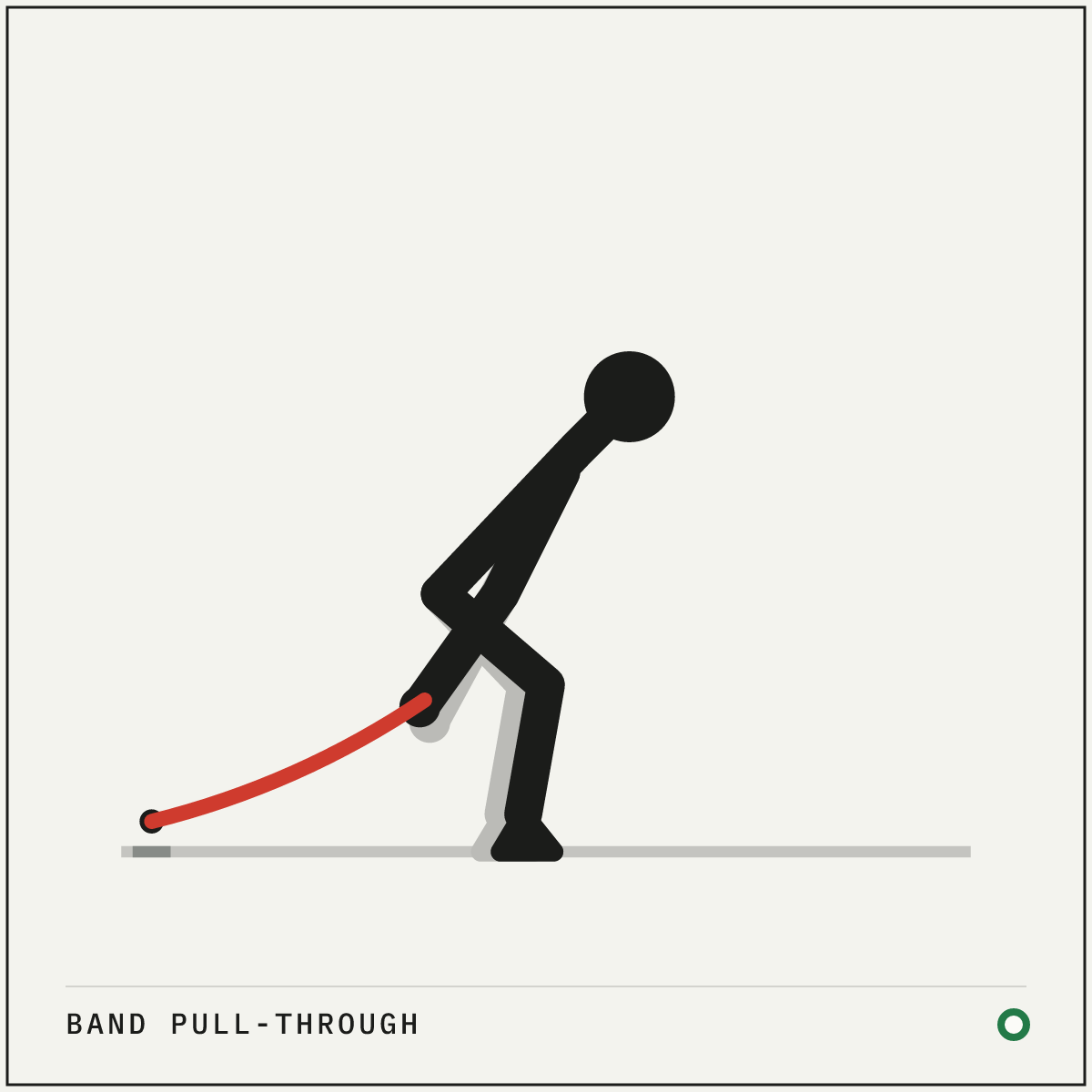
A band anchored low behind you, pulled through your legs by your hips. A hinge that pulls backward instead of down, which makes the glutes obvious.
TrainsGlutesHamstrings
NeedsResistance band
The movement
2 stages
Hips back
01 Hips back
Push the hips back and let the band draw your hands between your legs.
02 Hips through
Drive the hips forward to standing and squeeze the glutes, arms still hanging long.
How to do it
Setup
- Anchor the band at ankle height behind you, on something heavy enough that it cannot slide.
- Face away from the anchor, stand over the band and reach between your legs to hold a handle in each hand.
- Walk forward until the band is tight with your arms hanging straight down and your feet about hip-width apart.
Execution
- Push your hips back and let the band draw your hands between your legs, knees bent slightly.
- Stop when your hamstrings are stretched and your back is still flat.
- Drive your hips forward to standing and squeeze your glutes at the top, with your arms still hanging long.
BreathingBreathe in as your hips travel back, out as you stand up.
Cues and mistakes
Check every rep
- Your arms stay long, and your hips move the band.
- Stop the top at tall and upright, with your ribs over your hips.
What goes wrong
- Bending the knees and dropping the hips, which turns the hinge into a squat.
- Pulling the handles up with the arms, which hides how little the hips did.
- Leaning back at the top to feel the squeeze, which loads the lower back.
Safety
- Check the anchor and the band before every set. Anchor at ankle height rather than to a door handle, and step forward slowly at the end of a set rather than letting the tension go at once.
General guidance, not medical advice. See how Setkit works.
Notes
The pull-through is the clearest way to feel a hinge, because the resistance points where your hips actually work. A deadlift loads you downward, so your back and legs both fight gravity and the hips are easy to under-use. A band anchored behind you pulls you backward instead, and the only thing that can win that fight is your hips coming forward. Beginners usually find their glutes on the first set.
The arms are the tell. They are a rope between the band and your hips, nothing more, and if your elbows are bending the hips have stopped moving. Watch the handles: they should arrive at the top of the rep because you are standing up, not because you pulled them there. Standing side-on to a mirror for one set will settle it faster than any cue.
Loading works the same way it does on other band work. A thicker band, a doubled band, or a step further away from the anchor all add tension, and the change is bigger than it looks. Since the band is tightest at lockout, this exercise trains the top of the hinge hard and the bottom barely at all. Pair it with a deadlift or a Romanian deadlift once you have gear for them, and keep the pull-through as a warm-up or a finisher.
Anchoring is the practical limit. A band tied at ankle height to a heavy rack, a loaded barbell or a post is fine. A door anchor at floor level works if the door opens toward you and is latched. Anything that can slide, tip or swing is worth ruling out before you load it, because the band pulls hardest in the position where you are least able to react.