Plank shoulder tap
A high plank where one hand lifts to touch the opposite shoulder. Core work against the twist that a plank alone never sees.
TrainsCore
NeedsBodyweight
The movement
2 stages
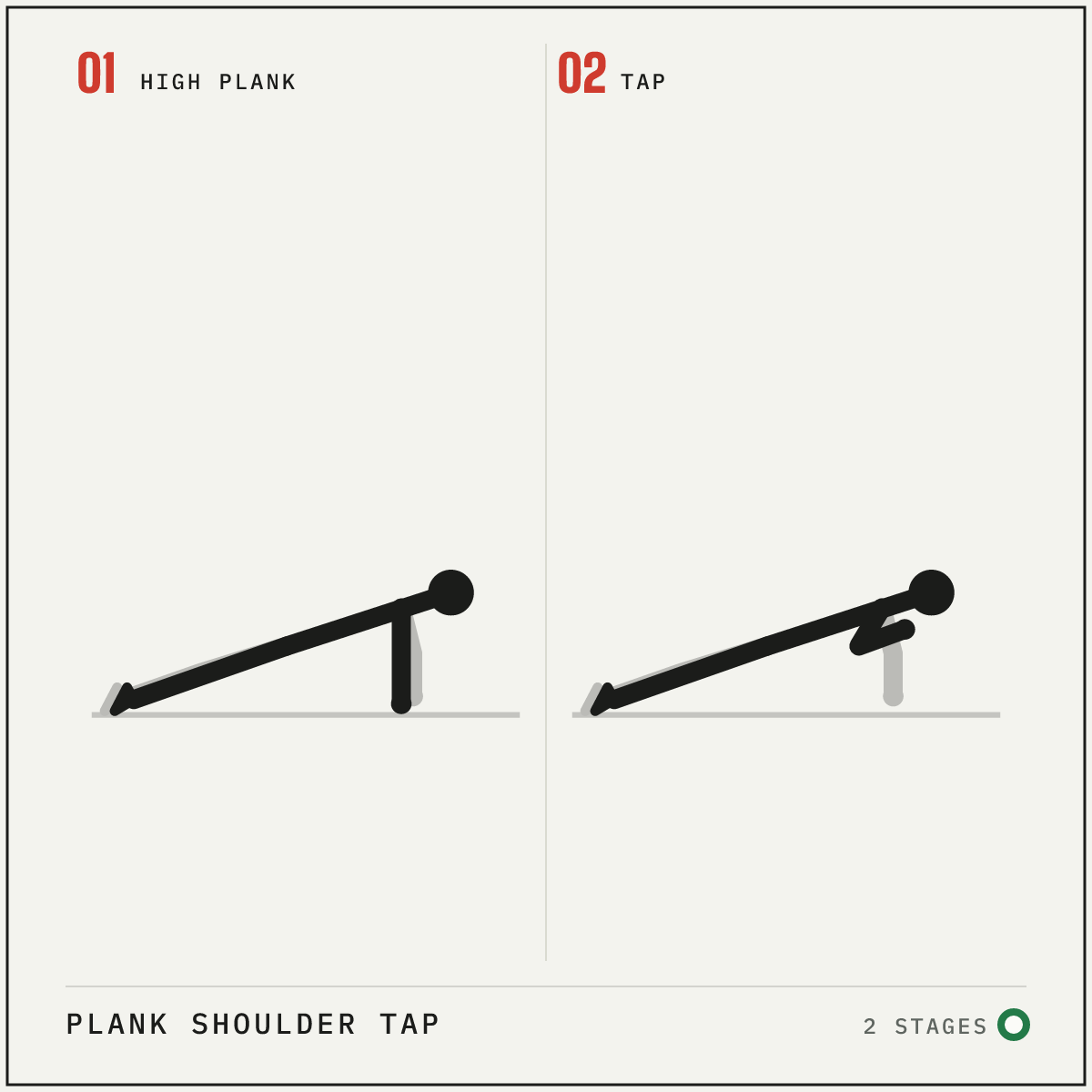
High plank
01 High plank
Hands under the shoulders, feet about shoulder-width apart, body one line from head to heels.
02 Tap
Lift one hand to the opposite shoulder while the hips stay square to the floor.
How to do it
Setup
- Set up in a high plank with your hands under your shoulders and your feet about shoulder-width apart.
- Squeeze your glutes and tighten your stomach so your body holds one line from head to heels.
Execution
- Shift your weight slightly onto one hand without letting the hips move.
- Lift the other hand and touch it to the opposite shoulder.
- Put it back under the shoulder with control, then repeat on the other side.
- Keep the hips level with the floor through each tap.
BreathingBreathe steadily through the set. Do not hold it between taps.
Cues and mistakes
Check every rep
- Hips stay square to the floor as the hand lifts.
- Feet wide to start, narrower as it gets easier.
- Tap slowly, with a full second on each shoulder.
What goes wrong
- Hips swinging toward the planted hand, which makes the tap easy and the exercise pointless.
- Lifting the hips high to shorten the lever.
- Rushing the taps so the trunk never has to hold anything.
Safety
- Wrists take the full load one at a time. If they complain, make a fist on the planted hand or shorten the sets.
General guidance, not medical advice. See how Setkit works.
Notes
Lifting one hand off the floor removes a quarter of your support, and your trunk has to stop the hips from falling toward the gap. That twist is the exercise. A plank asks your stomach to resist sagging. The shoulder tap asks it to resist turning, which is the same demand a carry, a single-arm press or a row puts on it, and almost nothing else in bodyweight training trains it.
Foot width sets the difficulty. Wide feet give a stable base and an easy tap. Feet together leave the body balanced on two points, and the hips fight to stay square. Walk the feet in a little each week, and when touching the feet together is comfortable, raise them onto a step. The same movement keeps getting harder without a single extra rep.
Watch for the hips rotating toward the planted hand. Most people cannot feel it happen, so set a phone camera on the floor or ask someone to watch the hips from behind. If they turn, slow the tap down or widen the feet until they hold still through the whole set.