Copenhagen plank
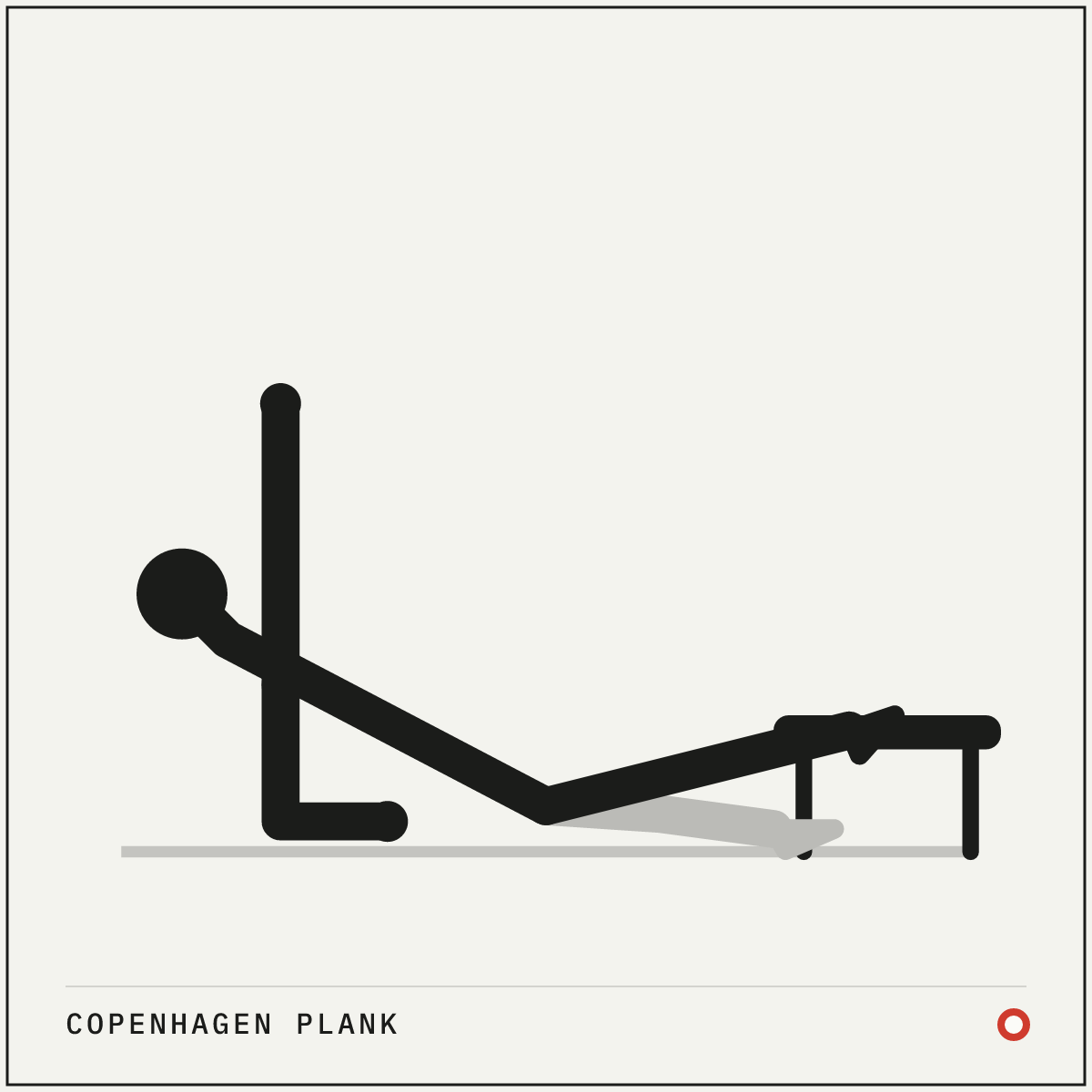
A side plank with your top foot on a bench and nothing under the bottom leg. The inner thigh holds you up.
The movement
2 stages
Set
01 Set
Elbow under the shoulder, top foot on the bench, hips still low.
02 Hold
Press the top foot into the bench and lift the hips into one tilted line.
How to do it
Setup
- Lie on your side beside a bench with your elbow under your shoulder, forearm flat on the floor.
- Place the inside edge of your top foot on the bench, leg straight.
- Let your bottom leg rest under the bench for now.
Execution
- Press the top foot down into the bench and lift your hips until your body forms one straight, tilted line.
- Raise the bottom leg so it hovers under the bench, holding nothing.
- Hold, breathing steadily, then lower with control and switch sides.
Cues and mistakes
Check every rep
- Squeeze the bench with the top leg. That squeeze is the exercise.
- Hips forward and high, in line from ankle to shoulder.
What goes wrong
- Hips dipping toward the floor as the inner thigh tires.
- Bending at the waist so the body folds instead of holding one line.
- Resting the bottom leg on the bench without noticing.
Safety
- The inner thigh muscles are rarely trained this hard and they let you know quickly. Start with short holds and the knee, rather than the foot, on the bench, and add seconds before you add length.
General guidance, not medical advice. See how Setkit works.
Notes
The Copenhagen plank hands the side plank’s job to the muscles of your inner thigh. With the top foot on a bench and the bottom leg hanging free, the only thing holding your hips off the floor is the top leg squeezing down and in. Nothing else in the library trains the adductors, the big muscles along the inside of your thigh, with anything like this intensity.
Those muscles matter more than their reputation suggests. They stabilize every lunge, squat and change of direction, and this exercise became standard in football training because loading them directly protects the groin from the sprint-and-cut work that usually injures it. The obliques still work exactly as they do in a side plank. The inner thigh is simply added to the bill.
Scale it by lever length. The knee on the bench is the sensible start, the foot on the bench is the full exercise, and a straighter, longer body makes every version harder. Ten full seconds a side is a respectable first goal. Treat it like the side plank’s next rung, not a replacement, and give the weaker side the first hold.