Suspension fallout
A standing hold where your arms reach overhead and your trunk refuses to arch. The hardest core work most people can do without a wheel.
TrainsCore
NeedsSuspension trainer
The movement
2 stages
Braced and leaning
01 Braced and leaning
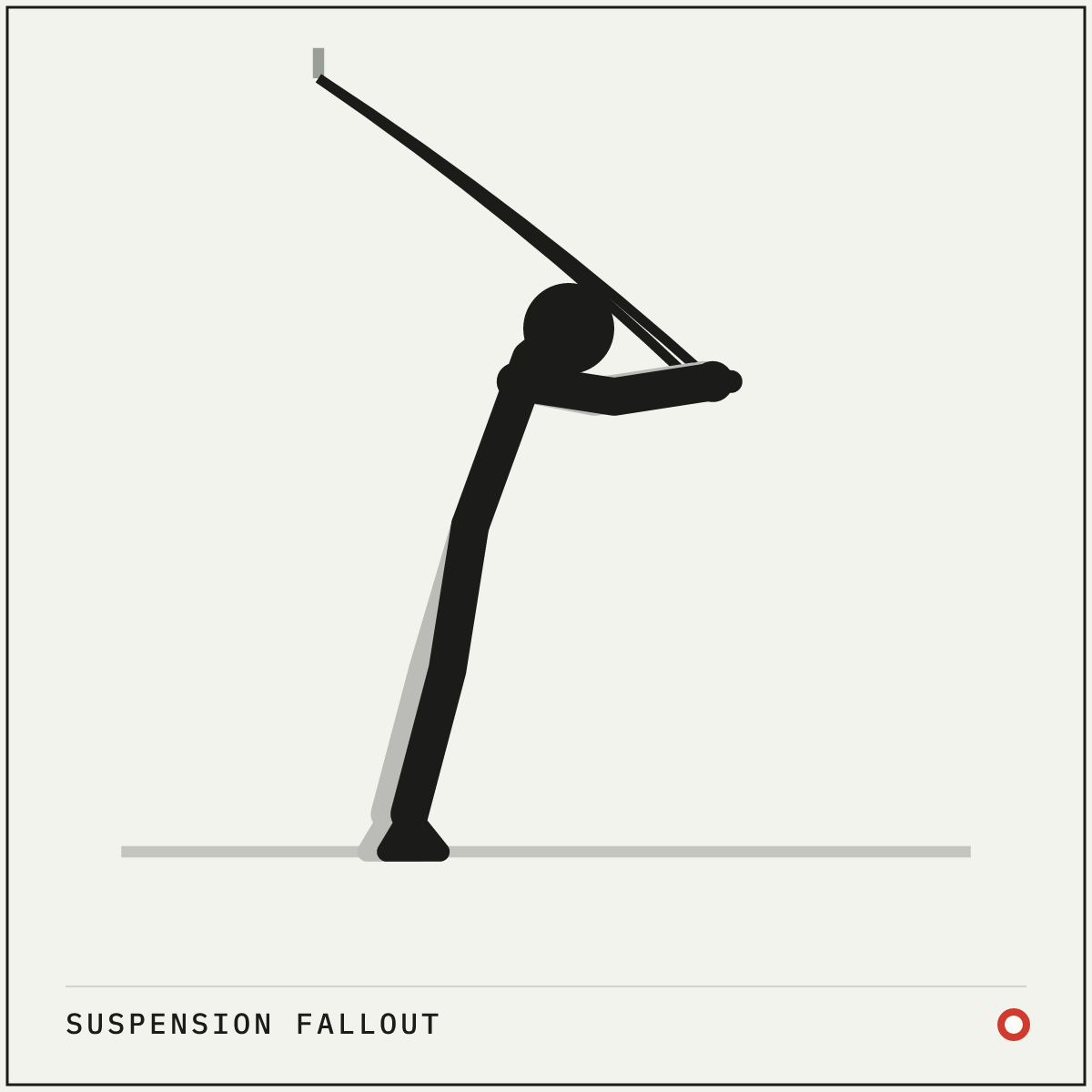
Arms straight ahead at chest height, ribs stitched down to the hips.
02 Arms overhead
Reach until the arms line up with the body. Stop the instant the lower back starts to arch.
How to do it
Setup
- Face away from the anchor holding a handle in each hand, arms straight ahead at chest height.
- Walk your feet back until you are leaning forward onto the straps.
- Tighten your trunk and squeeze your glutes so you form one line from heels to head.
Execution
- Keeping your arms straight, let them travel forward and up until they reach overhead.
- Go only as far as you can without your lower back arching or your hips sagging.
- Pull your arms back down in front of your chest by tightening your trunk, not by folding at the hips.
BreathingInhale before you reach, hold the brace through the range, exhale as you return.
Cues and mistakes
Check every rep
- Keep your ribs down and your hips in line the whole way out.
- Move at the shoulders only; your spine does not change shape.
What goes wrong
- Reaching past the point where your hips drop, which loads your lower back instead of your stomach.
- Bending at the hips to return, which turns it into a shoulder exercise.
- Picking a lean based on what your arms can do rather than where your brace still holds.
Safety
- Your lower back is what is at risk here. The moment you feel it start to arch, that is the end of the range and the end of the set.
General guidance, not medical advice. See how Setkit works.
Notes
Most core training asks your trunk to move. The fallout asks it to refuse, holding your ribs and hips together while your arms travel overhead and your spine is pushed toward arching. That is the job your trunk actually does under a heavy squat or an overhead press, which is why it carries over better than any amount of crunching.
Your lower back sets the range, not your shoulders. Almost everyone can physically reach further than they can hold a brace, and reaching into that extra distance is the whole failure. Your hips drop, your lower back arches, and a demanding trunk exercise becomes a loaded back stretch. Stop where the line breaks and it stays worth doing.
It is an advanced exercise, and the difficulty changes sharply with foot position. Half a step back alters the leverage far more than it would on a strap row. If you cannot hold a strict plank for forty seconds, build that first, because a fallout is a plank with a much longer lever and no quiet way to cheat.
Coming back is the half people skip. The return should come from your trunk pulling your ribs down while your arms stay long. If your hips break first, the rep did not train what it was meant to.