Cossack squat
A deep side-to-side squat, shifting from one bent leg to one straight leg. Leg strength and hip range in one movement.
NeedsBodyweight
The movement
2 stages
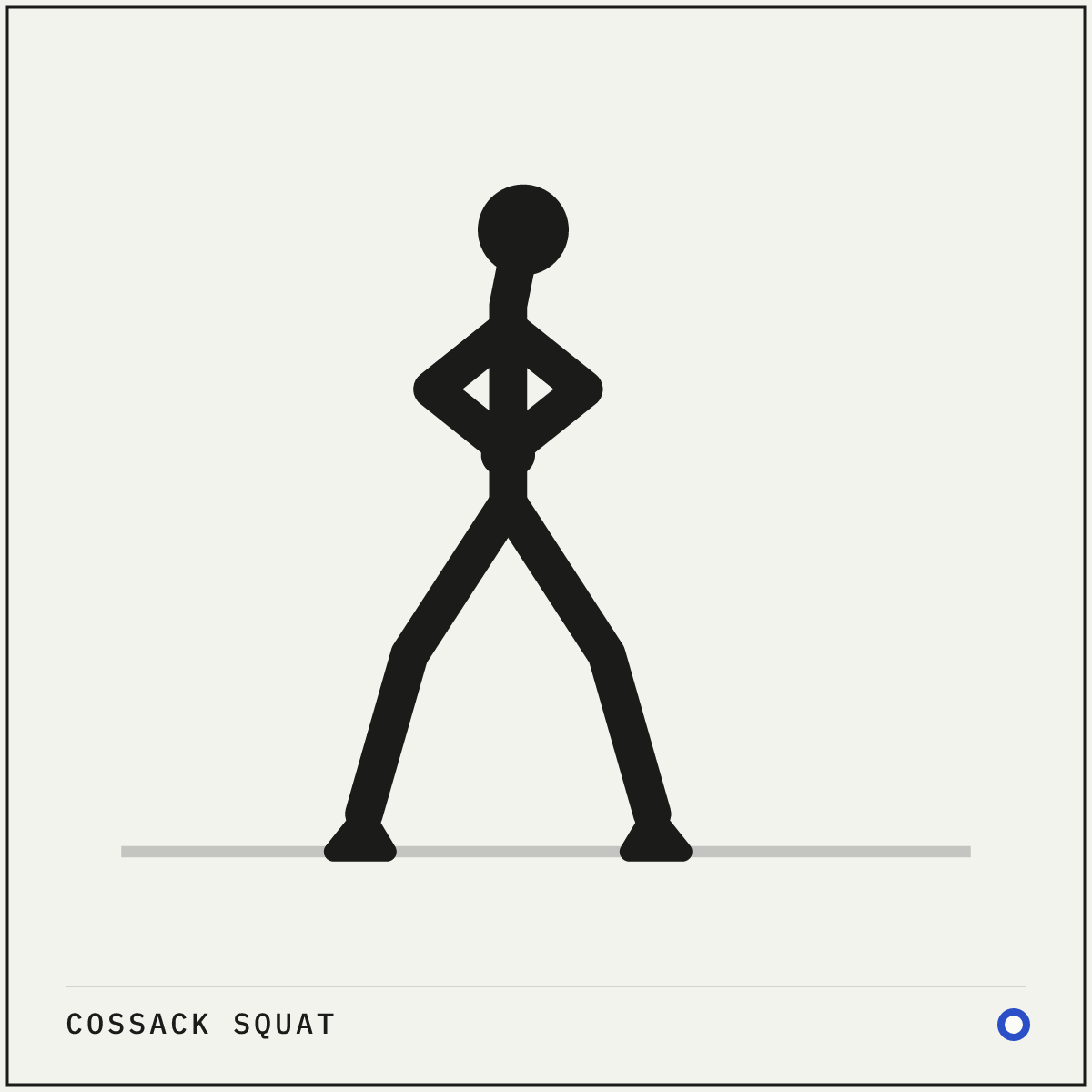
Wide stance
01 Wide stance
Set the feet much wider than the shoulders with the toes turned slightly out.
02 Sink over one side
Sit down over one leg while the other goes long with its toes turned up. Both heels stay down.
How to do it
Setup
- Stand with your feet much wider than shoulder-width, toes pointing slightly out.
- Hold your arms in front of you to help you balance.
Execution
- Shift your weight onto one leg and squat down over that side, bending that knee.
- Let the other leg straighten with its toes pointing up, keeping both heels on the floor.
- Push back to the middle, then repeat to the other side.
BreathingInhale as you lower to one side, exhale as you push back to the middle.
Cues and mistakes
Check every rep
- Sit into one hip and let the other leg straighten.
- Both heels stay on the floor the whole time.
What goes wrong
- Letting the working heel lift, which shortens the range and rolls your ankle inward.
- Rounding forward over the working leg instead of sitting your hips back and down.
- Bouncing side to side rather than pausing where the position is hardest.
Safety
- This trains a range most people rarely use, so build it slowly. Depth bought by tipping onto your toes or rounding your back is not depth worth having.
General guidance, not medical advice. See how Setkit works.
Notes
Almost all lower-body training moves in one direction. Squats, hinges and lunges all travel forward and back. The Cossack squat travels sideways, which is how it reaches hip and inner-thigh range that nothing else in a normal program touches. It is also why the first attempt humbles people who squat well.
It is really two exercises at once. The bent leg does a deep single-leg squat, while the straight leg is taken to the end of its range under load. That makes it useful as strength work and as one of the few mobility exercises that builds something rather than only stretching it.
Your heels tell you how much range you actually have. Nearly everyone can get lower by letting the working heel rise and rolling onto the outside of the foot, and that extra depth trains nothing except a position you would not want to be loaded in. Stopping where both heels stay flat gives you a shallower squat and a better one.
Holding a light weight at your chest makes this easier rather than harder, for the same reason a goblet squat is easier than a bodyweight one. The counterweight lets you sit back further without falling over. Start there, and do the unloaded version later.