Bodyweight squat
The basic lower-body movement. A full bend of the knees and hips, no equipment, useful forever.
NeedsBodyweight
The movement
2 stages
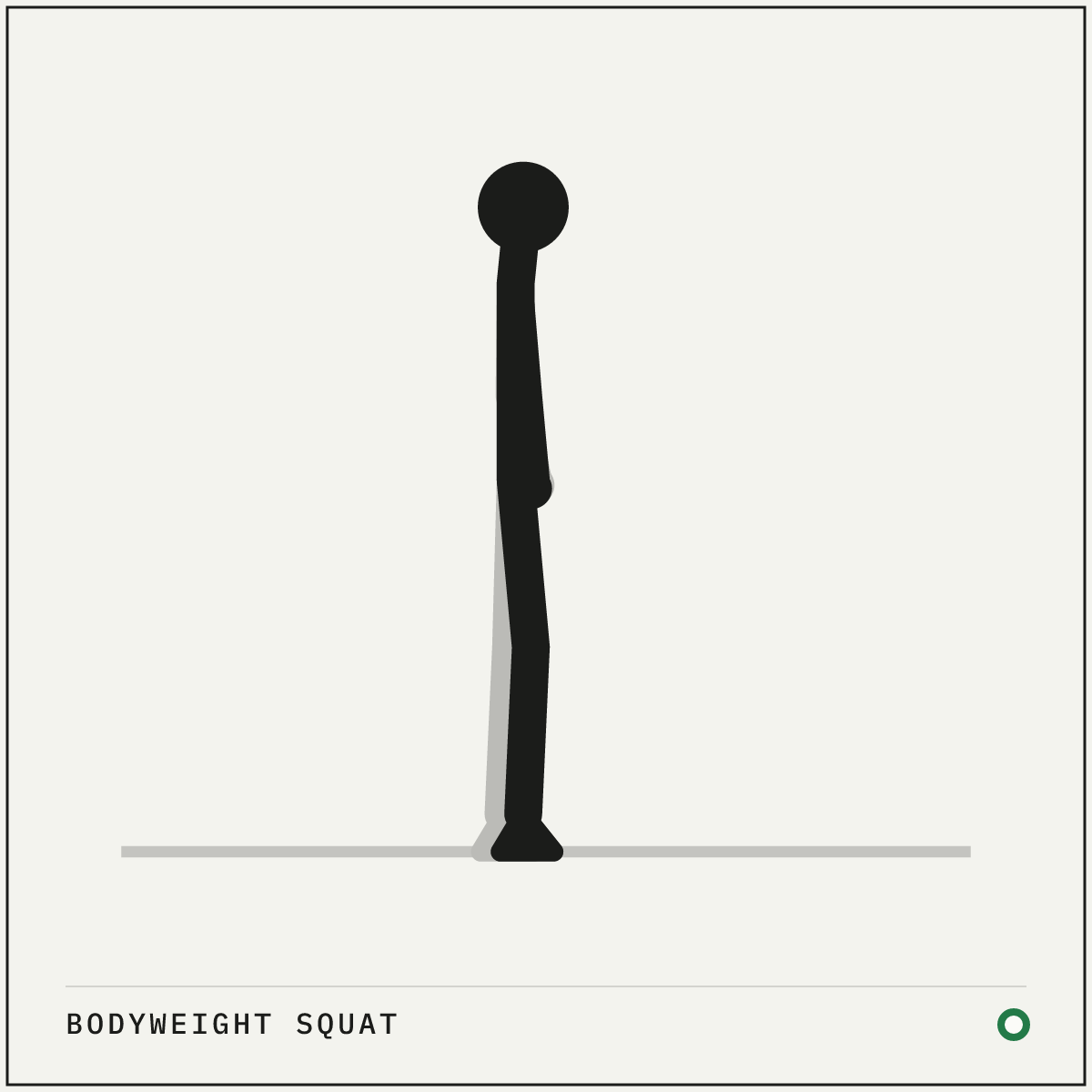
Stand tall
01 Stand tall
Feet shoulder-width, toes slightly out, weight over mid-foot.
02 Bottom
Hips at or below knee height, chest up, heels planted.
How to do it
Setup
- Stand with your feet shoulder-width apart and your toes turned out slightly.
- Hold your arms out in front or crossed at your chest for balance.
- Take a breath and tighten your stomach before you go down.
Execution
- Bend your knees and hips together, sitting down between your heels.
- Go as deep as you can with your heels down and your chest up.
- Push through your whole foot to stand all the way back up.
BreathingInhale on the way down, exhale as you drive up.
Cues and mistakes
Check every rep
- Knees track in line with your toes, pushed outward.
- Sit down between your heels rather than folding at the waist.
What goes wrong
- Heels lifting, which tips your weight onto your toes.
- Stopping at a quarter of the way down when you could go deeper.
- Knees falling inward on the way up.
Safety
- Build depth rather than forcing it. Go as deep as you can control today and extend it over time.
General guidance, not medical advice. See how Setkit works.
Notes
Squatting all the way down with your heels on the floor is a basic human position before it is an exercise. Training it keeps the mobility and leg strength that everything else in the lower body is built on, and for a beginner it produces real strength on its own for months.
Good form is more individual than diagrams suggest. How wide you stand, how far your toes point out, and how much your torso leans all depend on your proportions. The parts that do not vary are heels down, knees tracking over your toes, and a back that stays long instead of rounding at the bottom.
Once sets of twenty feel comfortable, the bodyweight squat becomes a warm-up and conditioning exercise while goblet squats or split squats take over the strength work. It stays in your program as the warm-up and as the conditioning piece.