Reverse lunge
Step back, lower, and drive up. The kindest lunge for knees and balance, working one leg at a time.
NeedsBodyweight
The movement
2 stages
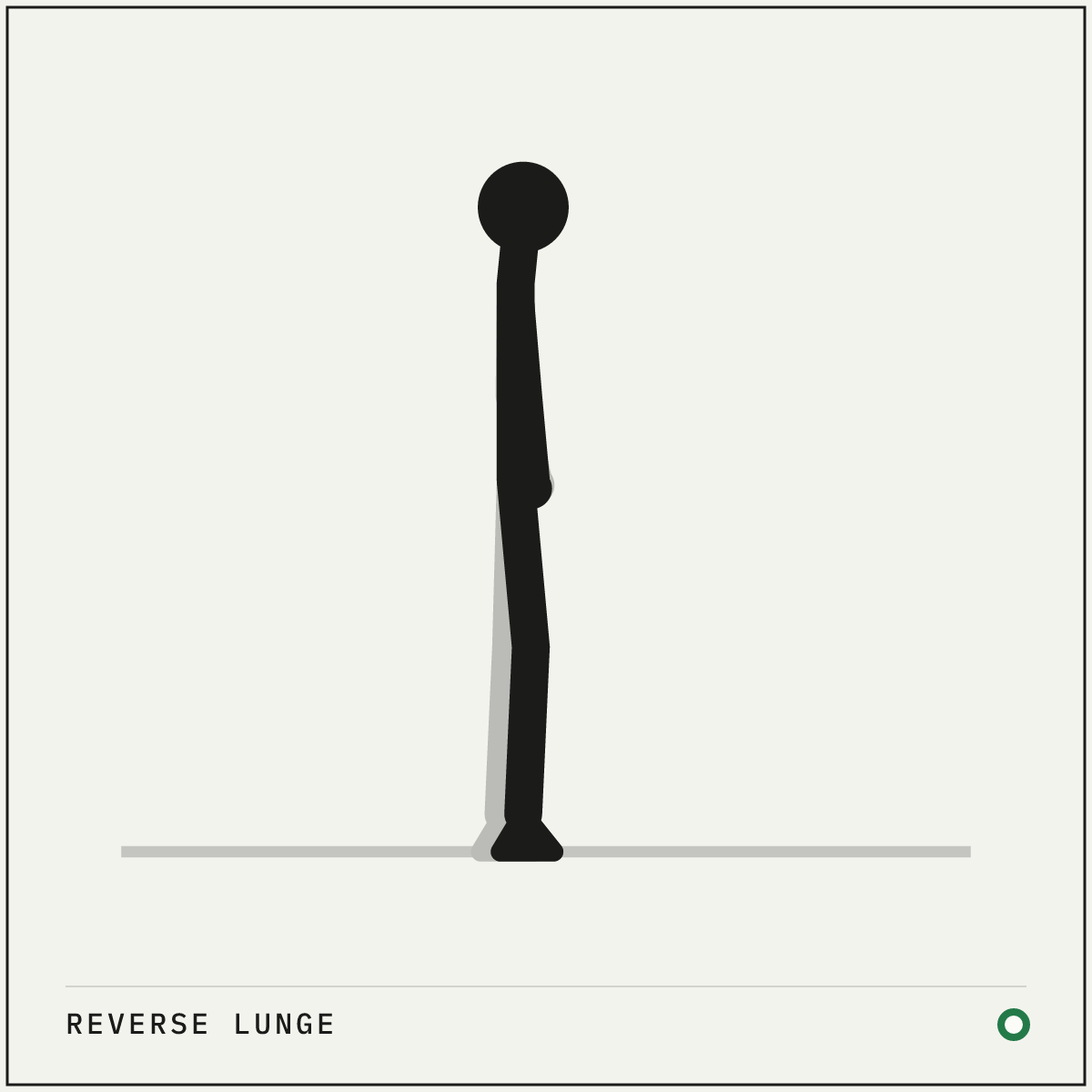
Stand tall
01 Stand tall
Feet hip-width, eyes forward.
02 Bottom
Step back and lower the rear knee to just above the floor.
How to do it
Setup
- Stand tall with your feet hip-width apart and your hands at your sides or on your hips.
- Fix your eyes on a point ahead of you to help your balance.
Execution
- Step one foot back about a metre, landing on the ball of that foot.
- Lower straight down until your rear knee hovers just above the floor.
- Drive through your front heel to return to standing.
- Do all your reps on one side, or alternate legs.
BreathingInhale as you step back, exhale as you drive up.
Cues and mistakes
Check every rep
- Drop straight down rather than travelling forward.
- Keep your front shin close to vertical.
What goes wrong
- Stepping back too short, which cramps the stance and loads the front knee.
- Pushing off your back foot instead of driving through your front leg.
- Letting your torso tip forward.
Safety
- If your balance is shaky, do these beside a wall or chair and rest your fingertips on it.
General guidance, not medical advice. See how Setkit works.
Notes
Of all the lunges, stepping backward is the gentlest. Your front shin stays vertical, the knee is loaded lightly, and balancing is easier than in the forward version because your bodyweight never has to catch a moving landing. That makes the reverse lunge the right first single-leg exercise for almost everyone.
Single-leg work matters because life and sport happen one leg at a time, and because two-legged squats let a stronger side quietly carry a weaker one. Lunges show the difference immediately. Expect one side to wobble more at first, and train that side first while you are fresh.
Add weight by holding dumbbells at your sides once bodyweight sets of ten feel steady. From there the path runs to the split squat and then to the Bulgarian split squat, with each step trading some stability for a lot more work on the leg.