Skater hop
A sideways bound from one foot to the other, landing and steadying each time. Sideways power and single-leg landing strength.
NeedsBodyweight
The movement
3 stages
Loaded on one leg
01 Loaded on one leg
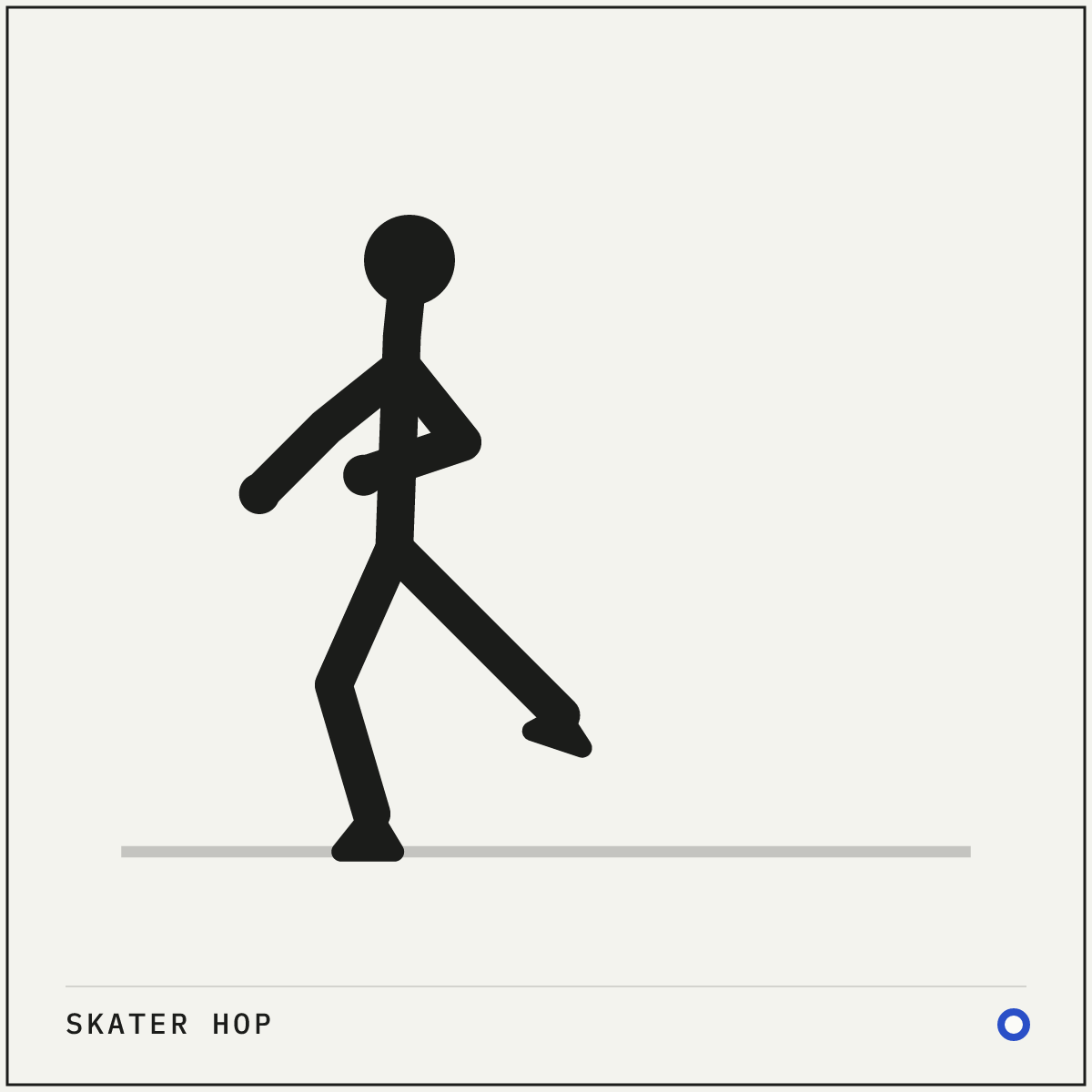
Sit into a half squat with all your weight over the planted foot, the free leg swept clear of the floor.
02 Airborne phase
Push sideways off the planted leg, driving for distance across the floor rather than height.
03 Landed and quiet
Absorb the landing on a soft, flat foot with the knee tracking over the toes, and hold still before bounding back.
How to do it
Setup
- Stand on one leg with a soft knee and enough clear floor to bound sideways.
- Let your free leg trail behind you rather than hang beside you.
Execution
- Push off sideways from your standing leg and bound across onto the other foot.
- Land on a soft, bent knee with your foot flat, and absorb the landing before moving.
- Pause until you are balanced, then bound back the other way.
BreathingExhale as you push off, and breathe normally between bounds.
Cues and mistakes
Check every rep
- Land softly and hold the landing for a beat.
- Push sideways for distance rather than upward for height.
What goes wrong
- Bounding straight back before you have controlled the landing, which trains rhythm instead of strength.
- Letting your landing knee collapse inward, which is the exact position this exercise is meant to train out of.
- Landing on the ball of your foot with a stiff knee instead of absorbing it through a flat foot.
Safety
- The landing is where injuries happen, not the jump. Keep the bound short enough to control every landing, and end the set the moment your knee starts caving inward.
General guidance, not medical advice. See how Setkit works.
Notes
Nearly all jumping happens forward and upward. The skater hop moves sideways, which loads the glutes in the job they are worst at and train least, which is stopping the leg from collapsing inward. That is what fails when an ankle rolls or a knee caves, and it improves with very little work, because almost nobody does any.
The landing is the exercise, not the jump. Pushing off is easy. Arriving on one leg and stopping dead needs the glute to fire hard and hold. Bounding straight back the other way skips all of that and turns the set into a bounce that trains your tendons and nothing else. A one-second pause on each landing changes what you get from it.
Aim for distance rather than height. Height sends the landing force straight down through a stiff leg. Distance keeps the movement sideways, which is where the value is. Most people jump too far on the first few reps and find the landing is beyond them.
Progress by widening the bound and holding the pause longer, and treat a knee that starts caving as the end of the set. This is deliberately low-volume work. Sets of six to ten bounds per side done well do more than long tiring sets where every landing is slightly worse than the last.