Band overhead triceps extension
An overhead extension against band tension. Stretches the long head of the triceps with resistance that grows as you press.
TrainsTriceps
NeedsResistance band
The movement
2 stages
Locked overhead
01 Locked overhead
Stand tall with the band pressed straight overhead and the ribs pulled down.
02 Hands behind the head
Bend only at the elbows so your hands lower behind the head; the upper arms stay pointing up.
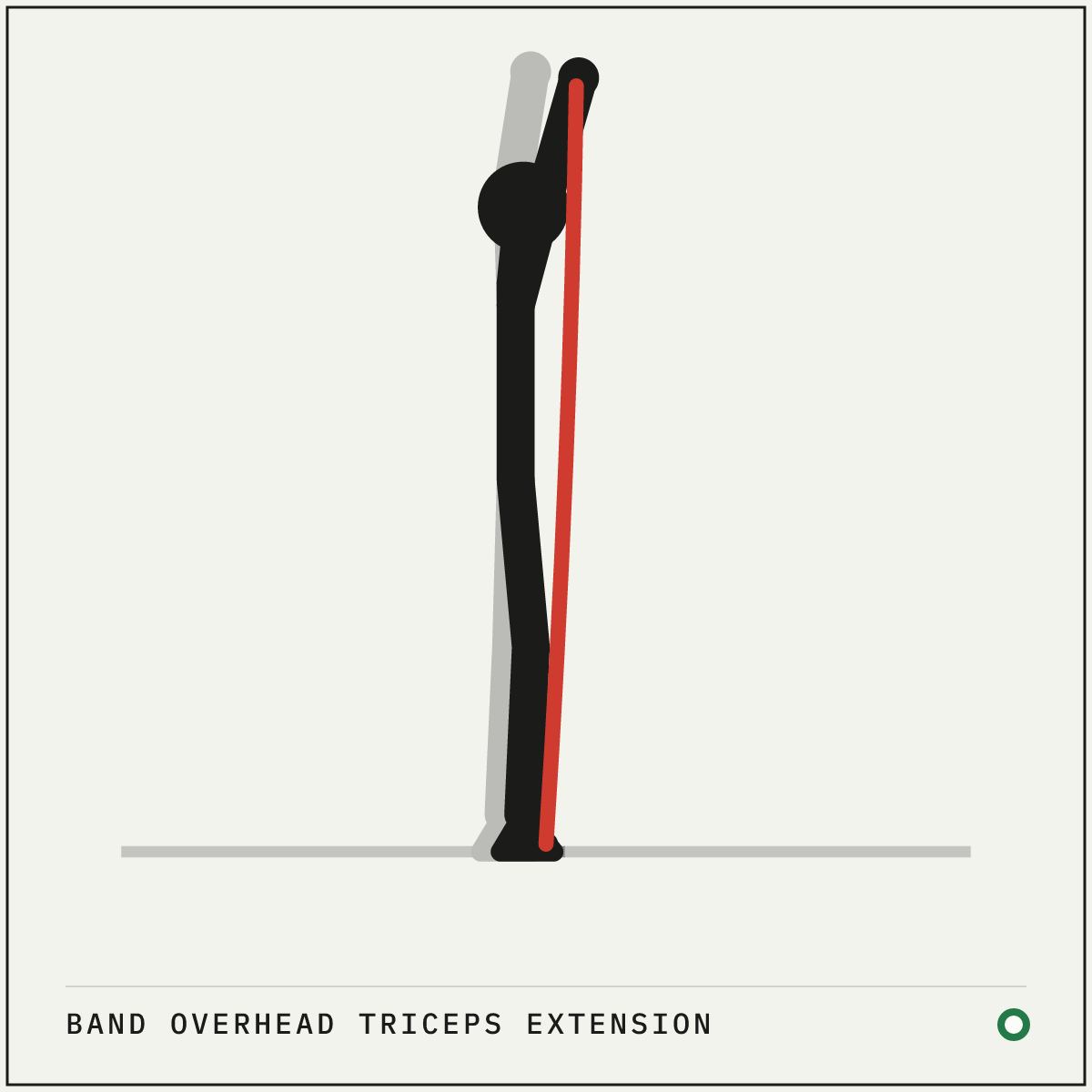
How to do it
Setup
- Stand on the middle of a resistance band and hold an end in each hand.
- Bring your hands behind your head, elbows pointing straight up at the ceiling.
- Pull your ribs down and squeeze your glutes so your body is a solid base.
Execution
- Press your hands straight up toward the ceiling until your elbows lock.
- Squeeze your triceps at the top where the band is tightest.
- Lower under control, bending only at the elbows until your hands are behind your head again.
BreathingInhale as your hands lower behind your head, exhale as you press up.
Cues and mistakes
Check every rep
- Keep your upper arms locked pointing straight up; only your forearms move.
- Resist the band on the way down, do not let it snap your hands back.
What goes wrong
- Letting the elbows drift wide, which shifts the work to the shoulders.
- Arching the lower back as the band gets tight at the top of the rep.
- Cutting the range short and not locking out the elbows at the finish.
Safety
- Check the band for nicks or tears before stretching it overhead. A band that snaps under tension will whip back.
General guidance, not medical advice. See how Setkit works.
Notes
The triceps has three heads, and the long head only gets fully stretched when your arm is overhead. That makes an overhead extension fundamentally different from a pushdown or a press. If your band setup only has pushdowns, adding this movement trains the part of the arm you are missing.
Using a band rather than a dumbbell changes how the exercise feels. A band pulls hardest at full stretch, which means the hardest part of the rep is at the top when your arms are straight. A free weight is hardest at the bottom. This makes the band version especially good at teaching a hard lockout, because you have to fight for the last few inches.
Elbow position is the entire technique. The moment your elbows flare out or point forward instead of up, the tension leaves the triceps and your shoulders take over. That cheat happens exactly when the band gets heavy, so it is the thing to watch for as the set gets hard. Keep them tucked in and pointing at the ceiling.