Floor triceps extension
A bodyweight extension pushing your body away from the floor. Heavy, scalable triceps isolation.
TrainsTriceps
NeedsBodyweight
The movement
2 stages
Arms straight
01 Arms straight
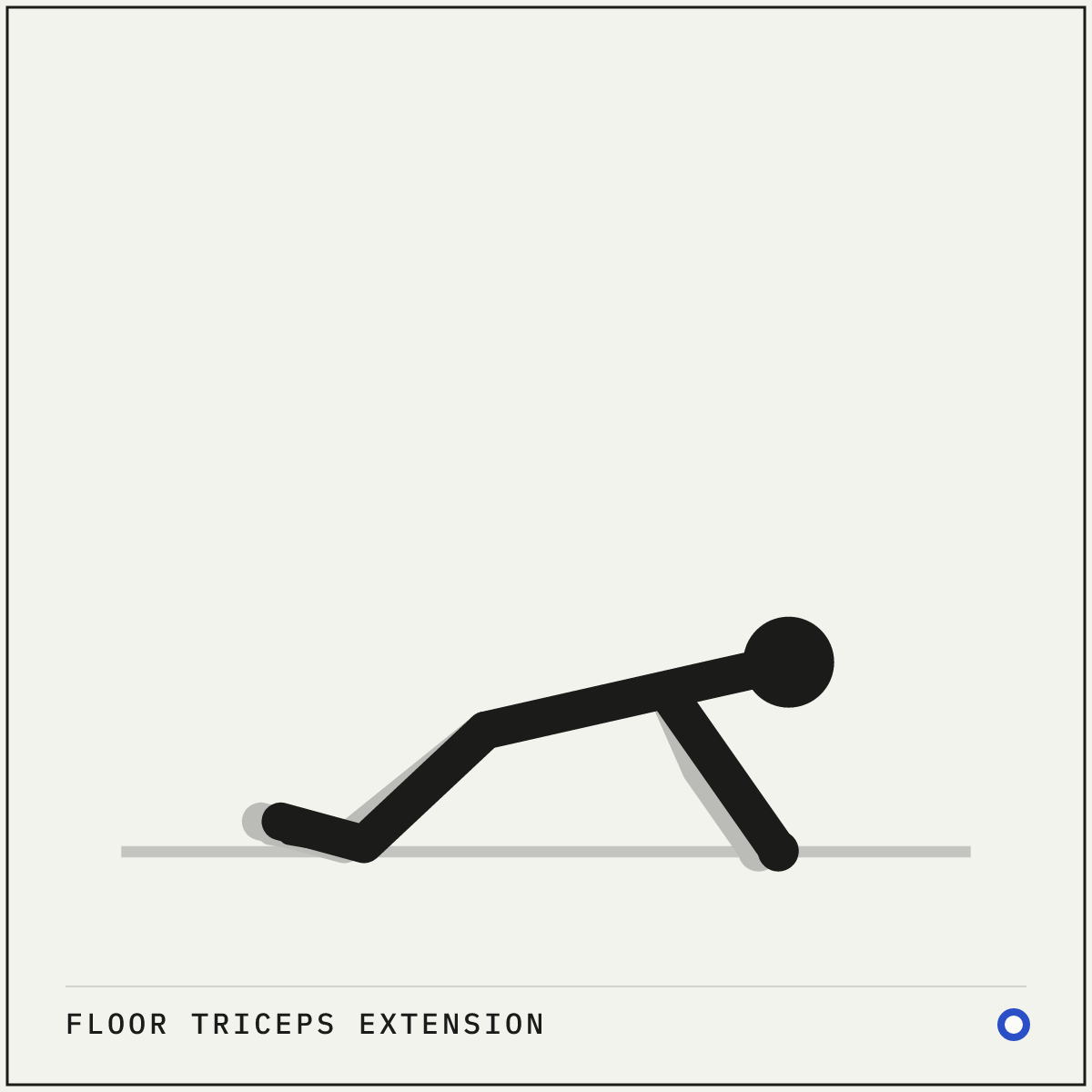
Kneeling with hands planted shoulder-width apart, body in a straight line.
02 Elbows to the floor
Bend the elbows to lower your forearms flat to the ground.
How to do it
Setup
- Kneel on the floor and plant your hands slightly in front of your shoulders.
- Walk your knees back until your body forms a straight line from head to knees.
Execution
- Bend your elbows and lower your forearms until they touch the floor.
- Pause briefly at the bottom.
- Press through your hands to straighten your arms and return to the start.
BreathingInhale as you lower, exhale as you press.
Cues and mistakes
Check every rep
- Keep your elbows tucked in, tracking straight back toward your knees.
- Keep your core tight so your hips do not sag as you press.
What goes wrong
- Letting the elbows flare out to the sides, which turns the movement into a push-up and robs the triceps.
- Piking the hips to push back up, taking the weight off the arms.
Safety
- If you feel stress in the elbow joint, move your hands closer to your knees to reduce the leverage.
General guidance, not medical advice. See how Setkit works.
Notes
The floor triceps extension is a bodyweight skull crusher. By fixing your hands and moving your body, you load the triceps heavily without needing any equipment. It fills the gap for a heavy bodyweight triceps isolation that the bench dip cannot safely cover.
Leverage dictates the difficulty. Moving your hands further from your knees makes the movement dramatically harder. If kneeling is too easy, perform the movement from your feet, exactly like a push-up. If kneeling is too hard, perform it with your hands elevated on a bench or against a wall.
Form breaks down when the triceps fail. The hips sag, the elbows flare, and the body tries to turn the movement into a chest press to survive. Keep the elbows tucked tight and the body straight. When you can no longer press back up with strict form, the set is over.