Incline dumbbell triceps extension
Lying back on a tilted bench and lowering the weights past your head. The same stretch as an overhead extension, without balancing it.
The movement
2 stages
Past the head
01 Past the head
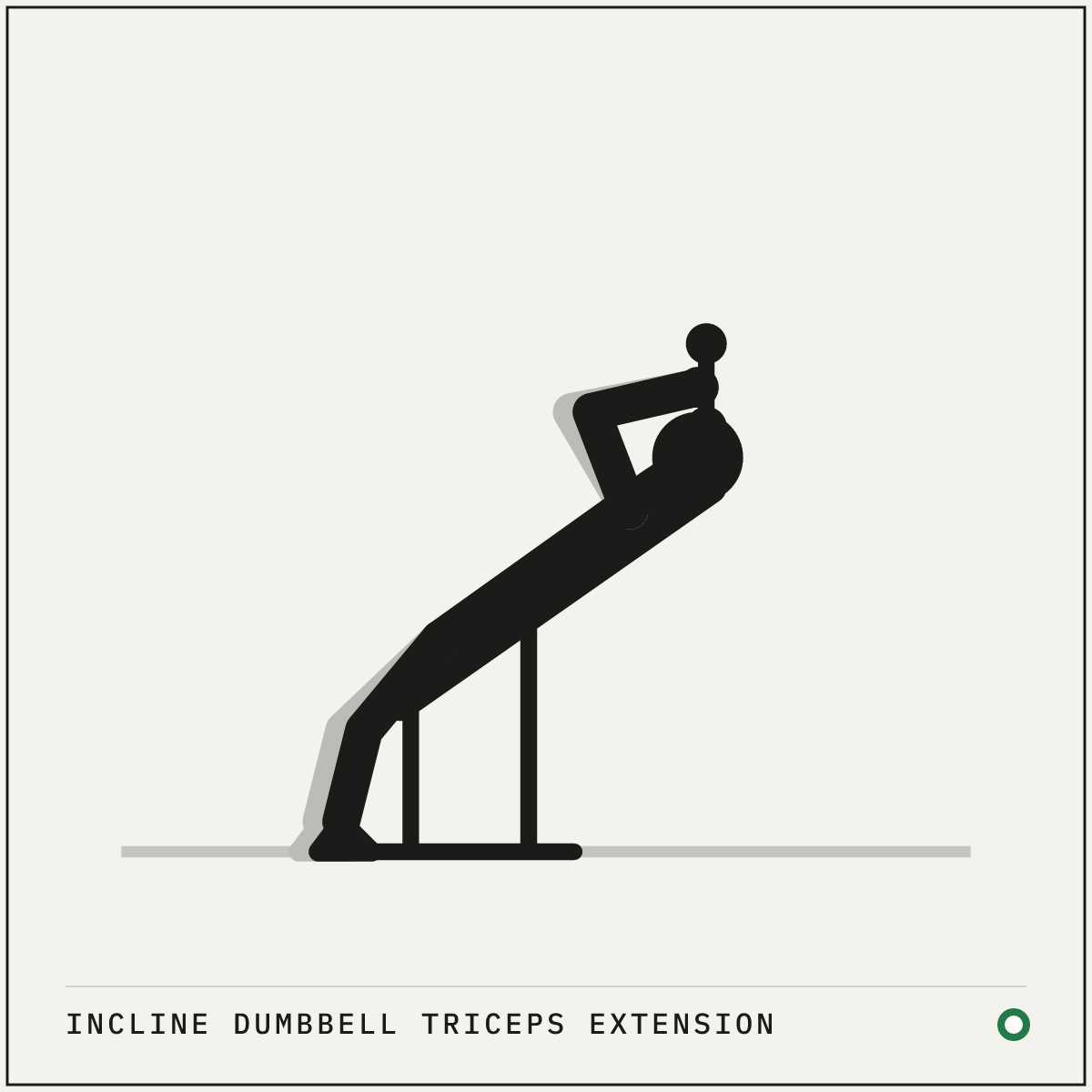
Bend the elbows to lower the weights past the sides of your head, forearms past parallel.
02 Extend
Straighten the arms without letting the elbows drift forward or apart.
How to do it
Setup
- Set the bench to a moderate incline, around 40°, and lie back with a dumbbell in each hand, palms facing each other.
- Press both weights up, then tip your upper arms back so they point up and slightly behind you.
- Hold that upper-arm angle, because it does not change for the rest of the set.
Execution
- Bend your elbows to lower both weights past the sides of your head.
- Go down until the back of your arms is stretched and your forearms are past parallel.
- Straighten back up without letting your elbows drift apart or forward.
BreathingInhale as the weights lower, exhale as your arms straighten.
Cues and mistakes
Check every rep
- Elbows stay about shoulder width apart and point at the ceiling.
- Only your forearms move; your upper arms hold their angle.
What goes wrong
- Letting your elbows travel forward on the way up, which turns the extension into a press.
- Flaring your elbows wide as the set gets hard, which shortens the range and loads the joint unevenly.
- Lowering so fast that your elbow has to stop the weights rather than your muscle.
Safety
- The weights travel beside your head, so grip them firmly and end the set while you can still control the descent. Two dumbbells are easier to bail out of sideways than one bar.
General guidance, not medical advice. See how Setkit works.
Notes
The largest part of the triceps crosses your shoulder as well as your elbow, so it only stretches fully when your upper arm is overhead or behind you. That is why overhead extensions build the back of the arm in a way that pushdowns and dips do not. Doing the same movement lying back on an incline keeps the stretch and removes the balancing problem.
Standing with a weight overhead means your trunk has to hold the position, and for most people the lower back gives out or the ribs flare before the triceps is properly tired. With your torso against a pad, the only thing that can fail is the muscle you came to train. That is the whole reason to use a bench.
Watch your upper arm. Held still and tipped slightly back, the triceps works through its full range while stretched. Allowed to drift forward as the set gets hard, the movement becomes a narrow press and the shoulders take over. It is the same drift that ruins the standing version, just easier to spot against the pad.
Expect modest weights, and treat the bottom position as the exercise. Reps that stop with your forearms vertical skip the part you picked this version for. Better to use lighter dumbbells and finish every rep past parallel.