Skull crusher
Lying on a bench, the bar lowers to your forehead and the triceps press it back up. Heavy, direct triceps work.
The movement
2 stages
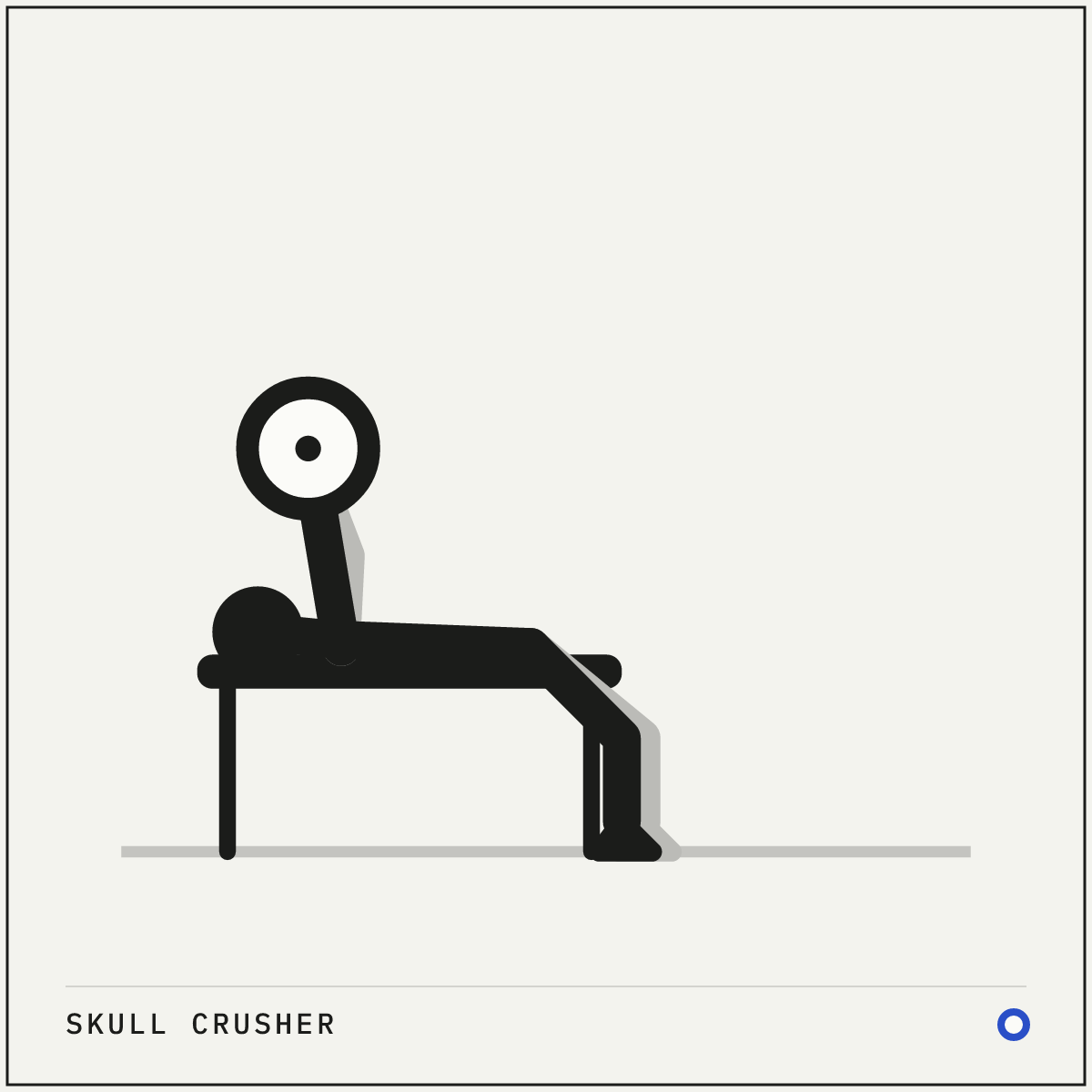
Arms vertical
01 Arms vertical
Bar over the shoulders, upper arms angled slightly back and held still.
02 Bar to the forehead
Bend only the elbows and lower the bar toward the forehead under control.
How to do it
Setup
- Lie on the bench holding the bar over your shoulders with a grip a little inside shoulder width.
- Plant your feet flat and press your upper arms toward vertical, angled slightly back toward your head.
Execution
- Bend only your elbows and lower the bar toward your forehead, or just past it.
- Stop the bar under control an inch above your head.
- Press back to straight arms without letting your elbows drift apart.
BreathingInhale as the bar lowers, exhale as you press.
Cues and mistakes
Check every rep
- Upper arms stay still. The elbows are the only hinge.
- Lower slower than you press.
What goes wrong
- Letting the elbows flare wide, which turns the extension into a strange narrow press.
- Dropping the upper arms toward the bench, which lets the lats and chest sneak in.
- Loading it like a press. The elbows tolerate far less than the shoulders do.
Safety
- The name is a warning about a real failure mode. Keep the reps controlled, stop the set two reps before your elbows get shaky, and never bounce the bar out of the bottom.
General guidance, not medical advice. See how Setkit works.
Notes
The skull crusher is the heaviest pure elbow extension in the library. Lying down takes your torso out of the movement, the bench takes balance out, and everything the bar weighs lands on the triceps alone. Where the close-grip bench press trains the triceps with help from the chest, this leaves them nowhere to hide.
Keeping the upper arms still is the entire technique. The moment they rock back and forth with each rep, part of the load transfers to the shoulders and lats and the triceps get a rest they did not ask for. A slight fixed backward lean of the upper arms is good, because it keeps tension on the triceps at the top. Rocking is the mistake to watch for on every rep.
Elbows set the loading rules here. They are small joints doing lonely work, so add weight in the smallest steps available and stay in the 8–12 range rather than grinding heavy triples. If your elbows nag even at sensible weights, lower the bar behind your head instead of to your forehead. The longer stretch is easier on the joint and at least as productive for the muscle.