Chest-supported dumbbell row
A row with your chest on an incline bench. Removing the lower back and any momentum leaves the back nowhere to hide.
TrainsUpper backLats
The movement
2 stages
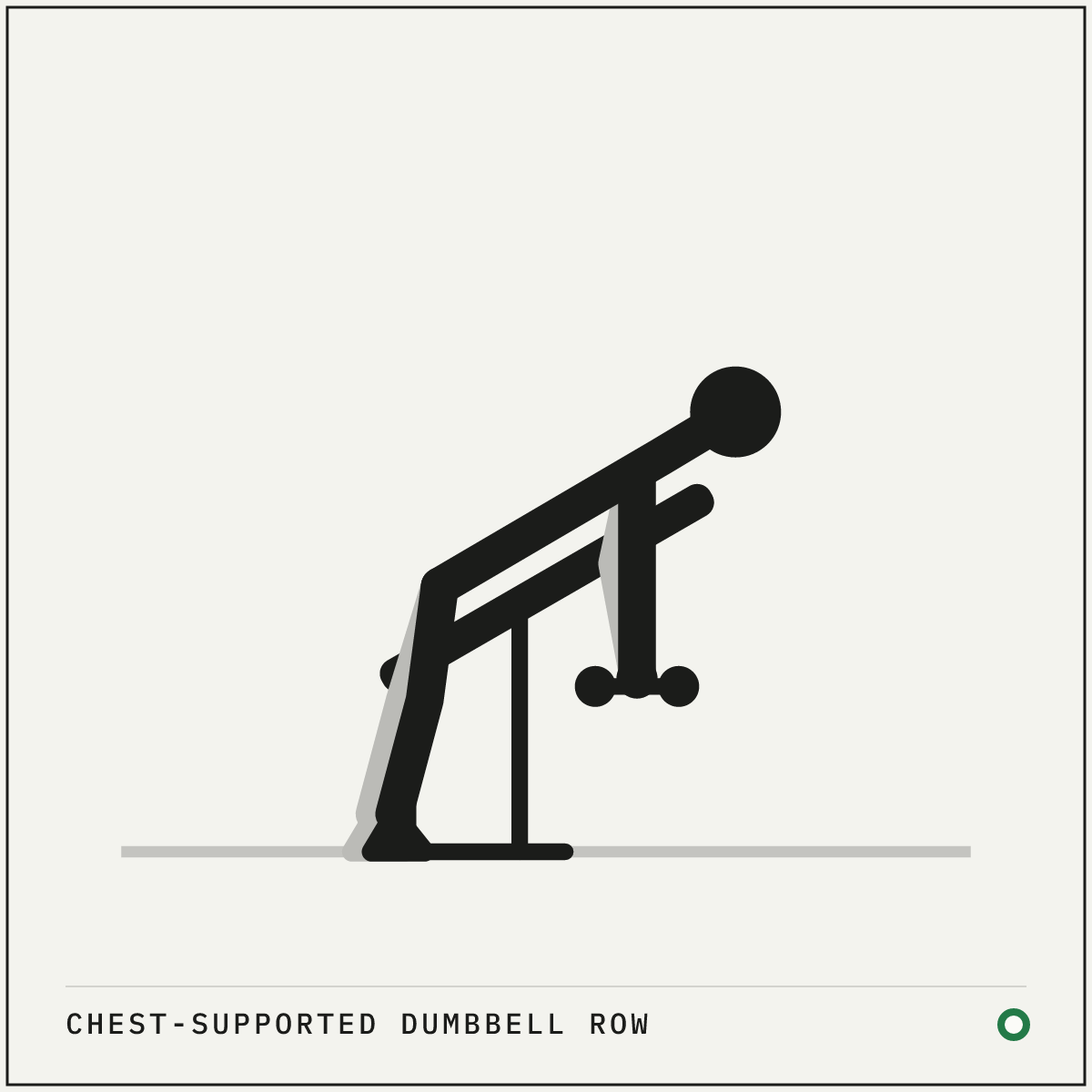
Arms hanging
01 Arms hanging
Chest flat on the pad, weights hanging straight down, shoulder blades spread.
02 Elbows past the ribs
Drive the elbows back and up; the chest never leaves the pad.
How to do it
Setup
- Set a bench to a low incline and lie face down with your chest on the pad.
- Hold a dumbbell in each hand hanging straight down, palms facing each other.
- Let your shoulder blades spread apart at the bottom.
Execution
- Row both dumbbells up by driving your elbows back past your ribs.
- Finish with your shoulder blades pulled together and the weights at your lower ribs.
- Lower all the way until your arms are straight and your shoulder blades spread again.
BreathingExhale as you row, inhale as the weights lower.
Cues and mistakes
Check every rep
- Keep your chest on the bench for every rep.
- Drive your elbows back past your ribs, rather than your hands to your chest.
What goes wrong
- Peeling your chest off the pad to help the weights up, which brings back the cheating this exercise exists to prevent.
- Shrugging your shoulders toward your ears instead of pulling your shoulder blades together.
- Stopping short at the bottom, so your back never stretches under load.
Safety
- With your chest supported there is almost nothing for the lower back to do, which makes this the row to pick when your back is tired or sore from deadlifting.
General guidance, not medical advice. See how Setkit works.
Notes
Every free-weight row is partly a lower-back exercise. Holding yourself bent over under load is real work, and on a heavy barbell row it is often what fails first. Your back rounds, your torso rises, and the set ends while the lats still had reps in them. Putting your chest on a bench takes that out of the equation.
What is left is a row with nowhere to cheat. There is no way to swing the weight up, no way to use your hips, and no way to shorten the range without it being obvious. Most people need noticeably less weight here than on a bent-over row. The gap is the help the other version was getting from your hips and torso.
The trade is that you cannot load it as heavily, and you lose the trunk work that a supported row deliberately removes. This is a partner to barbell rowing rather than a replacement. Use heavy free rows to train the back and hips together, and chest-supported rows to train the upper back on its own.
The bench angle shifts the emphasis. A low incline pulls closer to horizontal and favors the middle of the back. A steeper one moves toward a vertical pull and brings in more lats. Around 30° covers both well enough that most people never need to change it.