Band face pull
A high band pulled apart toward your forehead. High-rep work for the rear shoulders that suits a band better than any weight.
TrainsUpper backShoulders
NeedsResistance band
The movement
2 stages
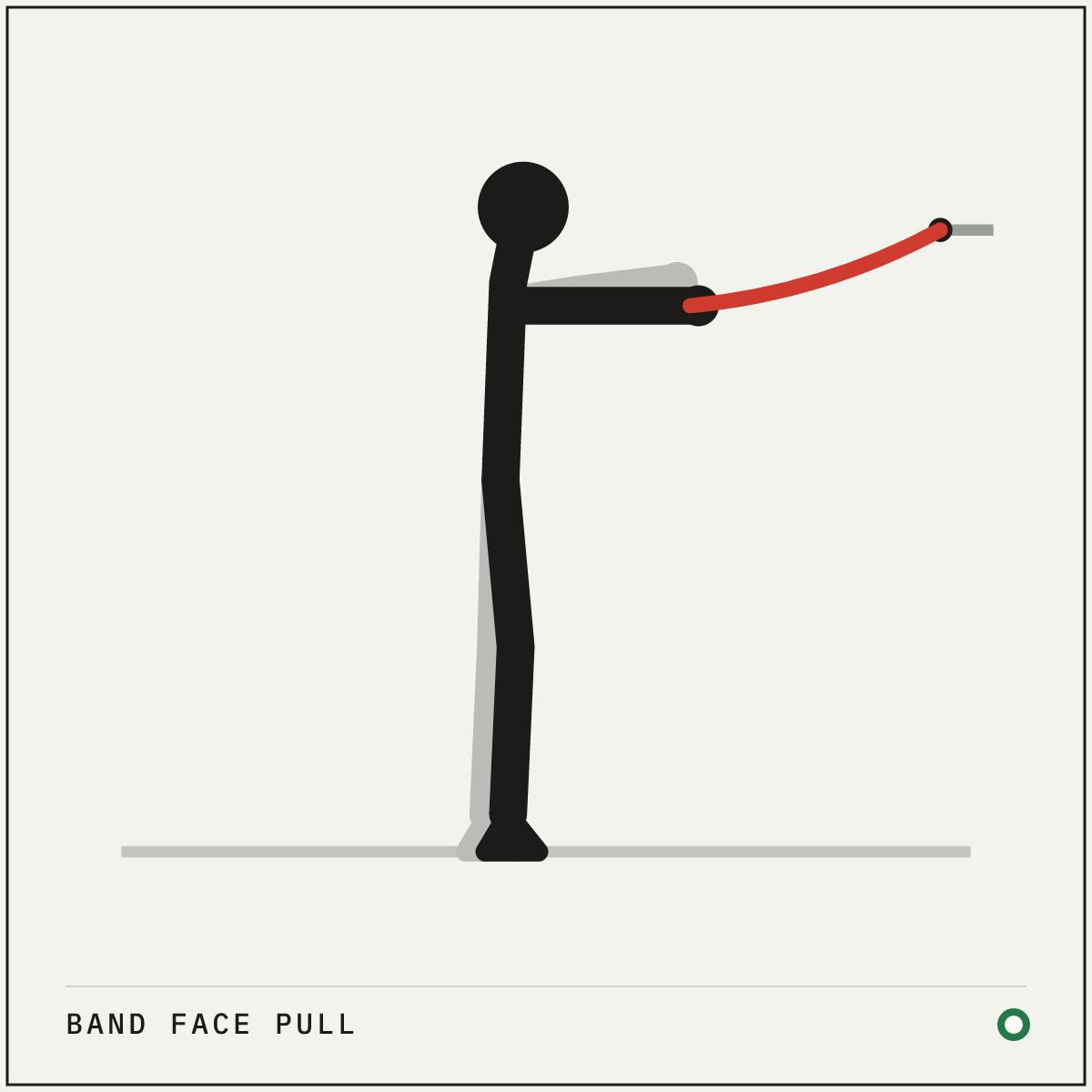
Arms straight
01 Arms straight
Stand tall a step back from the anchor with the band taut and the arms straight ahead.
02 Band to the forehead
Pull the band apart as it travels back, finishing with the elbows high and wide.
How to do it
Setup
- Anchor a band at about head height and take an end in each hand, palms facing down.
- Step back until the band is tight with your arms straight out in front of you.
Execution
- Pull the band toward your forehead, splitting your hands apart as they travel.
- Finish with your hands beside your ears, elbows high and wide, band level with your forehead.
- Return slowly to straight arms without letting your shoulders roll forward.
BreathingExhale as you pull apart, inhale on the return.
Cues and mistakes
Check every rep
- Pull the band apart as you pull it back.
- Finish with your elbows level with your shoulders, wide and high.
What goes wrong
- Letting your elbows drop, which turns it into a narrow row for the lats.
- Leaning back to move a band that is too heavy.
- Not splitting your hands apart, so the rear shoulders never do anything.
Safety
- Check the anchor and the band for nicks before each set. A band that fails under tension snaps back toward your face.
General guidance, not medical advice. See how Setkit works.
Notes
The face pull is the movement most people’s shoulders are missing, and a band suits it better than a cable machine does. A band pulls harder the further it stretches, which matches how your strength changes through the movement. It is easy where your arms are out in front and weak, and hardest at the finish where the rear shoulders are strong. A dumbbell or a cable does the opposite, heaviest where you are weakest.
Two things happen in one rep, and skipping either one loses the point. Your hands travel back toward your head, which is a row. Your hands also travel apart from each other, and that part is what actually works the rear shoulder and the muscles between the shoulder blades. Pulling straight back with your hands close together is a narrow row done at an odd height.
Elbow height tells you whether it is working. High and wide, roughly level with your shoulders, means the rear shoulder is doing the job. Dropped toward your ribs means the lats have taken over. Check it in a mirror once, because from the inside the two feel much the same.
Keep the reps high, twelve to twenty, and pick a band you could manage twenty-five with. There is no version of this exercise that should be a grind, and the shoulders respond far better to volume here than to tension you have to lean into.