Dumbbell rear delt fly
A bent-over fly with light dumbbells. Direct work for the back of the shoulder, which pressing never reaches.
The movement
2 stages
Hinged, arms hanging
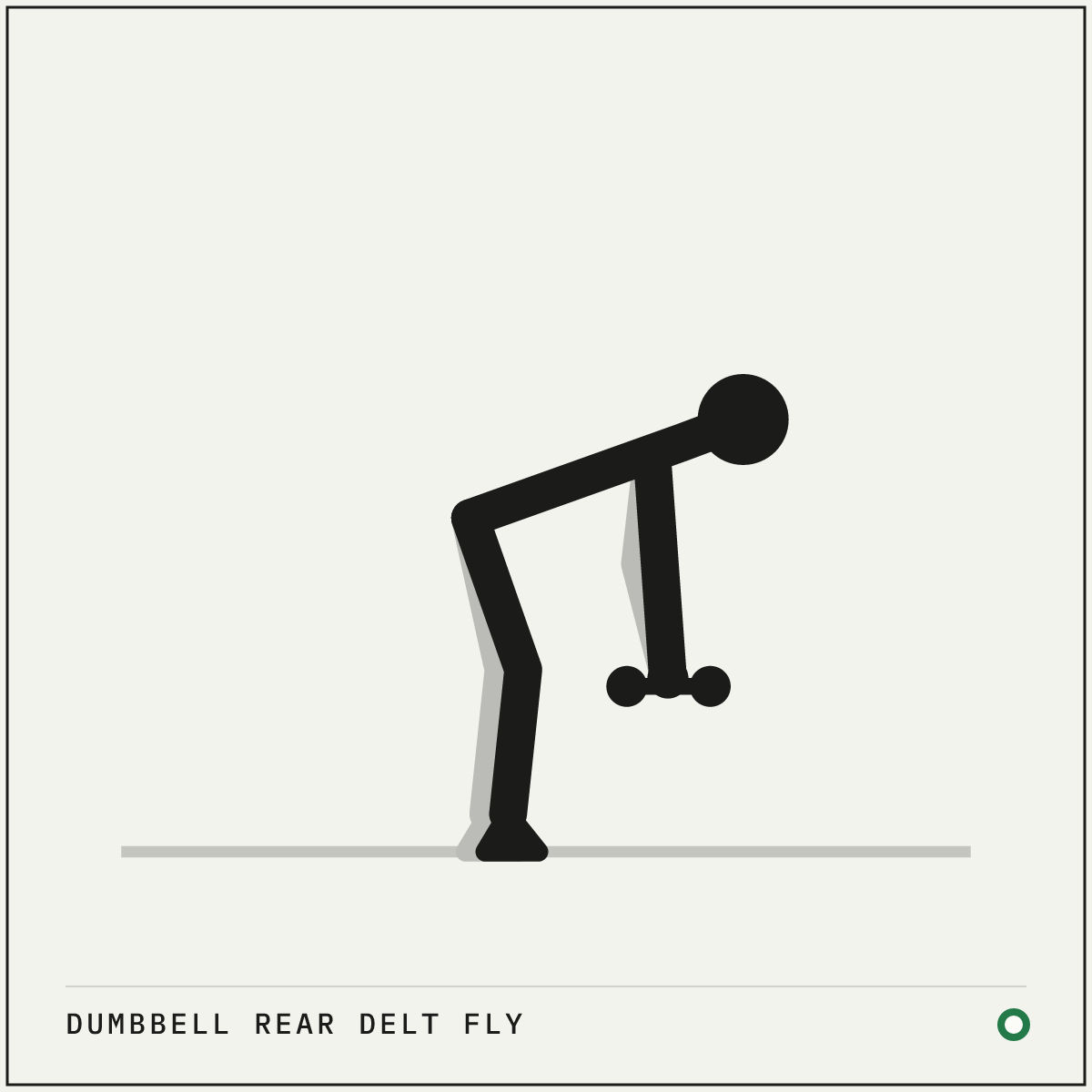
01 Hinged, arms hanging
Hinge until the torso is near parallel, back flat, arms hanging under the shoulders.
02 Level with the shoulders
Sweep the arms out until they are level with the shoulders, elbows leading.
How to do it
Setup
- Hold a light dumbbell in each hand and fold forward until your torso is close to parallel with the floor, knees softly bent.
- Let your arms hang straight down under your shoulders, palms facing each other, elbows slightly bent.
- Keep your back flat and your head in line with your spine.
Execution
- Raise both arms out to the sides in a wide arc until they are level with your shoulders.
- Pause at the top with your elbows leading and your thumbs pointing slightly down.
- Lower slowly back under your shoulders without letting your torso rise.
BreathingExhale as your arms rise, inhale as they lower.
Cues and mistakes
Check every rep
- Lead with your elbows and let your hands trail behind.
- Stop when your arms reach shoulder height.
What goes wrong
- Using weights heavy enough that your torso rises with each rep, which turns the fly into a row.
- Bending your elbows more as the set goes on, which makes the weight easier and hides fatigue.
- Squeezing your shoulder blades hard instead of moving your arms, which shifts the work to your mid-back.
Safety
- A flat back is what protects your lower back here. If you cannot hold that position, do this lying face down on a bench instead.
General guidance, not medical advice. See how Setkit works.
Notes
The shoulder has three parts and most programs train two of them. Pressing covers the front, lateral raises cover the side, and the back of the shoulder is left with whatever it picks up during rows. That is not much, because rowing is dominated by the far larger muscles of the back. The rear delt fly is the direct fix.
Picking the weight is where this exercise usually goes wrong. The back of the shoulder is small, your arms are long, and the working weight is far lighter than most people are willing to hold. Once the dumbbells are heavy enough that your torso has to swing up to start each rep, you are doing a poor row and the muscle you wanted is no longer the limit.
Your elbow tells you which one you are doing. In a fly the elbow stays slightly bent and fixed while the arm rotates around the shoulder. If your elbow angle is closing during the rep, your lats and mid-back have taken over. Keeping your arms nearly straight makes that cheat physically difficult, which is worth more than the extra weight a bent arm would allow.
Twelve to twenty reps works best, both because the muscle responds well to volume and because a light weight moved slowly is the only way the rear delt stays the muscle doing the work. Lying face down on an incline bench takes your lower back out of it entirely if the bent-over position is hard to hold.