Suspension Y-raise
A lean-back raise where your arms finish overhead in a Y. Direct work for the rear shoulders and the muscles holding your shoulder blades down.
TrainsShoulders
NeedsSuspension trainer
The movement
2 stages
Straps taut
01 Straps taut
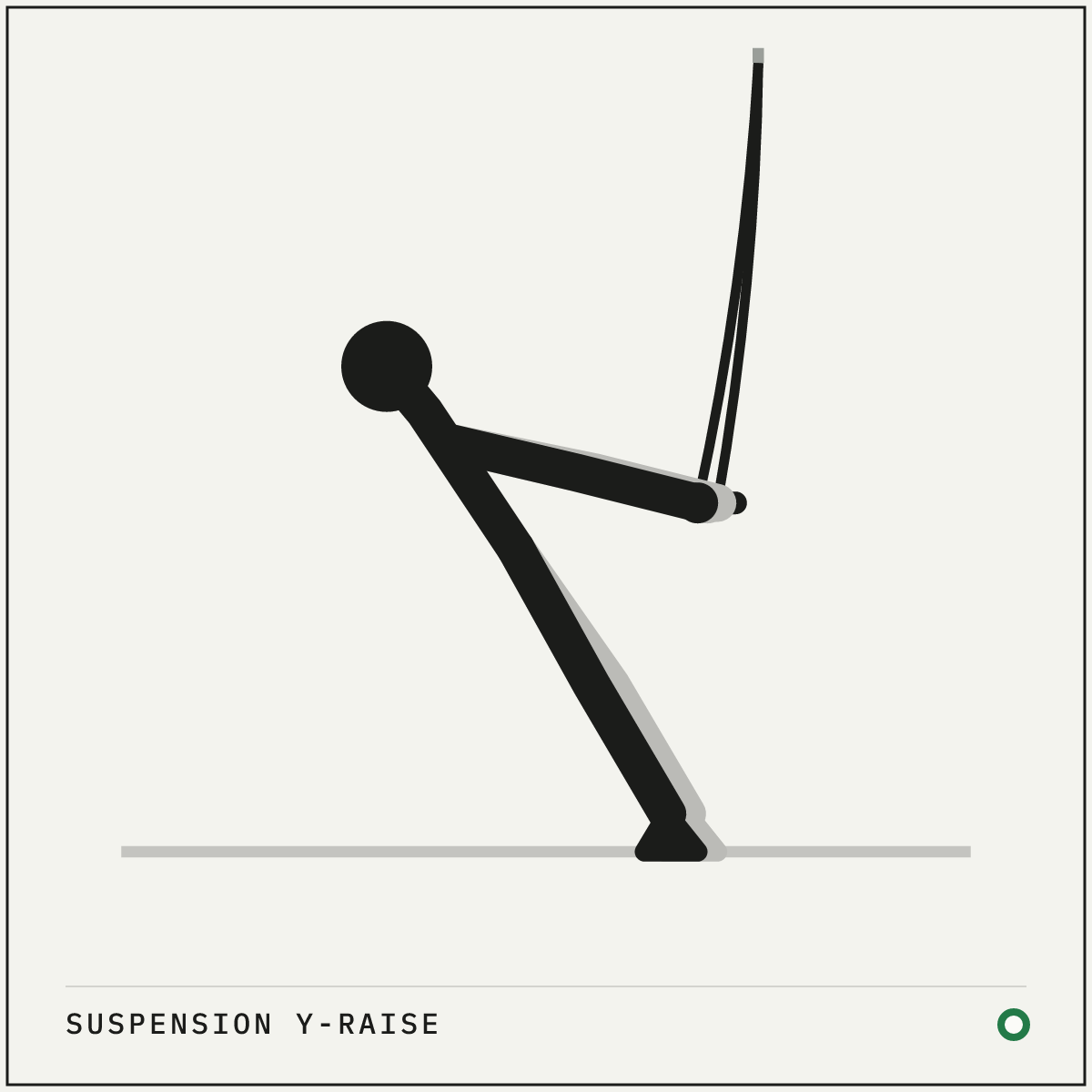
Lean back with straight arms and the straps under tension before the first rep.
02 Arms in a Y
Sweep straight arms overhead until they form a Y, shoulders away from the ears.
How to do it
Setup
- Take a handle in each hand with the straps set high, palms facing down.
- Walk your feet forward and lean back just past vertical with your arms straight.
- Start with only a small lean, because this one gets hard quickly.
Execution
- Keep your arms straight and sweep them up and out until they form a Y overhead.
- Pause where your arms are level with your ears and your shoulder blades sit down and back.
- Lower slowly along the same path until the straps are tight in front of you.
BreathingExhale as your arms sweep up, inhale on the way down.
Cues and mistakes
Check every rep
- Raise straight arms into a Y, without shrugging or bending your elbows.
- Keep your shoulders down away from your ears the whole way up.
What goes wrong
- Bending your elbows, which quietly turns it into a weak row.
- Leaning back so far that your arms cannot reach overhead without arching your lower back.
- Rushing the way down, which is where the position is actually trained.
Safety
- The back of the shoulder is small and easy to overload here. Start closer to standing than feels necessary and add lean over several weeks.
General guidance, not medical advice. See how Setkit works.
Notes
The Y-raise trains the parts of the shoulder that pressing never touches. The back of the deltoid, and the lower part of the trapezius that holds your shoulder blade down against your ribs. Both are badly undertrained in anyone whose upper-body work is mostly pushing, and both are what let the shoulder sit in a good position when you do press.
Straight arms are the whole exercise. The moment your elbows bend, the load moves to your lats and it becomes a badly done row, with the rear shoulder getting nothing. That is also why the load has to be light. With straight arms the lever is long, and a lean that looks trivial produces a set that is hard by rep eight.
The other reason to keep it light is range. Your arms need to reach a real overhead Y, and if the lean is too aggressive the only way to get there is to arch your lower back and fake the last thirty degrees. Full range at a shallow angle beats a deeper lean you can only half finish.
Treat this as accessory work rather than a main exercise. Two or three sets of ten to fifteen after your pulling for the day, stopping close to the point where your elbows start bending on their own.