Band lateral raise
Stand on a band and sweep straight arms out to shoulder height. The tension climbs as you lift, so the hardest point matches the strongest point.
TrainsShoulders
NeedsResistance band
The movement
2 stages
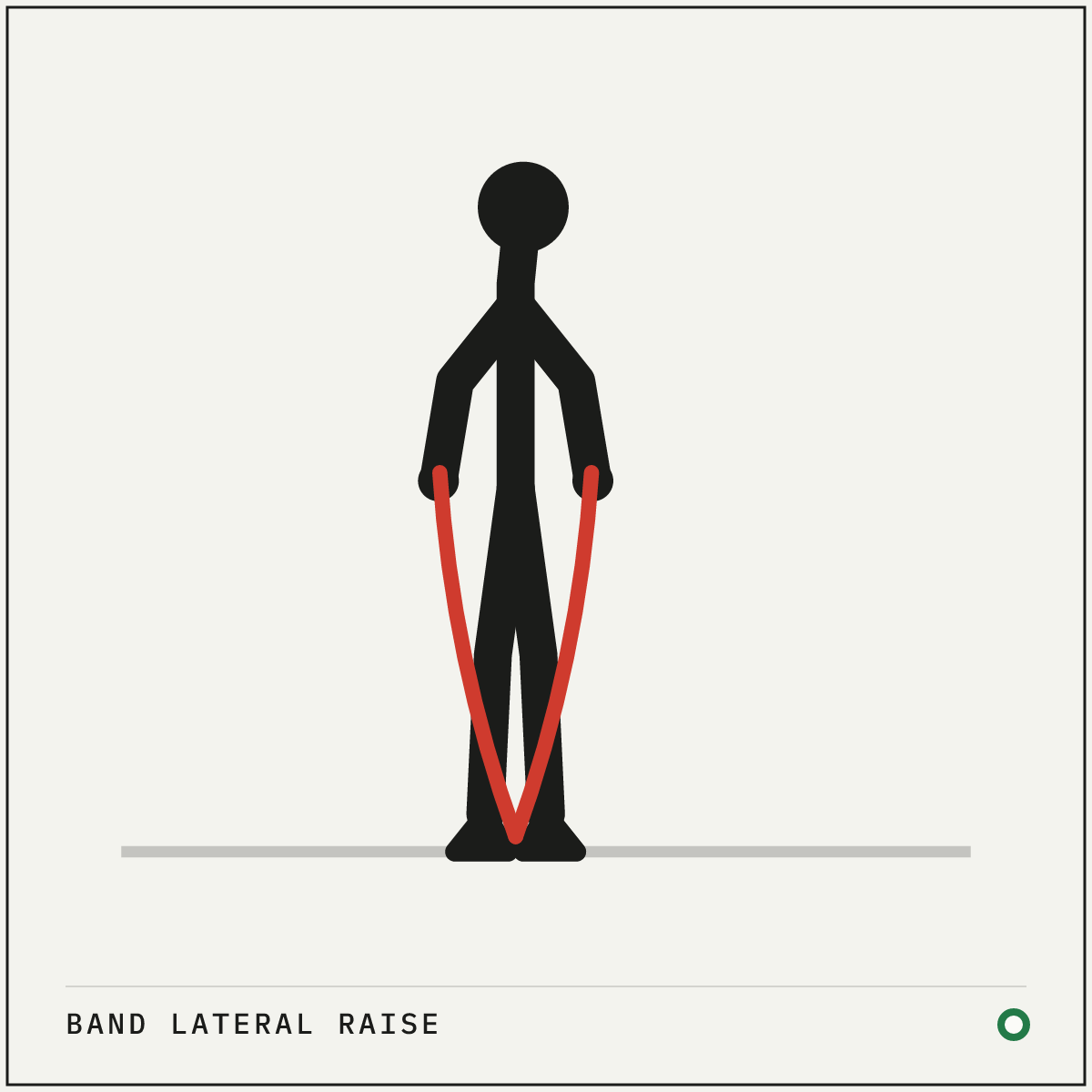
Arms down
01 Arms down
Stand on the band with a slight bend in the elbows and the arms hanging at the sides.
02 Raise
Sweep both arms out to the sides until the hands reach shoulder height.
How to do it
Setup
- Stand on the middle of the band with your feet about hip-width apart.
- Take one end in each hand so the band runs up the outside of each leg.
- Stand tall with your arms hanging at your sides and a slight bend in each elbow.
Execution
- Sweep both arms out to the sides, leading with your elbows.
- Stop when your hands reach shoulder height and your arms are level with the floor.
- Lower slowly against the band rather than letting it snap your arms down.
BreathingExhale as you lift your arms, inhale as you lower them.
Cues and mistakes
Check every rep
- Stop at shoulder height. Going higher hands the work to your traps.
- Keep the same small bend in your elbows from the first rep to the last.
What goes wrong
- Swinging the body to start each rep, which turns a shoulder exercise into a whole-body one.
- Letting the band pull your arms down fast, which throws away half of every rep.
- Shrugging the shoulders up toward the ears as the arms rise.
Safety
- A band that slips out from under a foot snaps upward toward your face. Stand on it with your whole foot rather than the ball of one, and check the rubber for nicks before every session.
General guidance, not medical advice. See how Setkit works.
Notes
The side delt sits on the outside of the shoulder and lifts your arm away from your body. It is a small muscle with one job, and lifting your arm out to the side is the only movement that trains it directly. Presses build the front of the shoulder and rows build the back, so without a raise of some kind the middle is left out.
A band behaves differently from a dumbbell here, and the difference works in your favor. A dumbbell is hardest when your arms are level with the floor and almost weightless at the bottom. A band is loosest at the bottom and tightest at the top, which lines the resistance up with the part of the range where your shoulder is strongest. You get useful tension across more of the rep.
The cost is that you cannot add a small amount of weight the way you can with dumbbells. Progress comes from standing on more of the band to shorten it, from a thicker band, or from slowing the lowering phase down. Counting reps alone stops working quickly here, so pick one of those and change it deliberately.
Side delts respond to volume more than to load, so higher reps suit them. Aim for 12 to 20 and stop the set when your arms stop reaching shoulder height, not when they stop moving at all. A raise that only gets halfway up is training a range you already trained.