Front lever
An advanced isometric hold where you hang from a bar and lift your entire body parallel to the floor.
NeedsPull-up bar
The movement
2 stages
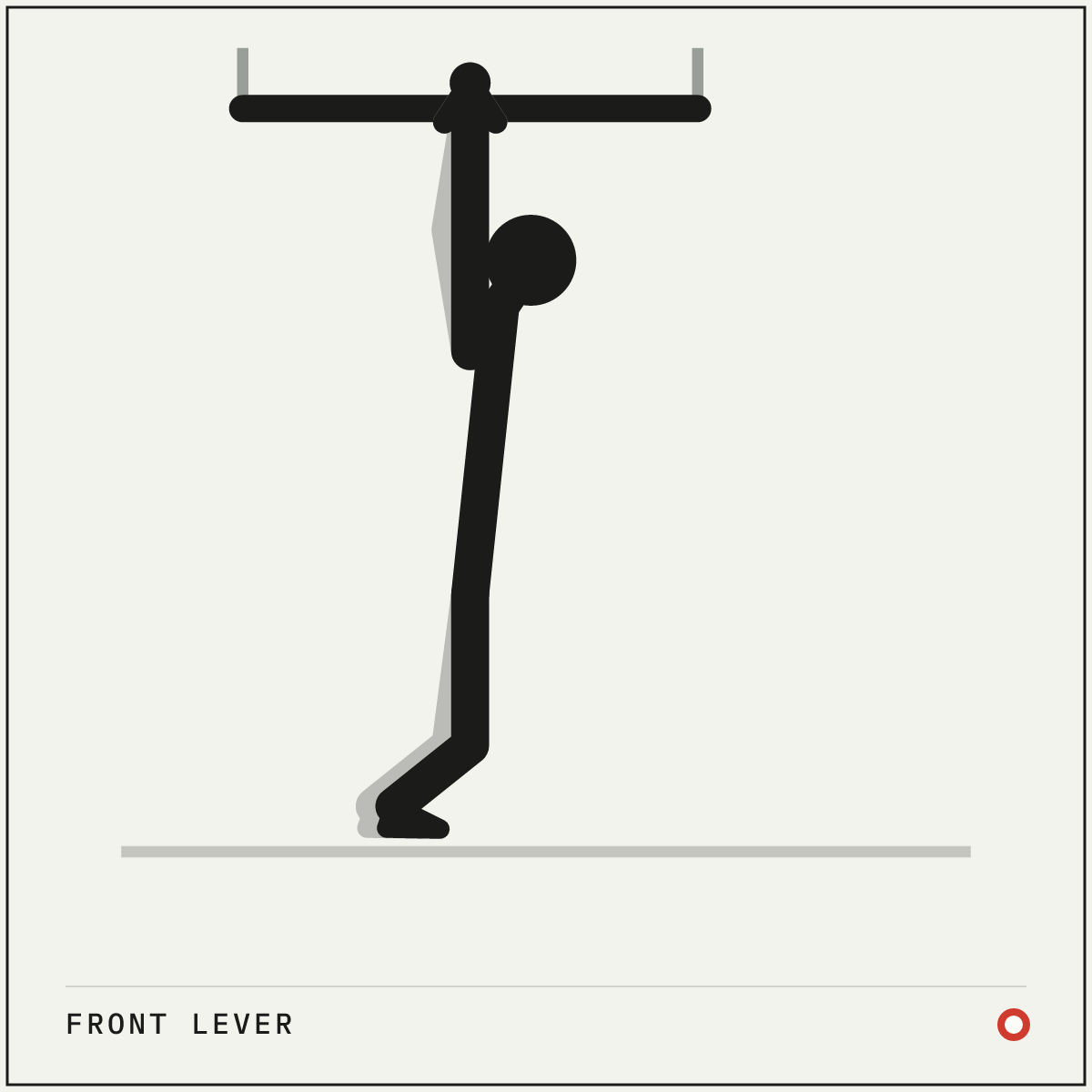
Hang
01 Hang
Hang with straight arms and tight core.
02 Hold
Lever your body up until it is perfectly horizontal.
How to do it
Setup
- Hang from a pull-up bar with a shoulder-width overhand grip, arms completely straight.
- Brace your core hard and squeeze your glutes.
Execution
- Drive your straight arms down toward your hips to lever your entire body up.
- Stop when your body is perfectly horizontal and parallel to the floor.
- Hold this position for as long as you can maintain a perfectly straight line from head to toe.
BreathingTake short, shallow breaths into your chest while keeping the abdomen braced hard.
Cues and mistakes
Check every rep
- Think about breaking the bar by pulling your hands down to your hips.
- Keep your arms perfectly straight; any bend in the elbow is a compensation.
- Squeeze everything: lats, core, glutes, and quads.
What goes wrong
- Bending the elbows to compensate for weak lats.
- Piking at the hips or letting the lower back arch downward.
- Losing tension in the legs.
Safety
- If you feel pain in your elbows or shoulders, immediately regress to an easier variation like the tuck front lever.
General guidance, not medical advice. See how Setkit works.
Notes
The front lever is the undisputed king of bodyweight horizontal pulling strength. It requires immense lat power to lever the body up, and a bulletproof core to keep it rigid. While it looks like a core exercise to the uninitiated, anyone who has trained for it knows it is a back movement first and foremost.
Because the leverage is so poor, you are effectively pulling a huge multiple of your body weight. The tension required across the entire posterior chain and core is extreme. You must actively engage every muscle from your neck to your toes to hold the position.
Mastering the front lever requires patience. It is an isometric hold, meaning progress is measured in seconds rather than reps. Build up through the progressions (tuck, advanced tuck, straddle, one-leg) before attempting the full layout, as jumping straight to the full version can easily strain the elbows or shoulders.