Dumbbell side bend
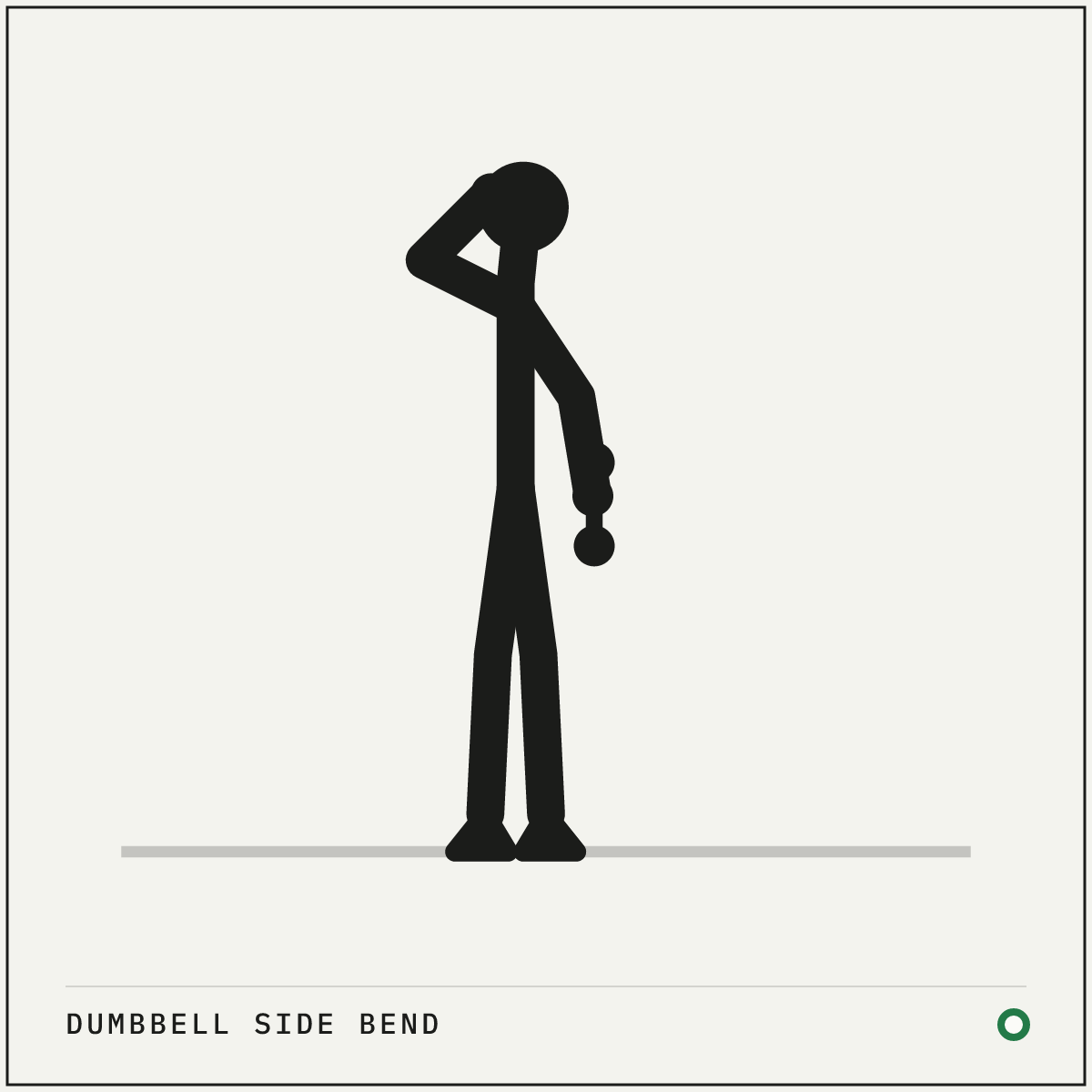
One dumbbell hanging at your side, bending sideways and standing back up. Direct, loadable work for the muscles down the side of your trunk.
The movement
2 stages
Stand tall
01 Stand tall
One weight hanging at your side, free hand behind your head, shoulders level.
02 Bend to the weight
Bend straight sideways and let the weight travel down your leg.
How to do it
Setup
- Stand tall with your feet hip-width apart and one dumbbell hanging at your side.
- Put your free hand behind your head so it cannot help.
- Face straight ahead with your shoulders level and your ribs down.
Execution
- Bend sideways toward the dumbbell, letting it slide down the outside of your leg.
- Stop when your side is fully lengthened and your feet are still flat.
- Pull yourself back upright with the side you just stretched, and keep going a few inches past straight.
BreathingBreathe out as you bend down and in as you come back up.
Cues and mistakes
Check every rep
- Bend straight sideways, with no turning and no leaning back.
- Let the weight slide along your leg, not away from it.
- Do every rep on one side before you swap hands.
What goes wrong
- Rotating as you bend, which turns a side bend into a twist and shortens the range.
- Holding a dumbbell in each hand, so the two weights cancel out and nothing gets loaded.
- Using a weight so heavy that your hips swing sideways to counterbalance it.
Safety
- Load this lighter than it looks. The muscles down your side are small, and the lower back takes over the moment the weight is more than they can hold.
General guidance, not medical advice. See how Setkit works.
Notes
The muscles down the side of your trunk bend you sideways and stop you being bent sideways. Planks, carries and Pallof presses train the second job. The side bend trains the first, which is why it can be loaded and progressed like any other isolation exercise while a carry can only get heavier or longer.
One weight at a time is the whole design. Hold a dumbbell in each hand and the two loads balance each other, so your sides do almost nothing while you rock back and forth. With one weight, the opposite side has to hold you up on the way down and pull you back on the way up.
Range matters more than load here. A full rep starts with the weight low beside your knee and finishes a few inches past upright on the other side, which is a bigger arc than most people use. Ten to twenty reps a side at a weight you can control through that whole arc will do more than a heavy dumbbell moved four inches.
The most common reason it feels like nothing is speed. Take two seconds down, pause where the stretch is longest, then pull back up without bouncing off the bottom.