Bicycle crunch
An alternating knee-to-opposite-shoulder crunch. The twisting core work most floor training skips, run as a continuous cycle.
TrainsCore
NeedsBodyweight
The movement
2 stages
One knee in
01 One knee in
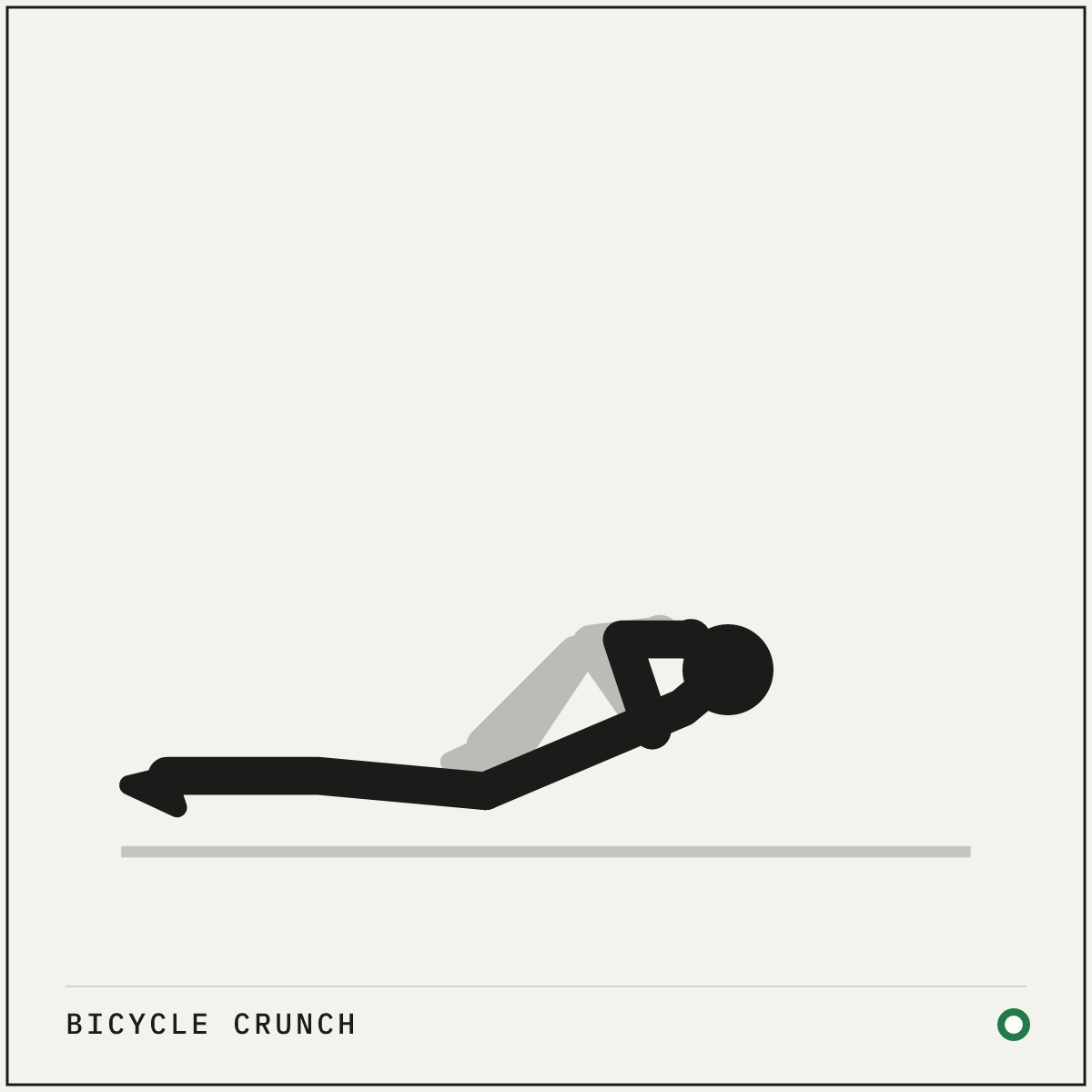
Shoulder blades off the floor, one knee drawn in as the other leg extends long and low.
02 Switch
Switch legs and turn the opposite shoulder toward the bent knee, without dropping the shoulders.
How to do it
Setup
- Lie on your back with your hands resting lightly behind your head and your elbows wide.
- Lift your shoulder blades off the floor and both feet off the floor with your knees bent.
Execution
- Draw one knee toward your chest while extending the other leg out long and low.
- Turn your torso so the opposite shoulder rotates toward the bent knee.
- Switch legs and rotation smoothly, keeping your shoulders off the floor throughout.
BreathingBreathe steadily through the cycle rather than holding your breath.
Cues and mistakes
Check every rep
- Turn your shoulder toward your knee, not your elbow.
- The extended leg stays straight and about a hand's width off the floor.
What goes wrong
- Pulling on your head with your hands, which strains your neck and fakes the rotation.
- Letting your shoulder blades drop to the floor between reps, which releases the tension.
- Racing through the cycle so the rotation never really happens.
Safety
- Your hands rest behind your head and never pull. If your neck is what feels this exercise, take your hands off your head and cross them over your chest.
General guidance, not medical advice. See how Setkit works.
Notes
Your trunk both twists and resists twisting, and almost no floor exercise trains either one. Planks and leg raises work in a single direction, which leaves the obliques doing little beyond holding still. The bicycle crunch is the simplest way to add the twisting half with no equipment.
The twist is what gets faked. Bringing your elbow to your knee is easy and mostly a matter of dragging your head across. Turning your shoulder toward your knee is what actually rotates your spine and works the obliques. From the outside the two look alike, and they feel completely different. The elbow version is why so many people finish this exercise with only a sore neck.
Staying under tension is the other half. It is meant to run as an unbroken cycle, with your shoulder blades never touching down and your extended leg never resting. That is what makes a set of twenty hard. Reset between reps and it becomes an easy movement with an impressive rep count.
There is nothing to load, so the difficulty comes from how long and low your extended leg travels and how slowly you run the cycle. Slowing down is almost always the right way to progress, and almost always the last thing people try.