V-up
Folding your legs and torso up into a V at the same time. Range and tempo do here what added weight cannot.
TrainsCore
NeedsBodyweight
The movement
2 stages
Long on the floor
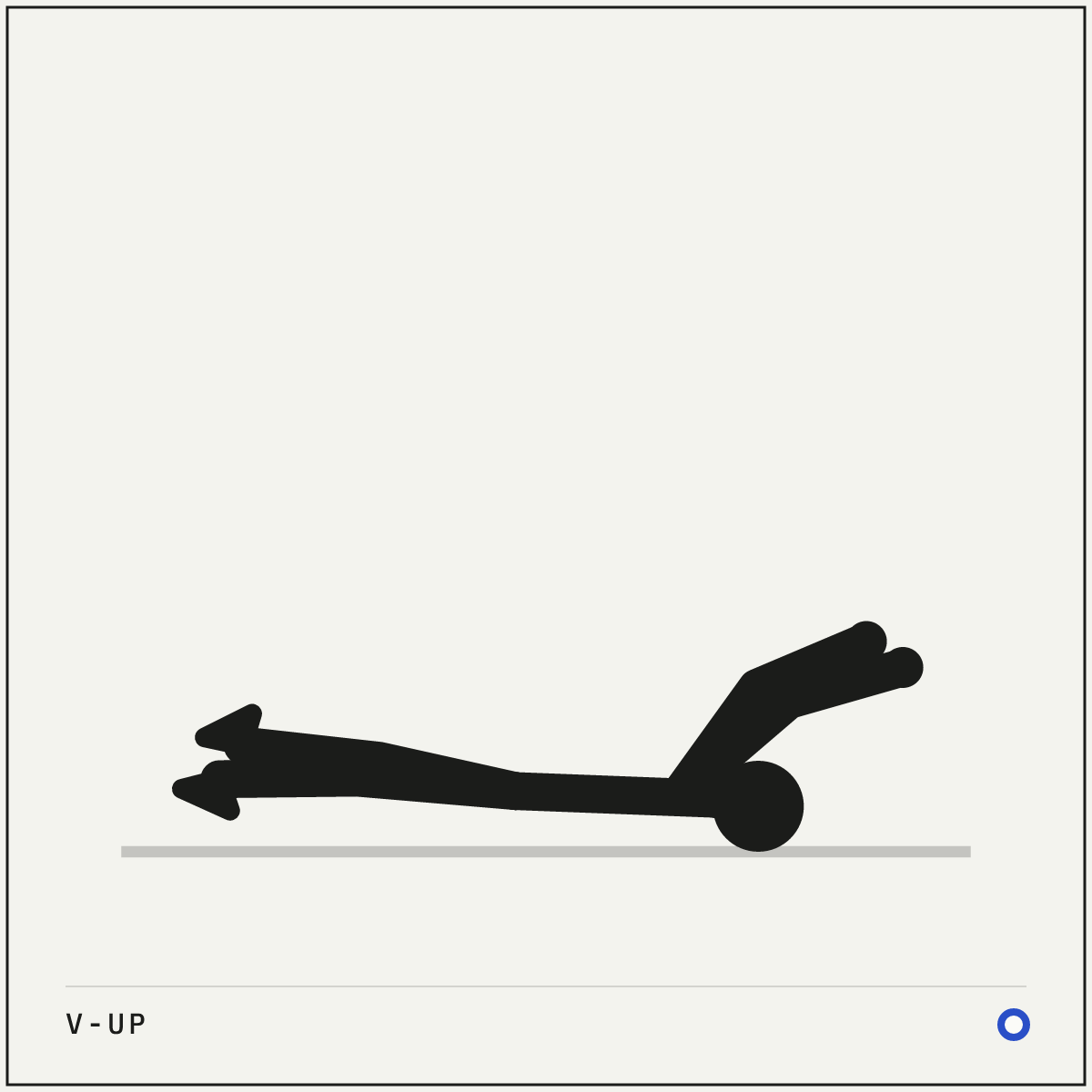
01 Long on the floor
Lie long with the arms overhead and both ends of the body just off the floor.
02 Folded into a V
Lift the legs and torso together and reach past your toes, legs straight.
How to do it
Setup
- Lie on your back with your legs straight and your arms reaching overhead on the floor.
- Press your lower back gently into the floor before the first rep.
Execution
- Lift your legs and your torso at the same time, reaching your hands toward your feet.
- Meet at the top in a V shape, balanced on your hips, with your legs straight.
- Lower both halves together until your arms and legs are just off the floor, then go again.
BreathingExhale as you fold up, inhale as you lower.
Cues and mistakes
Check every rep
- Your hands and feet meet at the same moment.
- Reach past your toes rather than just toward them.
What goes wrong
- Lifting your torso first and your legs second, which makes it a sit-up with a leg raise attached.
- Bending your knees to reach the top, which makes the movement much easier and hides it.
- Letting your arms and legs rest on the floor between reps, which dumps the tension.
Safety
- If your lower back lifts away from the floor at the bottom, shorten the range rather than reaching lower. That arch is where back strain comes from.
General guidance, not medical advice. See how Setkit works.
Notes
Most floor core exercises train one half of the trunk at a time. A sit-up brings your ribs toward your hips. A leg raise brings your hips toward your ribs. The V-up does both at once with both legs and arms fully extended, which is why it is far harder than either and why it stays useful long after crunches stop doing anything.
Timing is the technique. Both halves have to leave the floor together and arrive together. Lifting your torso first turns it into a sit-up that a leg raise then catches up with, which is easier and no longer the same exercise. Watch one rep in a mirror or on video to find out which one you are doing.
Straight legs are what make it hard, and bending the knees is the quiet compromise almost everyone makes. A tuck-up with bent knees is a perfectly good exercise and a sensible stepping stone. Just call it that rather than counting it as a V-up, because the difference in difficulty is enormous.
There is no weight to add, so progress comes from range and tempo. Keep your hands and heels off the floor between reps, pause at the top, and slow the descent down. Eight reps done that way beat twenty done as a bouncing rhythm.