Sumo deadlift
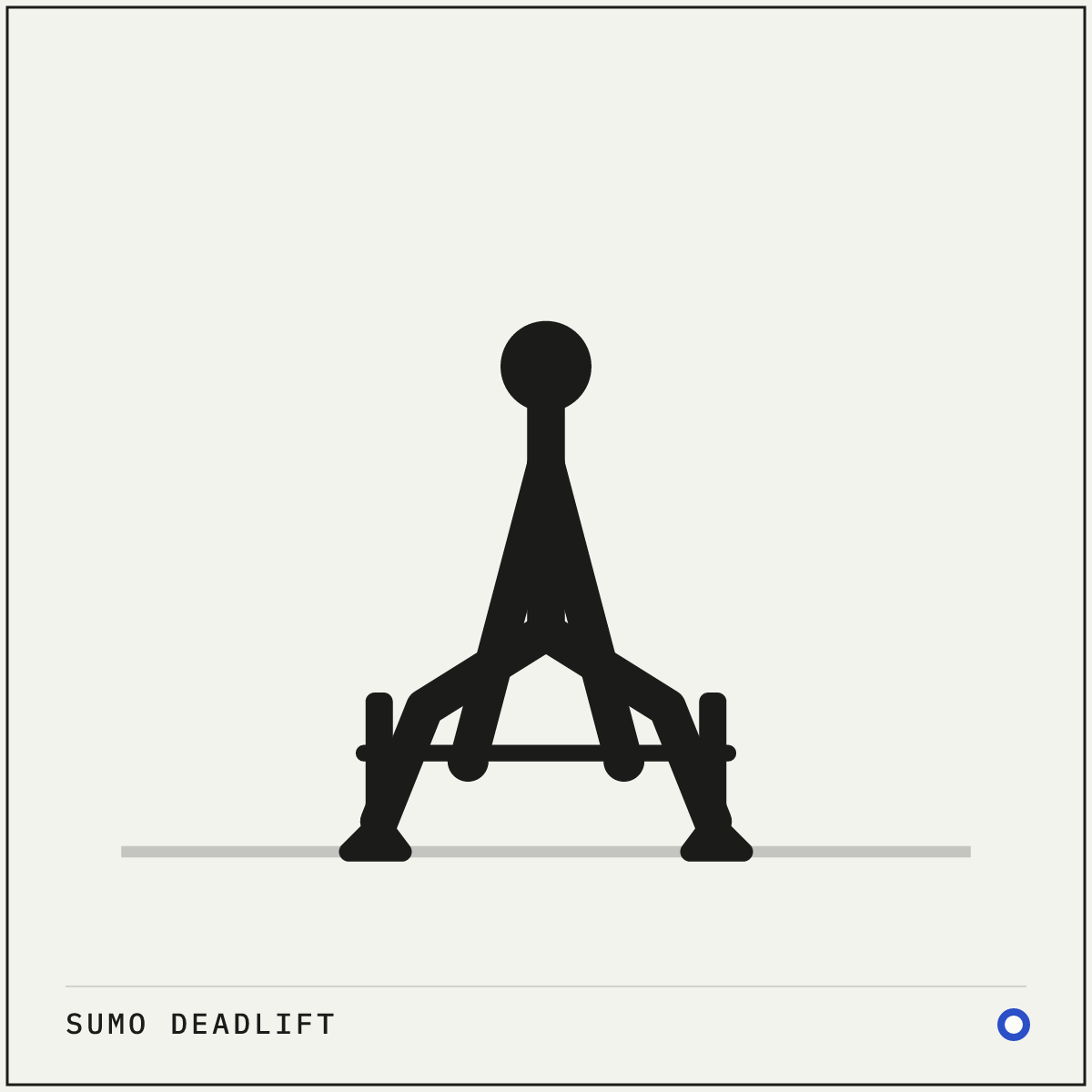
A deadlift with a wide stance and the hands inside the knees. A shorter pull with a more upright back, and more of the work on the quads and hips.
The movement
2 stages
Set
01 Set
Feet wide with the toes turned out, arms hanging straight down inside the knees.
02 Lockout
Drive the feet out into the floor and finish tall with the hips through.
How to do it
Setup
- Stand with your feet well wider than your shoulders and your toes turned out, with the bar over the middle of your feet.
- Push your hips back and down until you can grip the bar with your arms hanging straight inside your knees.
- Push your knees out toward your toes, flatten your back, and pull the slack out of the bar.
Execution
- Drive your feet out into the floor and stand up, keeping the bar against your legs.
- Push your hips forward to meet the bar and finish standing tall with your knees locked.
- Lower by pushing your hips back and letting your knees bend, keeping the bar close the whole way.
BreathingTake a breath and brace before the bar leaves the floor, and let it out at the top.
Cues and mistakes
Check every rep
- Knees out toward your toes from the first inch of the pull.
- Pull your chest up and the slack out before the bar moves.
What goes wrong
- Letting the knees fall inward as the weight gets heavy, which stalls the bar at the knees.
- Setting the hips too low, which puts you under the bar and turns the lift into a squat you cannot finish.
- Jerking the bar off the floor instead of building tension against it first.
Safety
- The wide stance asks a lot from your hips and the inside of your thighs. Warm those up with a few light sets, and stop the session if you feel a sharp pull in your groin rather than working through it.
General guidance, not medical advice. See how Setkit works.
Notes
The sumo deadlift is the same job as a conventional deadlift with the work shared out differently. Widening your stance and turning your toes out drops your hips closer to the bar and stands your back up. That shortens how far the bar travels, and it moves load off your lower back and onto your quads, glutes and inner thighs. Nothing about it is easier. The weight simply gets lifted by a different committee.
Which version suits you is mostly a question of proportions rather than preference. Long legs and a short torso make a conventional pull very steep, and sumo usually feels better. Shorter legs and long arms tend to favor pulling conventional. Try both for a few weeks at a light weight before deciding, because the answer is often obvious once your hips have adapted to the wide stance.
The start is where sumo pulls are won and lost. The bar has to break the floor with your knees pushed out and your hips already loaded, so there is no room for a running start. Build tension against the bar for a full second before it moves, and think about pushing your feet apart rather than just down. If the bar leaves the floor and stops at your knees, tension at the start is almost always the reason.
Range of motion is the standard to hold yourself to, because it is the one this variation makes easy to fudge. Widening the stance further shortens the pull, and past a point it becomes a way to move a heavier bar a shorter distance. Pick the stance that lets your knees track over your toes, and let the weight catch up to it.