Walking lunge
Lunges taken as steps across the room. Every rep starts from a moving position, which makes balance and breathing much harder.
NeedsBodyweight
The movement
2 stages
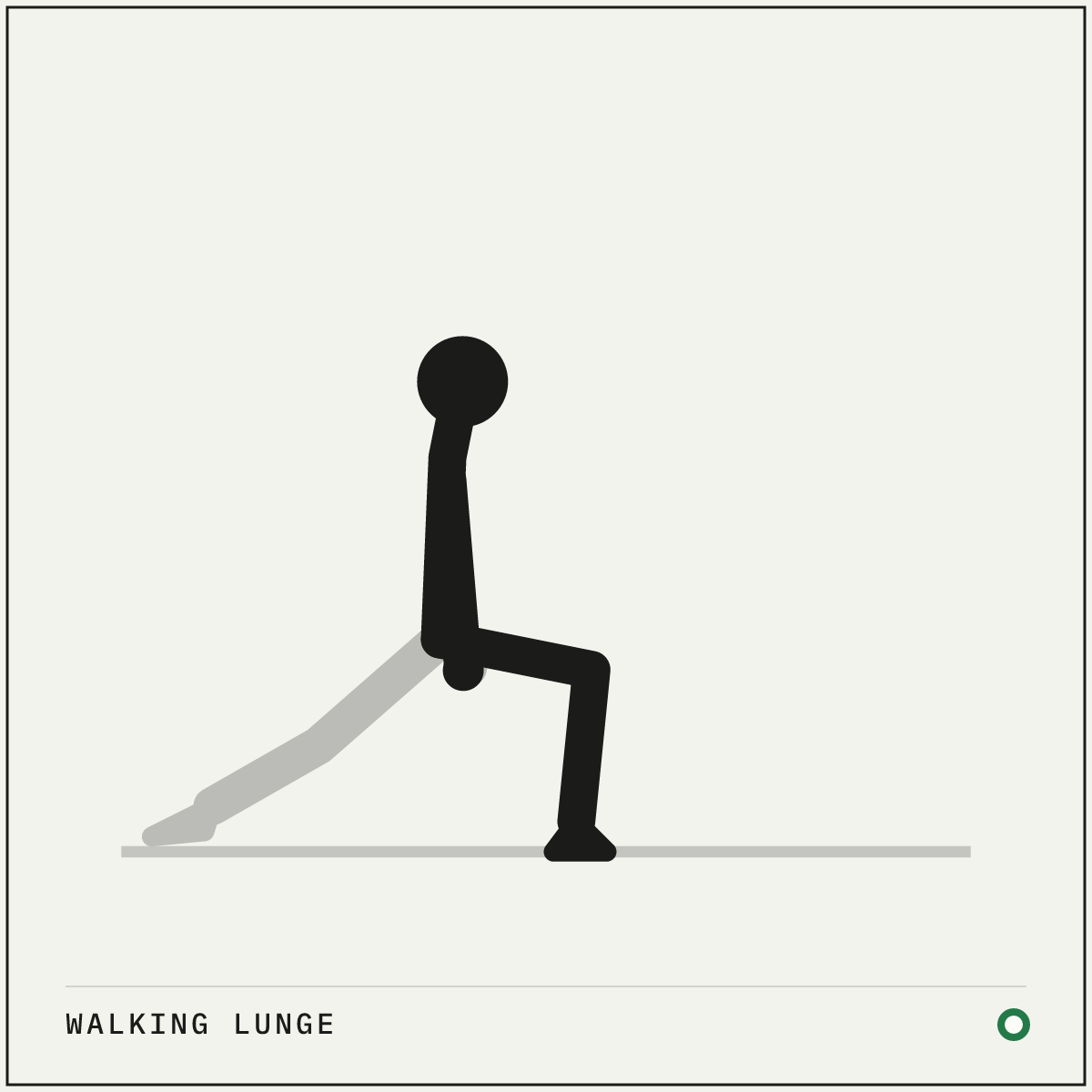
Step and sink
01 Step and sink
Step out far enough that the front shin stays vertical, back knee just above the floor.
02 Drive through
Drive through the front foot and bring the back leg straight into the next step.
How to do it
Setup
- Stand tall with your feet hip-width apart and enough clear floor to take several steps.
- Tighten your trunk and look ahead rather than down.
Execution
- Step forward into a lunge and lower until your back knee is just above the floor.
- Drive through your front foot to stand, bringing your back leg through into the next step.
- Keep alternating legs, one step per rep, without pausing to reset.
BreathingInhale as you step and lower, exhale as you drive up.
Cues and mistakes
Check every rep
- Step out far enough that your front shin stays vertical.
- Travel forward with each step instead of bouncing on the spot.
What goes wrong
- Taking short steps, which pushes your front knee well past your toes and loads it heavily.
- Letting your torso tip forward over your front leg as you tire.
- Dropping your back knee onto the floor instead of stopping just above it.
Safety
- Balance goes before strength on this one. When your steps start wandering sideways the set is over, because a wobbling lunge when tired is how ankles get rolled.
General guidance, not medical advice. See how Setkit works.
Notes
A walking lunge is a reverse lunge that never gets to reset. Every rep starts from wherever the last one finished, with your body still moving, which turns a simple single-leg exercise into a continuous balance problem. That is why it feels so much harder than the same number of stationary lunges.
It is also the version that suits conditioning best. There is no pause between reps and your whole body is travelling, so your heart rate climbs quickly and stays up. Twenty steps is demanding in a way twenty split squats are not.
Step length decides whether your knees enjoy it. Step too short and your knee travels well past your toes on every rep, which concentrates the load on the joint. Step long enough that your front shin stays roughly vertical and the work spreads into the glutes and hamstrings where it belongs. Most people step too short, and the fix is a deliberate reach rather than more effort.
Dumbbells scale it well, but only once you can do twenty steps unloaded without your path drifting. Adding weight to a balance problem you have not solved yet only makes the drifting happen sooner.