Dumbbell floor pullover
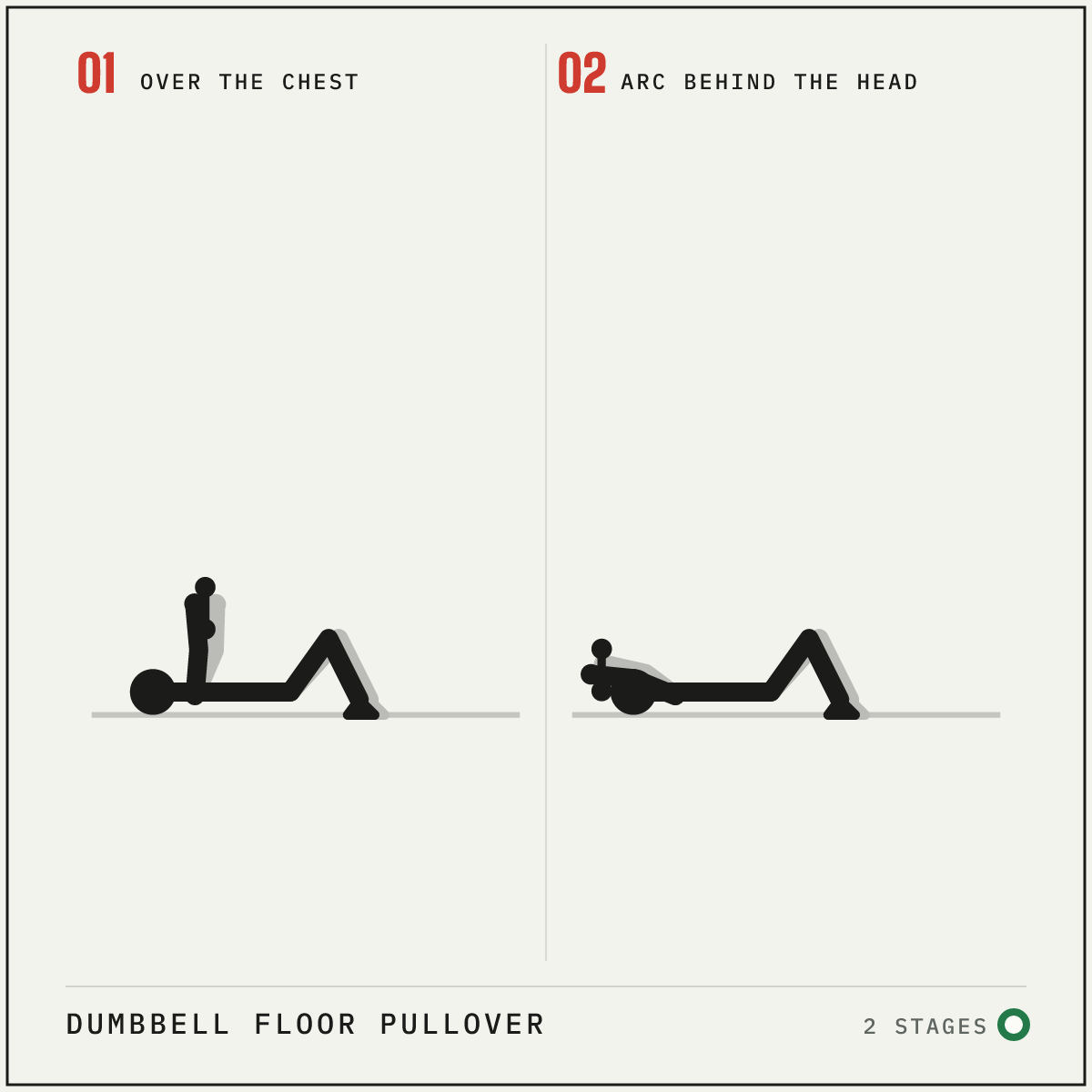
Lying on the floor, one dumbbell in both hands arcs from over your chest to behind your head. A vertical pull for the lats with no bench and no bar.
The movement
2 stages
Over the chest
01 Over the chest
One dumbbell in both hands over the shoulders, elbows slightly bent, lower back on the floor.
02 Arc behind the head
Lower the weight behind the head until the arms near the floor and the dumbbell hangs just above it.
How to do it
Setup
- Lie on your back with your knees bent and your feet flat on the floor.
- Hold one dumbbell in both hands, palms flat against the inside of the top plate, and press it up over your chest.
- Bend your elbows slightly and keep that bend fixed for the whole set.
Execution
- Lower the dumbbell in an arc over your face and behind your head until your upper arms are close to the floor.
- Pause for a moment with the weight held still.
- Pull it back through the same arc until it is over your chest again.
- Keep your lower back on the floor the whole way.
BreathingInhale as the weight goes back, exhale as you pull it over.
Cues and mistakes
Check every rep
- Elbows stay at the same slight bend from start to finish.
- Ribs down and lower back pressed into the floor.
- Lower slowly enough that the weight could stop at any point.
What goes wrong
- Arching the lower back off the floor to reach further behind the head.
- Bending and straightening the elbows, which turns it into a triceps extension.
- Choosing a weight you cannot pause behind your head.
Safety
- The weight passes over your face. Lock your grip before the first rep, keep the lowering slow, and build up the load over weeks rather than testing it.
General guidance, not medical advice. See how Setkit works.
Notes
The floor pullover is the one vertical pull you can do with a single dumbbell and nothing else. Pulling your arms from overhead back down to your body is the main job of the lats, and without a bar to hang from or a band to anchor, this arc is the only way to load it. The chest shares the first half of the pull.
The floor changes the exercise in one useful way. Your upper arms meet the ground before the shoulders reach their full stretch, which caps the range and makes the movement easier to control than the bench version. That is what makes it a sensible first pullover. It is also why the bench version is the progression, since the extra stretch at the bottom is what you move on to once the pattern is clean.
Keep the weight light and the reps in the 10–15 range. A pause behind the head with the lower back flat is the standard for each rep. If the back arches to get the weight further, the lats are no longer the limit, and the set is over. On a pull day without a bar, slot it after your rows as the overhead pull the session would otherwise lack.