Dumbbell hammer curl
A curl with your palms facing each other. It builds the forearm and the muscle under the biceps that adds visible width.
The movement
2 stages
Arms straight
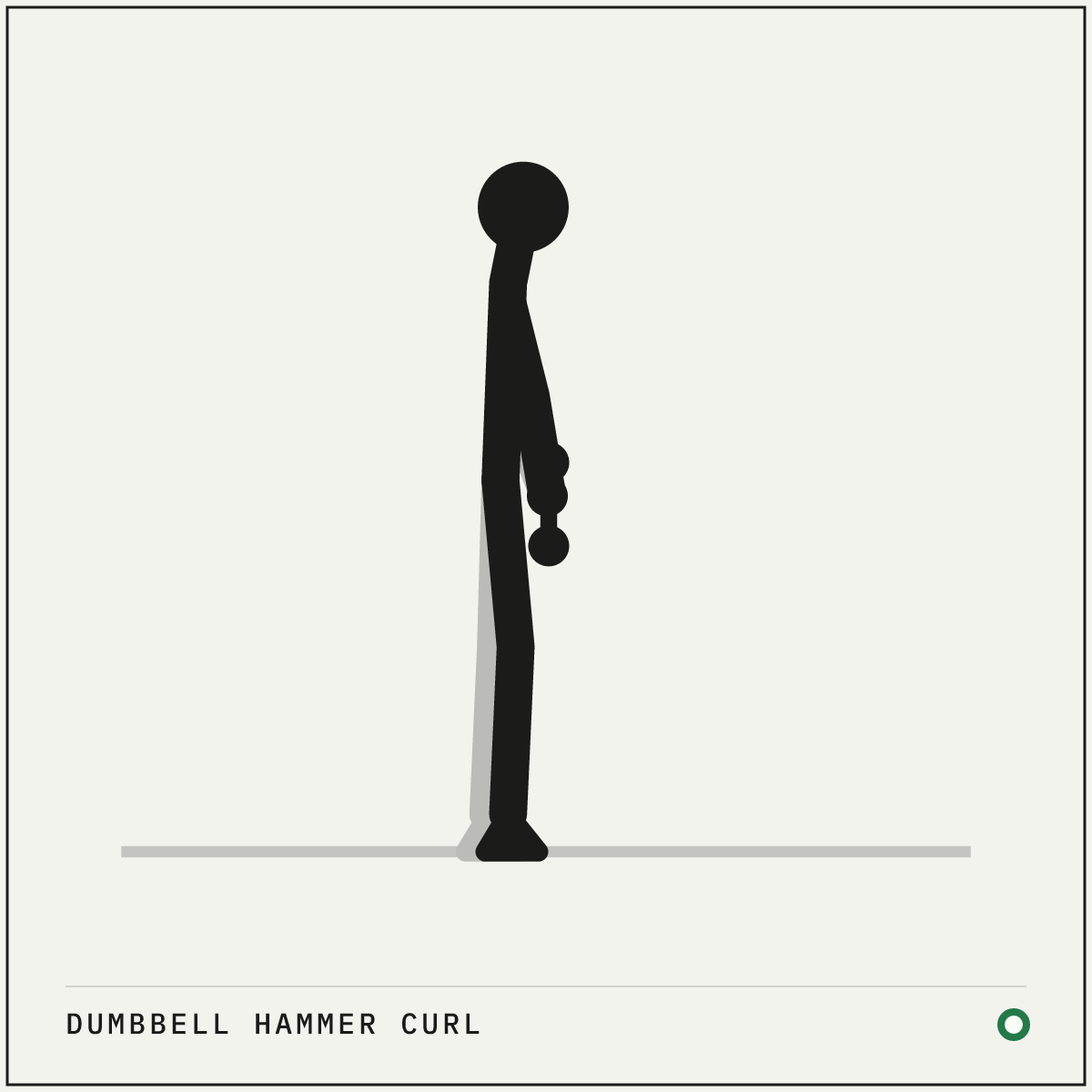
01 Arms straight
Stand tall with the palms facing your thighs and the elbows at your ribs.
02 Thumb to the shoulder
Curl with the palms still facing each other. The grip never rotates.
How to do it
Setup
- Stand tall with a dumbbell in each hand and your palms facing your thighs.
- Pin your elbows to your sides, and keep your palms facing each other for every rep.
Execution
- Curl the weights toward your shoulders, keeping your palms facing each other throughout.
- Finish with the thumb side of the dumbbell near your shoulder and your elbows still at your ribs.
- Lower to fully straight arms on a slow count.
BreathingExhale as you curl, inhale on the way down.
Cues and mistakes
Check every rep
- Palms face each other the whole rep, with no rotation.
- Elbows stay at your ribs for the whole set.
What goes wrong
- Rocking your torso to start each rep.
- Letting your elbows travel forward at the top, which parks the weight over your shoulder and removes the load.
- Turning your palms up on the way, which makes it an ordinary curl with heavier weights.
Safety
- This grip is easier on the wrist and elbow than a palms-up curl, which is why it is often the version to keep when standard curls start to ache.
General guidance, not medical advice. See how Setkit works.
Notes
The hammer curl is not variety for its own sake. Turning your palms to face each other moves work onto the muscle sitting underneath the biceps and onto the forearm. That underneath muscle is why hammer curls change how an arm looks. As it grows it pushes the biceps up from below, which adds width that palms-up curling does not produce on its own.
It is also the stronger position. Most people handle more weight here than on a standard curl, because this grip lets the forearm contribute properly and puts the wrist in a naturally stable position. Use the extra weight with the same still elbows as a standard curl, and keep it strict rather than swinging it.
If your elbows or wrists have started complaining about curls, this is usually the version that still works. Your forearm is not held twisted under load, which removes the strain a palms-up grip puts on the inside of the elbow.
Alternate grips across the week rather than picking one. Palms-up curls for the biceps, hammer curls for what sits under and beside it. Keep both in the 8–15 range and add reps before weight.