Incline dumbbell curl
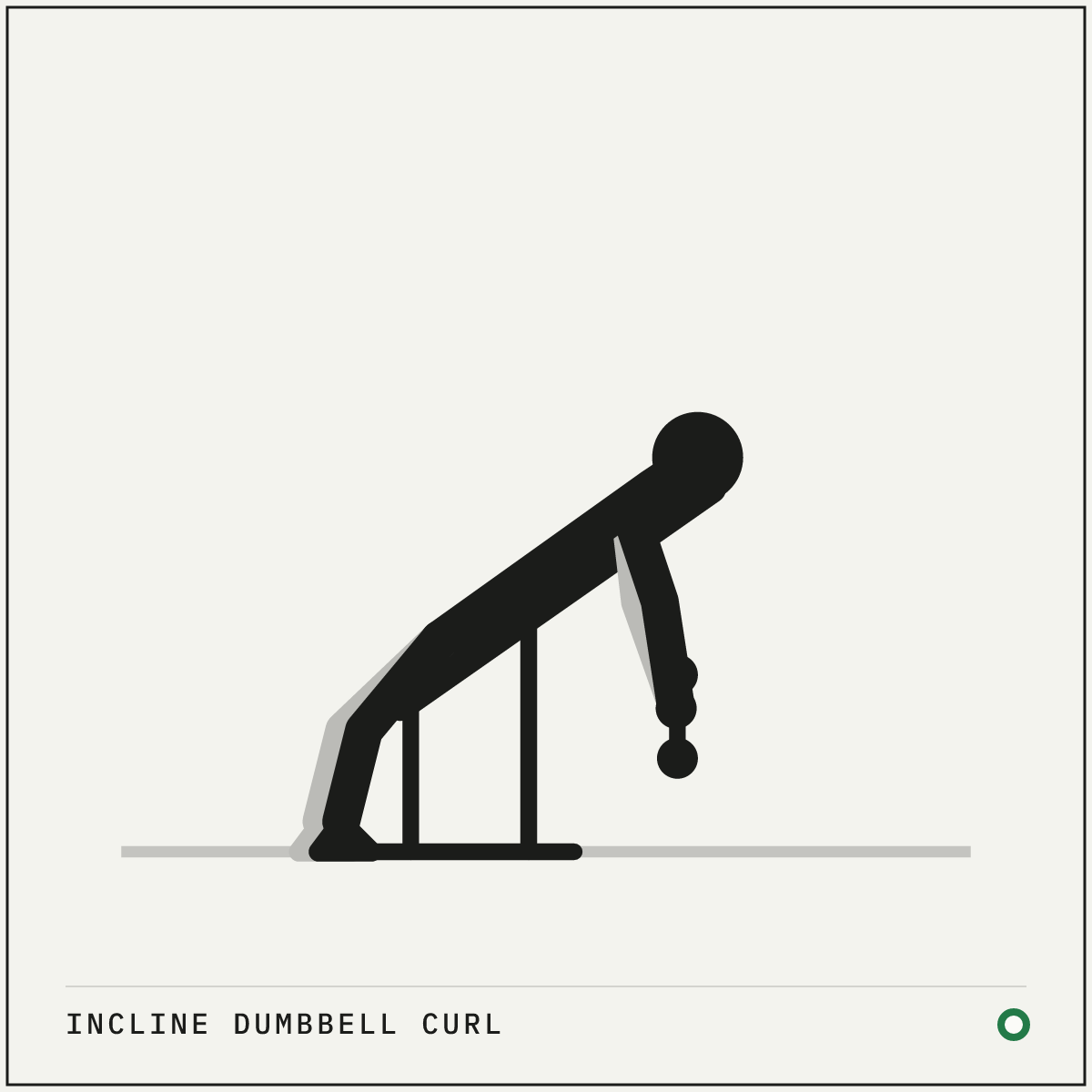
A curl lying back on a tilted bench so your arms hang behind you. The biceps loaded at a stretch no standing curl reaches.
The movement
2 stages
Arms hanging back
01 Arms hanging back
Let both arms hang straight down behind the body with the shoulders pressed into the pad.
02 Curl
Curl to the shoulder by bending the elbow only; the upper arm stays where it is.
How to do it
Setup
- Set the bench to a moderate incline, around 40°, and sit back against the pad with a dumbbell in each hand.
- Let both arms hang straight down behind the line of your body, palms facing forward.
- Press your shoulders into the pad so they stay there for the whole set.
Execution
- Curl both weights toward your shoulders by bending only your elbows.
- Stop before your upper arms swing forward off the pad.
- Lower slowly all the way back to straight arms, with your arms still hanging behind you.
BreathingExhale as the weights come up, inhale as they lower.
Cues and mistakes
Check every rep
- Shoulders stay against the pad; only your forearms move.
- Lower until your arms are fully straight before the next rep.
What goes wrong
- Letting your shoulders roll forward at the top, which hands the last part of the rep to the front of the shoulder.
- Stopping short at the bottom, which skips the stretched position this version exists for.
- Using your standing-curl weight, which forces one of the first two.
Safety
- The bottom position puts the biceps tendon at your shoulder under a long stretch. Add weight slowly and control the descent instead of dropping into it.
General guidance, not medical advice. See how Setkit works.
Notes
The biceps crosses two joints. Most people only train it at the elbow, but it also runs across the front of the shoulder, and it is only fully stretched when your arm is behind your body. Lying back on an incline puts your arm there and keeps it there for the whole set.
That stretch is the entire reason to do this instead of a standing curl, and it is also why the weight has to come down. With your upper arm behind your torso the biceps starts each rep in a weak position, and there is no way to rock your hips or swing your elbows through it. A bench-supported arm can only cheat by rolling the shoulder forward, which is easy to see and easy to stop.
The bench angle sets the dose. Steeper, near 60°, gives a mild stretch and feels close to a standing curl. Flatter, near 30°, is severe and quickly limits what you can lift. Around 45° is the usual working position, and moving flatter is a way to make the exercise harder without touching the dumbbells.
Use it as the second biceps exercise in a session rather than the first. A standing or hammer curl handles the heavy work at a favorable angle, and this adds the stretched position the standing version never reaches.