Barbell curl
The biceps curl with both hands on one bar. The heaviest strict curl you can load.
The movement
2 stages
Arms long
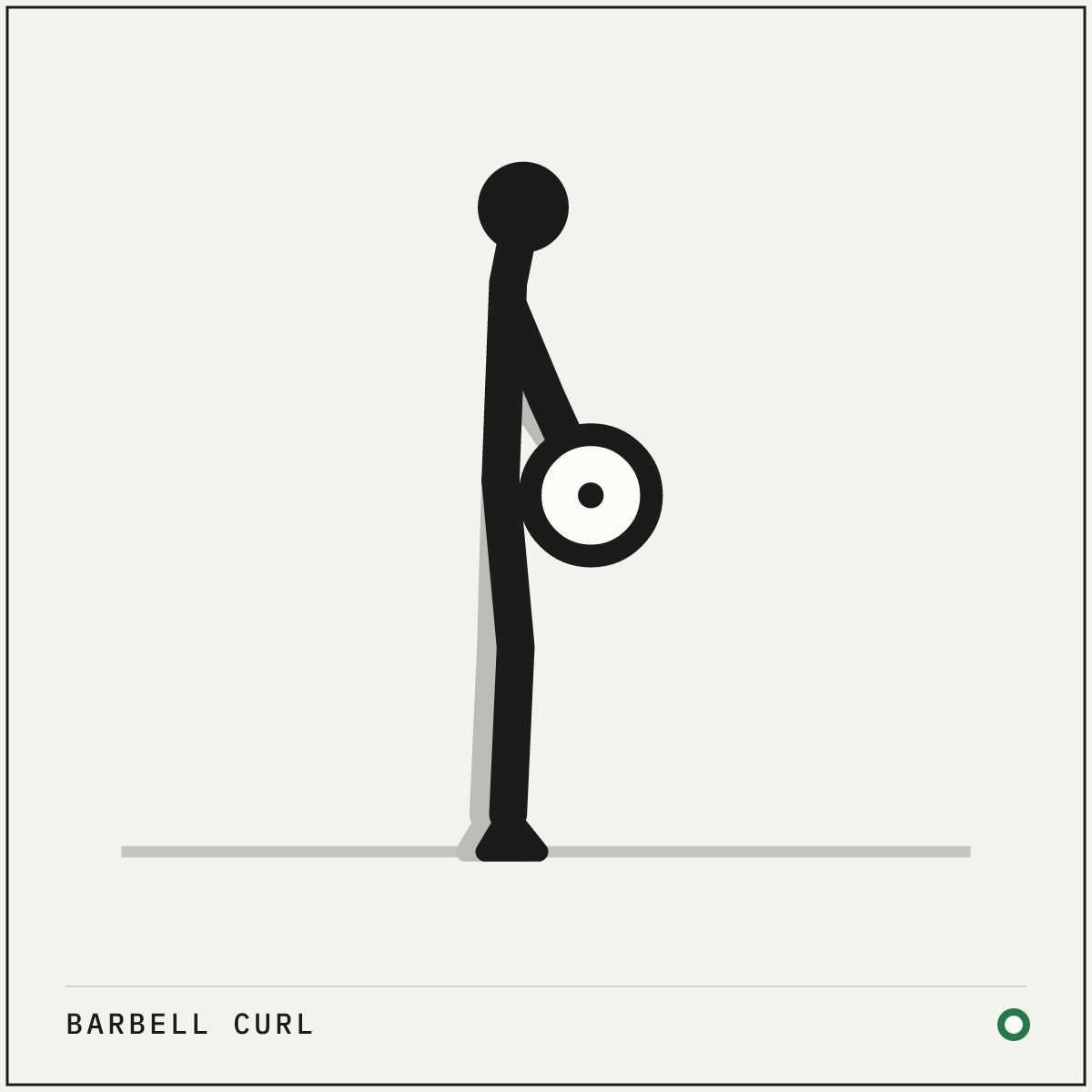
01 Arms long
Bar hanging at the thighs, elbows pinned to the sides.
02 Curl
Curl to the shoulders without the elbows drifting forward.
How to do it
Setup
- Stand tall holding the bar against your thighs with an underhand grip at about shoulder width.
- Pin your elbows to your sides, where they stay for the whole set.
Execution
- Curl the bar toward your shoulders by bending only your elbows.
- Squeeze at the top without letting your elbows drift forward.
- Lower all the way to straight arms on a slow count.
BreathingExhale as you curl, inhale as you lower.
Cues and mistakes
Check every rep
- Elbows stay at your ribs from first rep to last.
- Your torso does not move. Only your forearms do.
What goes wrong
- Rocking your hips to swing the bar past the hard middle part of the rep.
- Stopping short of straight arms at the bottom, which shrinks the range set by set.
- Adding weight faster than your strict form can follow.
Safety
- A straight bar locks your wrists into full palms-up. If your wrists or elbows ache there, widen the grip a little or curl dumbbells instead.
General guidance, not medical advice. See how Setkit works.
Notes
The barbell curl exists because two hands on one bar can hold more than two hands on separate dumbbells. Both arms drive one implement, nothing has to be balanced, and the load can climb in small steps for years. For pure curling weight it has no equal, and progressive weight is what builds arms.
The bar also removes the usual escape routes. With dumbbells a tired lifter drifts into a hammer grip or lets one arm lag. The bar fixes both hands palms-up and makes the two arms finish every rep together, which is exactly why strict sets of it are so productive and why cheated sets of it are so common.
Fight the cheat by ending the set when the swing starts. A hip-bump that launches the bar past the middle of the rep is the set telling you it is over. Keep 8–12 strict reps, lower slowly, and add weight only when every rep of the last session looked like the first.