Kettlebell curl
A biceps curl with a kettlebell in each hand. The weight hangs below your fist, so the bottom of the curl is loaded where a dumbbell goes light.
TrainsBiceps
NeedsKettlebell
The movement
2 stages
Arms long
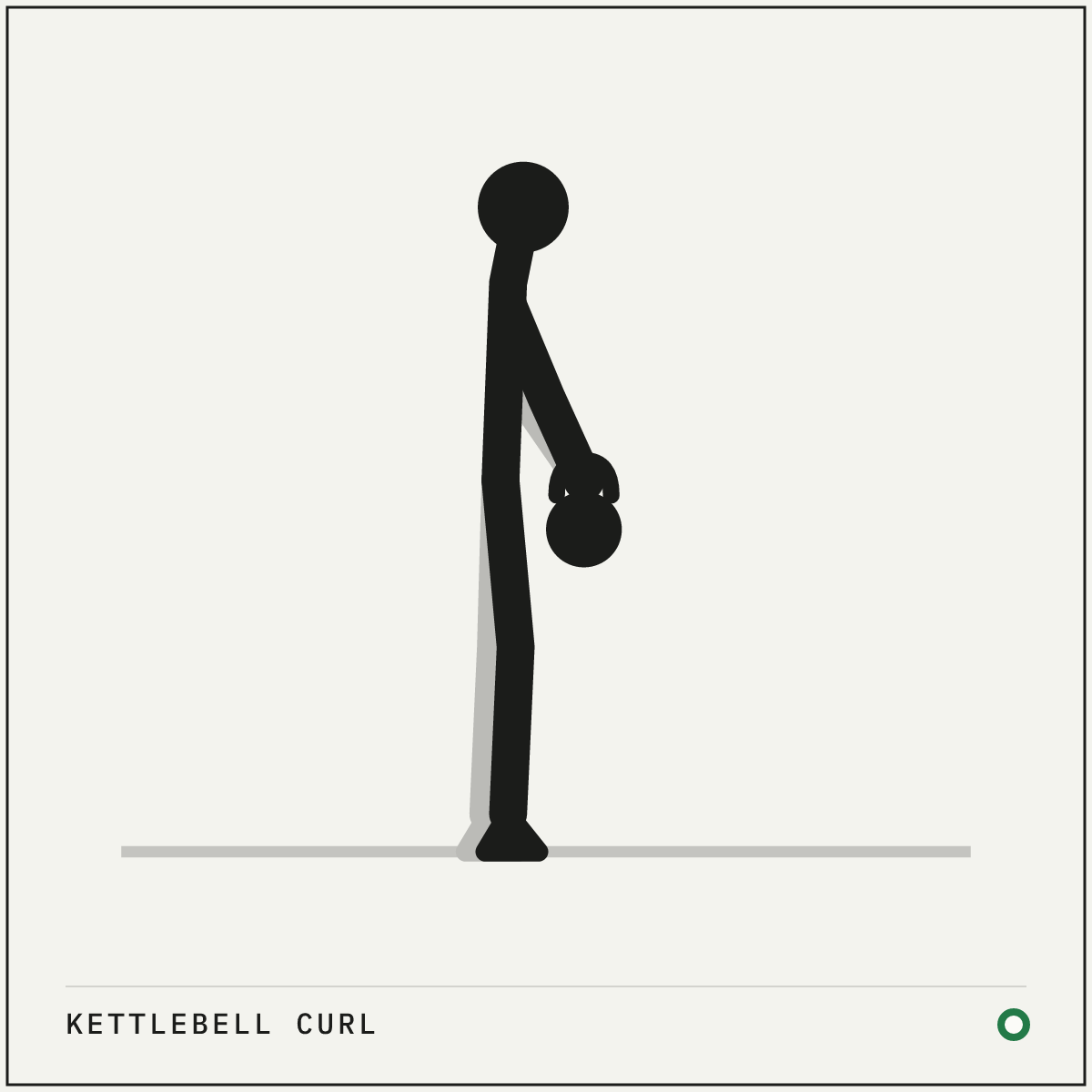
01 Arms long
Bells hanging below your fists, elbows pinned to your sides.
02 Curl
Curl to your shoulders and keep your wrists straight under the bell.
How to do it
Setup
- Stand tall with a kettlebell in each hand, palms facing forward and the bells hanging below your fists.
- Pin your elbows to your sides, where they stay for the whole set.
Execution
- Curl the bells toward your shoulders by bending only your elbows.
- Squeeze at the top without letting your elbows drift forward.
- Lower all the way to straight arms on a slow count.
BreathingExhale as you curl, inhale on the way down.
Cues and mistakes
Check every rep
- Elbows stay at your ribs; your upper arms do not swing.
- Keep your wrists straight so the bell does not pull your hand back.
What goes wrong
- Rocking your hips to swing the bells up past the hard part of the range.
- Letting your wrists bend back under the weight of the bell.
- Half reps that never reach straight arms at the bottom.
Safety
- The bell hangs below your fist and pulls the wrist back if you let it. Keep your wrists firm and straight so the load stays on the biceps, not the joint.
General guidance, not medical advice. See how Setkit works.
Notes
A kettlebell curls the biceps the same way a dumbbell does, with one difference that changes where the work lands. The weight of a kettlebell hangs below and behind your fist rather than sitting in your palm. That keeps tension on the biceps at the bottom of the curl, the exact point where a dumbbell goes almost weightless and lets you rest.
Being strict is still the whole technique. Elbows pinned, torso still, a full range from a straight arm to a hard squeeze. The offset load also asks more of your grip and forearm, because you are holding the handle while the bell tries to rotate your wrist back. Keep the wrist firm and straight, and the biceps keeps the work.
This is the curl to reach for when kettlebells are what you own. It is not better or worse than a dumbbell curl, just loaded in a different place. Keep the reps in the 8 to 15 range, add reps before you add a heavier bell, and make the last rep look like the first.