Kettlebell spider curl
A curl done lying chest-down on an incline bench with a kettlebell in each hand, where the bell hangs behind the hand and pulls at the grip.
TrainsBiceps
NeedsKettlebellBench
The movement
2 stages
Arms hanging
01 Arms hanging
Lie chest-down on the pad and let both bells hang straight below your shoulders.
02 Curl
Bend the elbows to bring the bells up, upper arms still pointing at the floor.
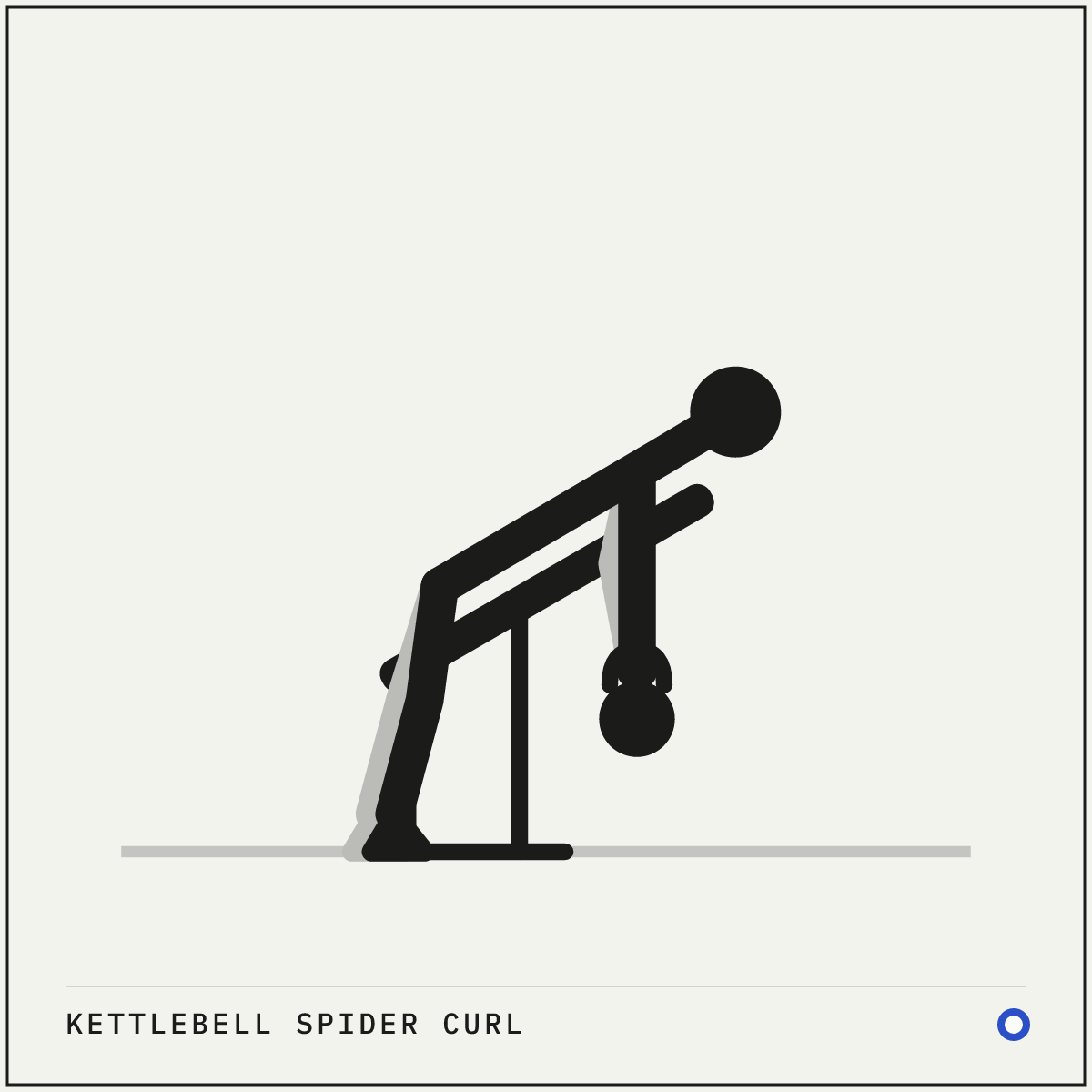
How to do it
Setup
- Set a bench to about 45° and lie face down along it with your chest on the pad.
- Hold a kettlebell by the handle in each hand and let both arms hang straight below your shoulders.
- Turn your palms to face forward so the bells hang behind your hands.
Execution
- Curl both bells up toward your shoulders by bending the elbows only.
- Squeeze at the top with the upper arms still pointing at the floor.
- Lower slowly until your arms are straight again.
- Let the bells settle before you start the next rep.
BreathingExhale as you curl, inhale as you lower.
Cues and mistakes
Check every rep
- Only your forearms move; the upper arms stay pointing at the floor.
- Grip hard enough that the handle cannot rotate in your hand.
- Keep your chest flat on the pad the whole set.
What goes wrong
- Starting the next rep while the bells are still swinging, which pulls on a straight elbow.
- Swinging the elbows back to start the weight, which hands the rep to the shoulders.
Safety
- The bell hangs behind your hand and wants to turn your wrist over. Stop the set when your grip starts to slip rather than when your biceps run out.
General guidance, not medical advice. See how Setkit works.
Notes
Curling a kettlebell is a different job from curling a dumbbell. The weight hangs below and behind your hand instead of sitting in line with it, so your grip and forearm spend the set stopping the bell from rolling your wrist over. On a spider curl, where the bench has already taken away every other way to cheat, that shows up in the first few reps.
That makes this the hardest of the three spider curls to load and the one that trains the forearms most. Choose it when grip is something you want to work on at the same time. If the biceps are the only target, the dumbbell version lets you use more weight for the same effect on the arm.
The bells will swing at the bottom of each rep, and that is the part worth being careful about. Straighten your arms under control and let the weight settle before you curl again. Starting the next rep on a moving bell puts a sudden pull through an elbow that is already straight.