Dumbbell spider curl
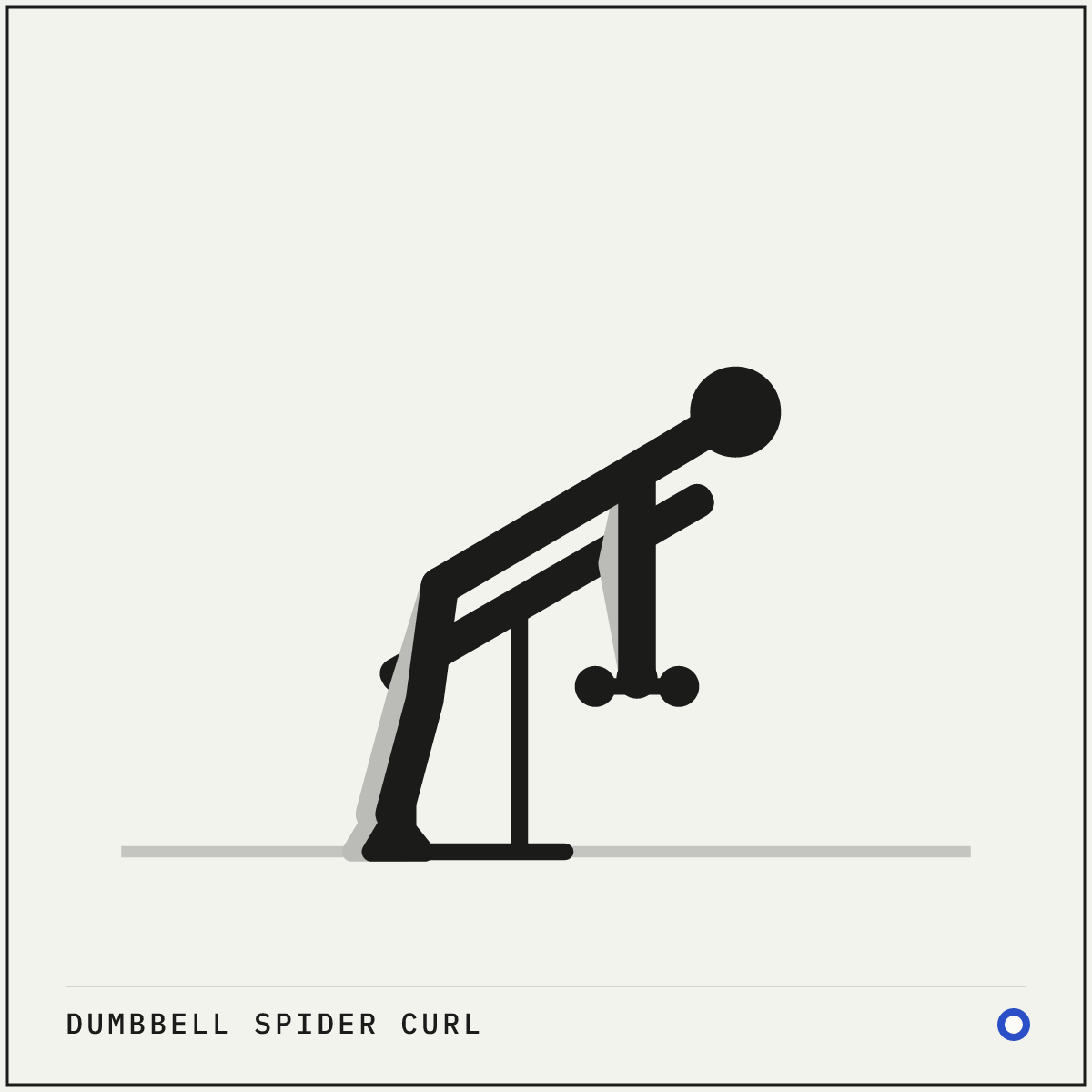
A curl done lying chest-down on an incline bench with the arms hanging straight below the shoulders. The bench takes the swing out.
The movement
2 stages
Arms hanging
01 Arms hanging
Lie chest-down on the pad and let both arms hang straight below your shoulders.
02 Curl
Bend the elbows to bring the weights up, upper arms still pointing at the floor.
How to do it
Setup
- Set a bench to about 45° and lie face down along it with your chest on the pad.
- Hold a dumbbell in each hand and let both arms hang straight below your shoulders.
- Turn your palms to face forward.
Execution
- Curl both weights up toward your shoulders by bending the elbows only.
- Squeeze at the top with the upper arms still pointing at the floor.
- Lower slowly until your arms are straight again.
- Keep the elbows in the same place from the first rep to the last.
BreathingExhale as you curl, inhale as you lower.
Cues and mistakes
Check every rep
- Only your forearms move; the upper arms stay pointing at the floor.
- Keep your chest flat on the pad the whole set.
- Take three seconds to lower every rep.
What goes wrong
- Swinging the elbows back to start the weight, which hands the rep to the shoulders.
- Lifting the chest off the pad, which is a small row disguised as a curl.
Safety
- Nothing here can help the biceps, so a weight that works standing will be too heavy. Go lighter than your standing curl to keep the strain off the elbow tendons.
General guidance, not medical advice. See how Setkit works.
Notes
Lying chest-down on the pad removes the two things that make a standing curl easy to cheat. You cannot lean back, and you cannot start the weight with your hips, because the bench is holding your torso still. What the biceps cannot lift does not move.
The arm position also changes where the work sits in the rep. With your upper arms pointing straight at the floor, the hardest part is the top of the curl rather than the middle. There is no point in the range where the weight parks on your skeleton and lets the muscle rest. That is why the same load feels heavier here than it does standing.
Dumbbells let each arm work on its own, so a stronger side cannot quietly take over. Watch whether the weaker arm finishes later or travels a shorter distance, and set the reps by what that arm can do. Matching the strong side is how a difference in the arms gets kept rather than fixed.