Single-leg calf raise
One calf carrying all your bodyweight. Double the load, and a clear look at each side.
TrainsCalves
NeedsBodyweight
The movement
2 stages
Flat
01 Flat
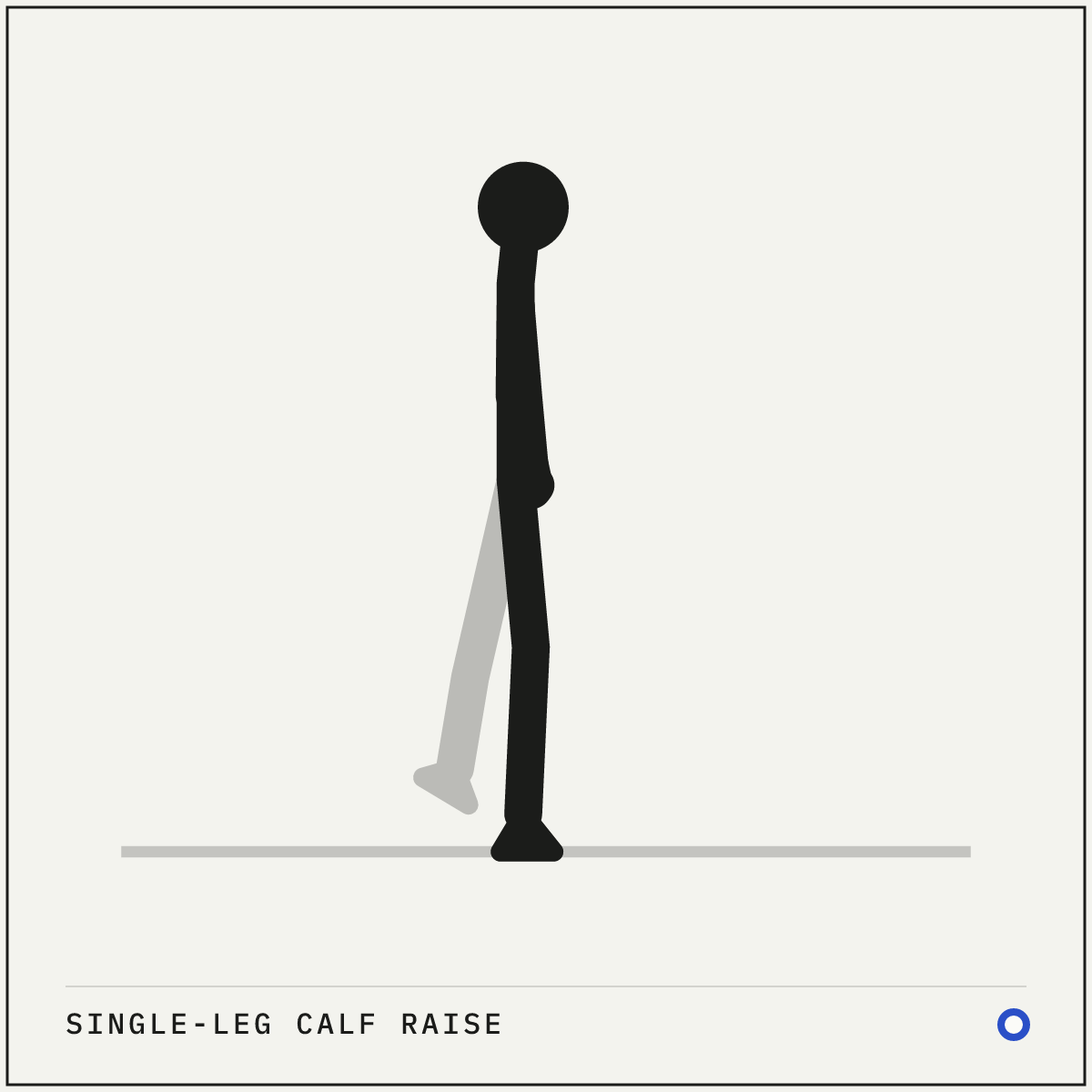
All weight on one foot; the other foot hooks behind.
02 Raise
Full height on one leg; steady yourself with a fingertip if needed.
How to do it
Setup
- Stand on one foot with the other hooked lightly behind the working ankle.
- Rest your fingertips on a wall or rail for balance only, never to pull on.
Execution
- Rise to full height on the ball of the working foot.
- Pause at the top, then lower on a slow three-second count.
- Finish all your reps, then switch legs. Start with the weaker side.
Cues and mistakes
Check every rep
- Rise and lower straight up and down, using the wall only for balance.
- Same pause at the top and stretch at the bottom as the two-leg version.
What goes wrong
- Turning fingertip support into a pull that helps you up.
- Cutting the range short as the reps add up.
Safety
- Off a step, the stretched bottom position on one leg is a real balance challenge. Keep something to hold within reach throughout.
General guidance, not medical advice. See how Setkit works.
Notes
Doubling the load on a calf takes nothing more than lifting the other foot. That turns bodyweight calf training into properly heavy work, and like every single-leg exercise it shows you where you stand. Most people find one calf noticeably stronger, and that gap is worth closing before it turns up during a run or a jump.
The fingertip rule matters. The support is there so that balance never ends the set early. The moment your fingers start pulling, the exercise gets easier and you are training less than you think.
The standards carry over unchanged from the two-leg version. Full height, a one-second pause, a slow descent and a deep stretch. Those standards plus single-leg load are usually all the calf training anyone needs.