Sliding floor fly
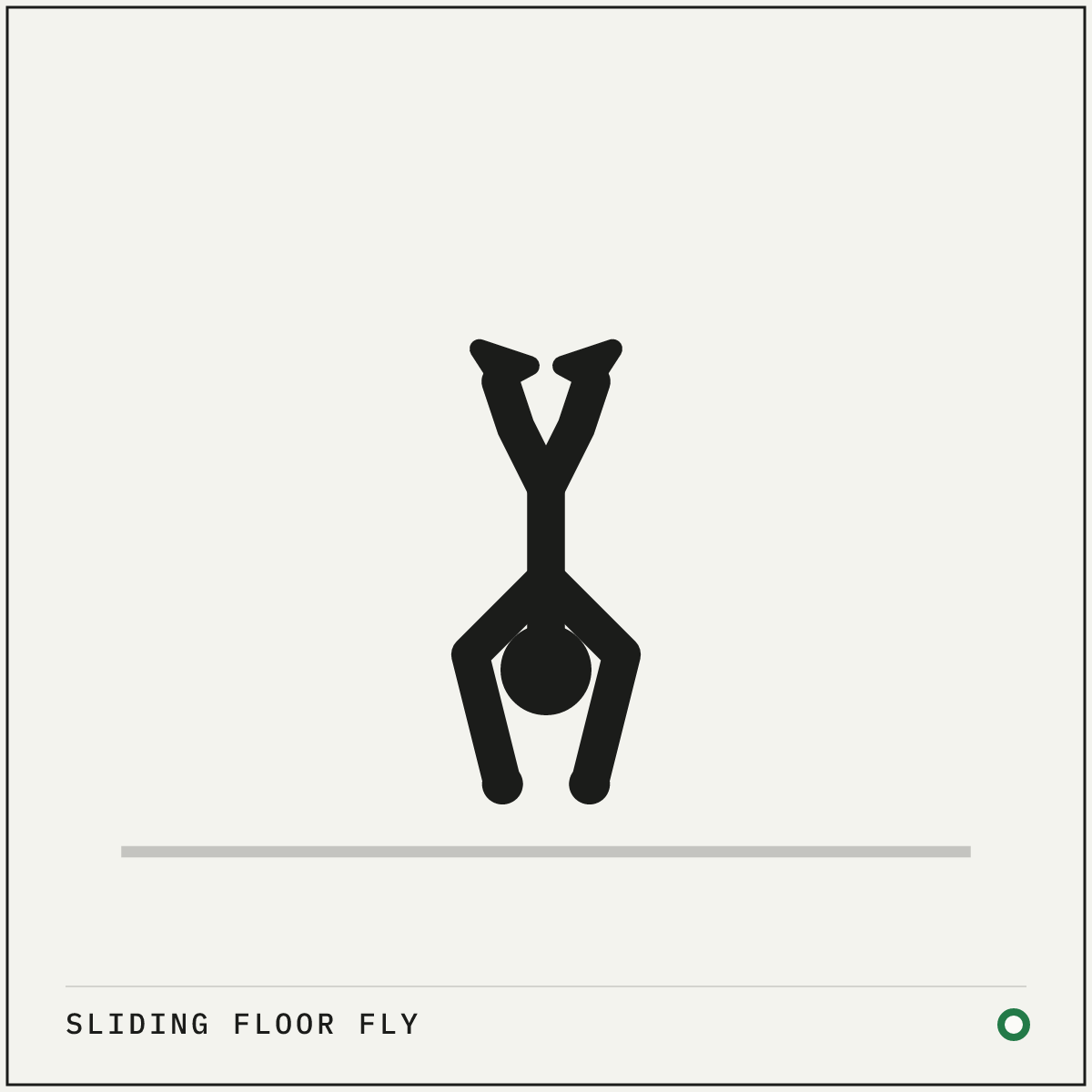
Hands on cloths on a smooth floor, arms sliding out wide and pulling back together. Direct chest work with no weights at all.
TrainsChest
NeedsBodyweight
The movement
2 stages
Hands together
01 Hands together
Lying face down with your hands together under your chest.
02 Arms wide
Slide both hands out to the sides and let your chest lower as they travel.
How to do it
Setup
- Put a cloth, a sock or a furniture slider under each hand on a floor they slide on.
- Kneel down and place your hands under your shoulders, then walk your knees back until your body forms a straight line from your head to your knees.
- Set your ribs down and squeeze your glutes so your hips cannot sag.
Execution
- Slide both hands out to the sides in a wide arc, keeping a small fixed bend in your elbows.
- Go out only as far as you can still pull back from, lowering your chest toward the floor as your hands travel.
- Drag your hands back together under your chest by squeezing them toward each other.
BreathingBreathe in as your hands slide out, out as you pull them back.
Cues and mistakes
Check every rep
- Hands travel level with your chest, not up by your head.
- Elbows keep the same small bend from start to finish.
What goes wrong
- Sliding out further than you can pull back, which leaves you dropping to the floor and standing up to reset.
- Letting the hips sag so the lower back holds the position instead of the trunk.
- Bending the elbows as you pull back, which turns the fly into a narrow push-up.
Safety
- Your chest is the only thing under you if your hands keep sliding, so add range one hand-width at a time. Keep the knees version until you can pull back from full reach without a bounce.
General guidance, not medical advice. See how Setkit works.
Notes
A fly is the only common chest exercise that does not need a joint anywhere except the shoulder, and it usually needs weights. Sliders replace them with friction and your own bodyweight. Your hands travel apart, your chest takes the load of holding them together, and the muscle works through the same wide arc a dumbbell fly asks for.
Difficulty here is set by how far your hands go and how much of your body is behind them. From the knees the load is mild and the range is easy to control. From the feet, in a full plank, the same movement becomes hard, because your chest is now holding most of your bodyweight at the end of a long lever. Move from one to the other slowly, since the position that fails is the one furthest out, and failing there means dropping onto the floor.
The trunk is the part nobody expects. Sliding your hands away from your shoulders pulls your hips toward the floor, and holding them up is the same work as an ab wheel rollout. If your lower back starts to complain before your chest does, shorten the range and squeeze your glutes harder rather than pushing through.
Wooden floors, tiles and a smooth mat all work with a cloth under each hand. Carpet needs plastic sliders or a pair of paper plates. Whatever you use, test it with one slow rep first, because a surface that grips halfway through the arc jolts the shoulder in exactly the position it is weakest.