Turkish get-up
Standing up from the floor with a bell held overhead, then reversing it. Slow, technical, and the most complete single exercise there is.
NeedsKettlebell
The movement
4 stages
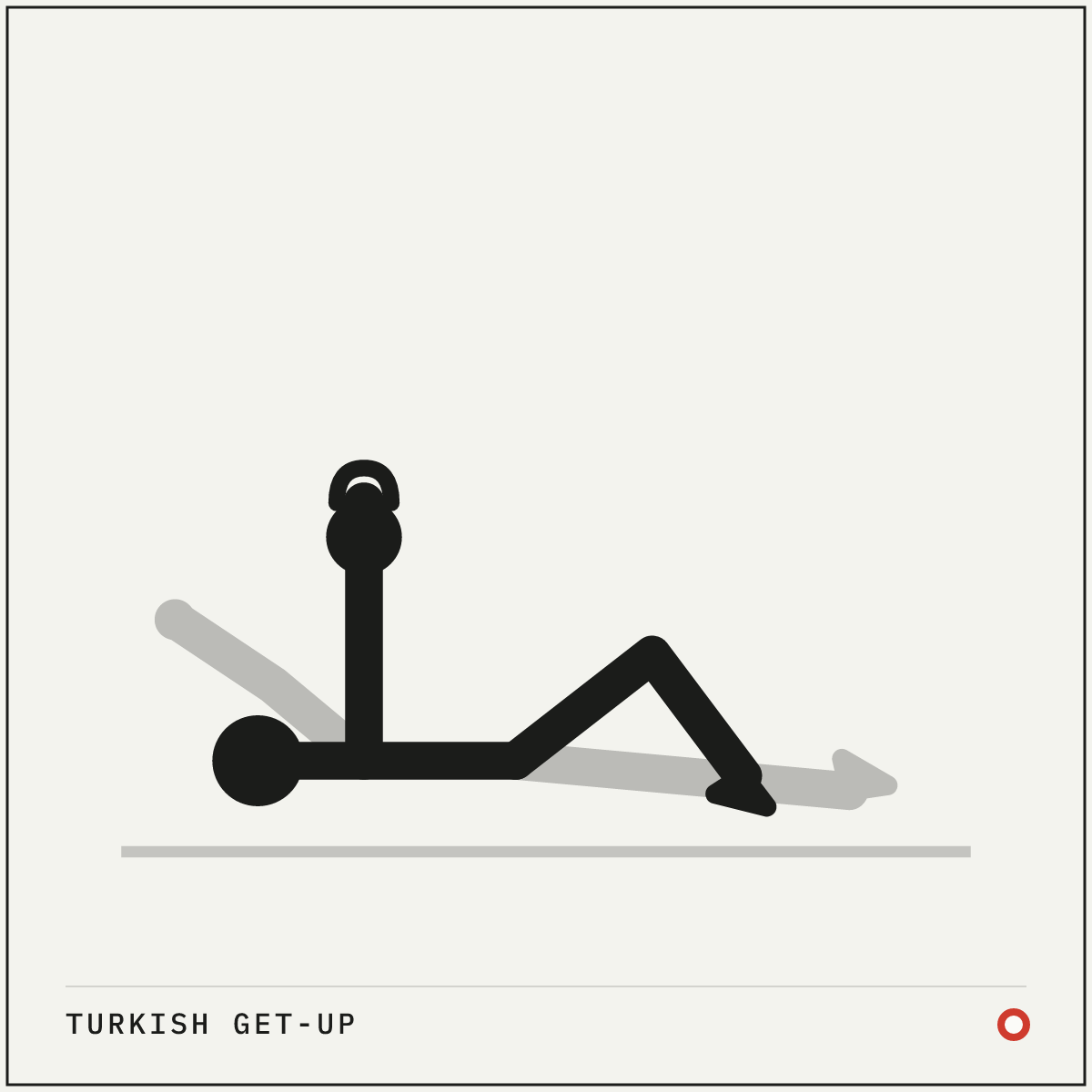
On the floor
01 On the floor
Bell pressed up with a locked elbow, the loaded-side knee bent and foot flat, the other arm and leg spread out.
02 Up on the hand
Roll onto the forearm and press up onto the hand, plant the free arm behind you and lift the hips.
03 Sweep the leg
Sweep the straight leg under the body and plant the knee directly under the hips.
04 Standing tall
Stand up and finish with the bell stacked perfectly over the shoulder.
How to do it
Setup
- Lie on your back and press the bell up with one arm, elbow locked and wrist straight.
- Bend the knee on the loaded side with that foot flat, and spread your other arm and leg out at about 45°.
Execution
- Push the bell up and roll onto your free forearm, then press up onto that hand.
- Lift your hips, sweep your straight leg back underneath you, and come to a half-kneeling position.
- Stand up, then reverse every step in order to get back to the floor.
BreathingBreathe steadily between positions rather than holding your breath through the whole rep.
Cues and mistakes
Check every rep
- Keep your eyes on the bell until you are standing.
- Move slowly enough that you could stop and hold any position.
What goes wrong
- Rushing between positions so the bell drifts out of line above your shoulder.
- Letting your wrist bend back, which loads the joint and makes the bell feel far heavier.
- Skipping the way back down, which is half the exercise and the harder half.
Safety
- Learn every step with no weight, then with a shoe balanced on your fist, before you use a bell. If your arm ever drifts out of vertical, set the bell down rather than chasing it.
General guidance, not medical advice. See how Setkit works.
Notes
The get-up is close to a whole training session in one rep. Going from lying down to standing with a loaded arm overhead asks your shoulder to stay stable through its entire range, your trunk to resist bending in every direction, and your hips to work through positions most people never visit. Nothing else here covers that much ground.
Slowness is what defines it. Every other exercise in the library has a tempo. The get-up has a sequence of positions, and each one should be stable enough that you could stop and hold it. Going faster does not make it harder, it makes it dangerous, because a bell that drifts out of line has to be caught by a shoulder in a bad position.
Your wrist decides how heavy the bell feels. Held with your forearm stacked straight underneath it, the load travels down through the bones and your arm can hold far more than it can control. Let the wrist bend back and the same bell feels enormous while your shoulder works overtime to keep it up. Stack the wrist before you add any weight.
Learn it in pieces. Floor to elbow, elbow to hand, hand to hips-up, then to half-kneeling, then to standing. Practicing the sections separately builds the full rep far faster than attempting the whole thing over and over. Two or three good reps per side is a full set, and this is not a movement that rewards volume.