Single-leg Romanian deadlift
A one-legged hinge with the free leg reaching back as a counterweight. Hamstring and glute work, and the hardest balance test here.
TrainsHamstringsGlutes
NeedsBodyweight
The movement
2 stages
Standing tall
01 Standing tall
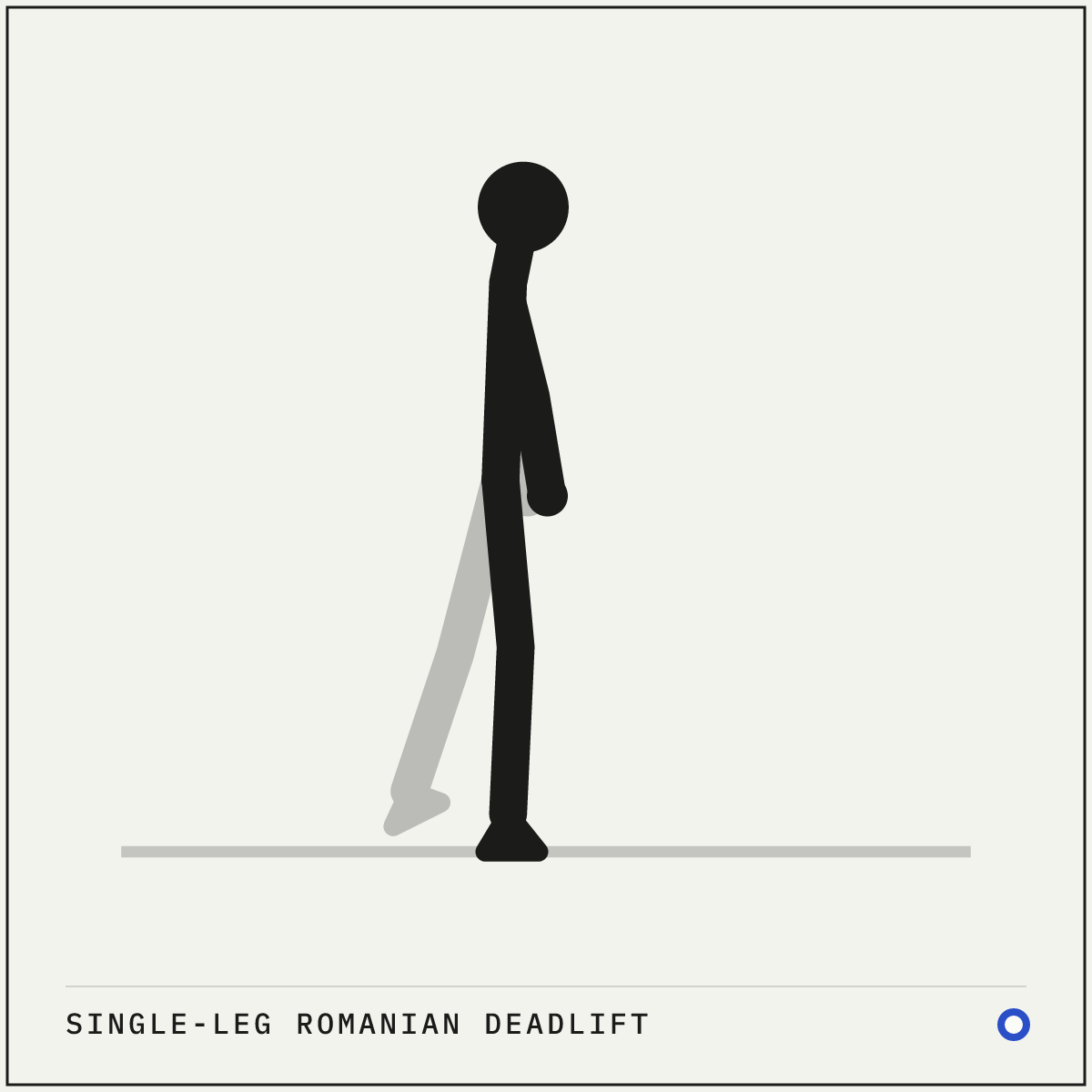
Balance on one leg with a soft knee, back flat, the other foot just off the floor.
02 Hinged, hips level
Send the free leg straight back as the chest lowers; both move together around the standing hip.
How to do it
Setup
- Stand on one leg with a slight bend in that knee and the other foot just off the floor.
- Set your back flat and your shoulders down.
Execution
- Fold at the hip, sending your free leg straight back as your chest travels toward the floor.
- Keep your hips level and stop when you feel a strong stretch in the standing hamstring.
- Drive your hips forward to stand tall, without letting the free foot touch down between reps.
BreathingInhale as you fold down, exhale as you stand.
Cues and mistakes
Check every rep
- Your torso and free leg move together in one line.
- Point your back heel at the wall behind you to keep your hips square.
What goes wrong
- Letting the free hip open toward the ceiling, which turns the hinge into a twist.
- Rounding your back to reach lower instead of stopping where the hamstring tightens.
- Bending and straightening the standing knee, which makes it a squat rather than a hinge.
Safety
- Losing your balance mid-rep is the real risk. Touch a wall with one hand while you learn it rather than fighting to stay upright with a rounded back.
General guidance, not medical advice. See how Setkit works.
Notes
The hinge is the pattern most people are worst at, and the single-leg version shows you why. Standing on one leg takes away every way of compensating. Your hips cannot shift across, your lower back cannot quietly take over, and any attempt to force the rep turns into a wobble straight away. It trains the hamstrings while teaching you to hinge almost against your will.
Hip position is the whole technical problem. As your free leg travels back it wants to rotate open so that hip points at the ceiling, because that is easier and reaches further. Keeping your hips square, with your back heel driving straight backward and your pelvis level, is what keeps the work in the hamstring and glute of the standing leg.
Let the hamstring set your range rather than how close your hands get to the floor. For most people the stretch arrives with the torso somewhere short of parallel, and anything past that comes from the lower back rounding. Stopping there is the full rep, not a short one.
Once your balance improves, bodyweight stops being much of a load. Add a dumbbell in the opposite hand, which also makes resisting the twist harder. That is usually the part still worth training.